
- Foreword
- Introduction
- The dubious modem dogma of the normality of homosexuality
- Homosexuality as a "Disease" of Self-Pity, A Neurosis
- History of the Self-Pity Theory for Homosexuality
- Part I: Generalities on Homosexuality; the Self-pity
- 1. Definition of Homosexuality; Latent Homosexuality, the Theory of a Bisexual Disposition, and the third Sex
- 2. Hormonal and Genetic Factors; Homosexuality as a Cultural Phenomenon
- 3. The "Self-Pitving Child" in the Neurotic; the Autopsychodrama, its Ongin and Fixation
- 4. Four Laws of Neurotic Complaining
- 5. Four Types of Justifications of Neurotic Complaining
- 6. Common Behaviors of the Complaining Compulsion
- 7. The "Child in Totum"
- 8. The "Child in Totum" (continuation)
- 9. The "Child in Totum": Common Reactive Behaviors (1)
- 10. The "Child in Totum": Common Reactive Behaviors (2)
- Part II: Male Homosexuality
- 11. The Autopsychodrama of the Male Homosexual
- 12. Some Elucidations of the Homosexual Autopsychodrama in the Male: The Preferred Partner
- 13. The Boy Who Does Not Belong to the Boyhood Community
- 14. Characteristics of Mothers and Characteristics of Homosexual Sons
- 15. Intermezzo: Effeminacy and Pseudofemininity in Male Homosexuals
- 16. Fathers of Male Homosexuals
- 17. Parental Attitudes as Catalyzing Factors; Additional Remarks
- 18. Other Catalyzing Factors for the Self-Image of "Being Weak, Unmanly"
- 19. Homosexuality-Related Complaints (1): Not Being Able To Face Life, Anxiety, Hypochondriac and Obsessive-Compulsive Complaints
- 20. Homosexuality-Related Complaints (2): Loneliness, Depression, Restlessness, Jealousy
- 21. Homosexuality-Related Infantile Attitudes
- 22. Dreams of Homosexuals
- 23. Bisexuality; the Married Homosexual
- 24. On Transsexualism and Transvestitism
- 25. Homosexual Pedophilia
- Appendix A. Other Variants of the Unmanliness Complex: Impotence, Don Tuanism, Sadomasochism
- Appendix B. Neuroticism (Neurosis-) Tests and Male Homosexuality
- Part III: Lesbianism
- 26. The Complaint of Being Inferior as a Woman
- 27. Lesbianism: Predisposing Factors in Childhood
- Appendix C. Neuroticism Tests and Lesbianism
- Part IV: Anticomplaining Therapy of Homosexuality
- 28. The possibility of a "Cure" of Homosexuality and the Nature of a Cure or Change
- 29. Nontherapeutically Cured Cases of Homosexuality
- 30. The Procedures of Anticomplaining Therapy: Self-Observation and Self-Analysis
- 31. Observation of the "Complaining Child" (Continuation)
- 32. Procedures of Anticomplaining Therapy: Analysis of the Individual "Child"; the Therapist's Observations
- 33. The Will to Change
- 34. Procedures of Anticomplaining Therapy: Techniques of Humor, Hyperdramatization
- 35. The Rationale of Humor Therapy
- 36. Hyperdramatization: Examples
- 37. Hyperdramatization: Variants
- 38. Hyperdramatization: Difficulties and Resistances
- 39. The Change
- 40. Results with Anticomplaining Therapy
- Appendix D. Notes on the Psychophysiology of Human Sexual Development
- Part V: Prevention of Homosexuality
- 41. How To Avoid Homosexual Development in a Young Child
- Bibliography
- About the Author
A Psychoanalytic Reinterpretation
Foreword
by Charles W. Socarides, M.D., Clinical Professor of Psychiatry, Albert Einstein College of Medicine, New York City; Author of The Overt Homosexual (1968) and Homosexuality (1978)
Dr van den Aardweg has written an important and highly valuable book on the topic of homosexuality. It is a significant achievement of theoretical and clinical research and represents many years of study and devotion to unlocking the mysteries of causation of this serious disorder which has long been considered highly resistant to therapeutic efforts He provides us with a vast amount of information with regard to homosexuality as well as information of the furthest advances in the direction of therapy and ultimate prophylaxis of this condition His approach has been most careful and his extensive clinical experience and observations are both fascinating and definitive.
His approach is highly original. A childhood reaction of self-pity (self-dramatization, as he terms it) and the important role of this emotion in the adult psyche of the homosexual is a central part of his thesis. By self-pity (and its concomitant drive to complain) he does not mean purposive self-pity but «an addiction to self-pity» that is not conscious to the homosexual himself. What is said here about self-pity is new and deserves our interest; it does not necessarily collide with the position of other theorists on homosexuality, especially with insights made by Adler, Homey, Bergler, and other psychoanalysts. He describes the immaturity of a part of the emotional life of the homosexual — that is, they remain «children» or «adolescents» — and uses highly innovative therapeutic approaches: the use of self-humor (the exaggeration or hyperdramatization technique) in an effort to make a corrective self-insight in the patient. This can be of interest to therapists of many theoretical orientations.
This book is directed to anyone who is after knowledge and information concerning homosexuals. It provides extensive information on the specific childhood circumstances, parental relationships, and peer relationships that form the experiential substructure for the development toward homosexuality. He has compiled research data from different countries and offers a unique compilation of studies on the relationship between homosexuality and neurosis («neuroticism») tests.
Dr. van den Aardweg is to be highly commended for his courage in producing this extensive volume, for there are many today who tend to normalize what is essentially a severe psychosexual disorder (in its obligatory form) and many others who, for reasons of their own, would deny to the public and to behavioral scientists the information which this volume contains. The author is convinced that knowledge is a necessary condition for helping the troubled homosexual as well as for a sound public attitude toward homosexuals. Such scientific knowledge can only lead both to realistic laws and prevention of homosexuality. One-sided normalizing or moralizing propaganda does not help those troubled by deep homosexual needs. While homosexuality should be decriminalized, an action which all enlightened psychiatrists and psychologists approve of, it should not be raised to the level of «sexual naturalness.»
Dr van den Aardweg’s book is really a plea for help for the individual homosexual who has to cope with what an unfortunate childhood upbringing has so cruelly forced upon him. Homosexuals can only feel despair that psychology and psychiatry have forsaken them were it not for volumes similar to Dr. van den Aardweg’s. The psychological and psychi atnc nonsense and social recklessness of «normalization» may well bring social and individual tragedy. There may well be a rise in homosexuality of the nonobligatory type at first, but ultimately profound gender identity disturbances may increase and more true homosexual deviations will result as parents distort the maleness and femaleness of their infants and children. Homosexuals in therapy would develop resistances to therapy, retarding their progress, while others may be unwisely dissuaded from seeking appropriate help at necessary times. Suicides may well increase among persons with gender-identity confusion. Other medical specialists such as pediatricians and internists are becoming baffled by psychiatry and psychology’s faulty reasoning in declaring this severe psychosexual disorder nothing but an «alternative lifestyle.» Young men and women with relatively minor sexual fears will be led with equanimity by psychologists, psychiatrists, and nonmedical counselors into a self-despising pattern and lifestyle. Adolescents, nearly all of whom experience some degree of uncertainty as to sexual identity, will be discouraged from assuming that one form of gender identity is preferable to another. Those persons who already have a homosexual problem are discouraged from finding their way out of a self-destructive fantasy, discouraged from all those other often painful but necessary courses that allow all of us to function as reasonable and participating individuals in a cooperative society. Anyone whose task is the alleviation of distress in man (as is Dr. van den Aardweg) can only be saddened by the scientific unreason that has brought this to pass. Scientific research such as that presented in Dr. van den Aardweg’s important volume can only be applauded and encouraged.
Introduction
The dubious modem dogma of the normality of homosexuality
More than ever before, homosexuality is nowadays depicted as a normal variant of human sexuality. At least one in every twenty persons is declared to be homosexual, so that this variant would be everything but exceptional. This enormous group has been repressed and discriminated against for many centuries, chiefly on the basis of Christian prejudices, we are told. What should be changed, accordingly, is the negative attitude of society toward homosexuality and homosexuals; homosexuals themselves should be taught to fully accept their condition and be given the opportunity to live according to their «nature» without inner inhibitions or social restrictions. Exactly the same rights and facilities should be granted them as traditionally were the privilege of married heterosexuals.
If the basic supposition of the advocates of the homosexual emancipation movement is right and homosexuality would indeed be one of the natural variants of sexuality, one would have to agree with their striving to deeply modify what would then be the prejudices of our society. But what evidence can the spokesman of this theory produce to strengthen his point? He who will give the subject only a little thought will quickly realize how thin the ice actually is on which the homosexuality-is-normal theorist walks. Is it really so probable that nature created this normal variant which has no procreational potentialities but still possesses the anatomical and physiological apparatus for it? To what end would that serve? Does exclusive homosexuality as we know it in humans also occur in five percent of animals in their natural habitat? If normal or natural, why do heterosexuals not feel homosexual desires? In other words, one who believes that homosexuality is something natural or normal must present very strong arguments because everyone can see at first glance that the biology of man and animal alike does not favor that idea. Detailed study of the argumentation put forward by normality advocates (Chapters 1 and 2) will confirm this initial skepticism. Their opinion will appear not to be supported by anything resembling convincing factual evidence. At best, these theorists clutch at some straws of evidence which upon closer examination do not hold up. Having neither the arguments of logic nor the outcome of research on their side, they betray that their motivation is emotional, not rational.
This is understandable if one realizes that the first and foremost articulate defenders of normality theory were themselves homosexuals. As much as a century ago the Hungarian homosexual doctor Benkert pled for recognition of this sexuality. Oscar Wilde defended his homosexual love affairs in court, and in the years after the First World War, France witnessed the discussion between novelist André Gide and his adversaries on the normalcy of homosexual love for children. However, in the wake of the sexual revolution of the 1960s the homosexual emancipatory movement gained momentum and homosexuals came out, militantly proclaiming their full equality to heterosexuals. They met with growing support from all levels of society: politicians, journalists, physicians, psychologists, social workers, and the clergy.
The emotional motives of the homosexual himself may well be comprehended. He experiences his erotic striving as if it were instinctual and irresistible, as the expression of his intrinsic «natural self»; moreover, he often feels as if his happiness would depend on its satisfaction. His emotions, however, blind him to reason. He gives the impression that he cannot tolerate even considering the idea that his inclinations would be unnatural because in that case his whole life appears to him to be at stake. He tries to justify his way of life in whatever manner he can, although it is questionable whether he succeeds in completely convincing himself of his deepest feelings. In his neurotic egocenteredness he may project his feelings in others and may believe that they must have the same inner life that he has. Therefore, he may believe in the bisexuality of others. I think the constant preoccupation of homosexuals with their homosexuality as well as their attempts at proving that everybody is basically like them reveals their inner insecurity as to their normalcy. According to some of them, almost every celebrity in history has been a homosexual: Shakespeare would have been one, the Biblical figures of David and St. John, and the last few Popes. The implicit message is: «There is nothing abnormal in it; yeah, homosexual love is an even superior form of love, so that if you would draw the correct conclusion you would see that homosexuals are not inferior but privileged.» An example of glorification of pedophilehomosexuality was Gide’s booklet «Corydon» (1924) in which a physician eruditely teaches and exalts the incomparable purity and naturalness of homosexual pedophile love.
The militant homosexual mostly does not really listen to arguments and observations that contradict his normalcy view. Nor is he prepared to consider the opportunities for a change of his orientation unless in order to ironize them. The sheer existence of change possibilities would cast doubts on his position and therefore he tends to deny them, or takes a sarcastic attitude about the mere idea. Sometimes he dramatically criticizes attempts at modification as «expressions of fascistoid thinking» or nazibehavior. By preference he presents himself as the victim of social discrimination and he compares himself with Jews and Blacks; anyone who cannot consent to his views of normality runs the risk of being accused of discriminatory tendencies, of being «heartless,» «not compassionate,» and «old-fashioned.»
Doubtless, many homosexuals suffer from social contempt. More especially homosexual men whose behavior — gestures, movements, voice — is markedly effeminate can become the object of ridicule. (I have not in mind the affected, exhibitionistic effeminates, but those who make an effeminate impression without purpose and even against their will.) It is also true that many homosexuals, among them many who do not engage in homosexual contacts and are not happy at all with their condition, do suffer from the fear[1] that their feelings would be discovered, because they are afraid people would not accept them if they knew «it.» These facts, however, are often overdramatized by the ones who want full recognition for homosexuality and who like to invoke the image of the cruelly persecuted homosexual in order to silence every objection to their philosophy. They forget, for instance, that there are also homosexuals who never feel persecuted or discriminated against even if they openly live a homosexual life. They forget, too, that there are homosexual men who behave affectedly like pseudowomen on purpose, who like to shock, to provoke resistances, and who stir justified irritations.
They forget, moreover, that there are homosexuals who put the blame of all their misfortunes and personal failures on their position as the discriminated ones. That way, «discrimination» becomes a cheap slogan that obscures the real questions about homosexuality and hinders unbiased thinking (as far as we are capable of that) on such fundamental issues as: «Is homosexuality really normal?» and «What would be a responsible attitude toward homosexuality and homosexuals?»
It is clear that the defensive homosexual who tries to justify his ways cannot be the best evaluator of his own case. Still not a few of the most articulate publicists of the normalcy idea belong to this category: writers, physicians, psychiatrists, and psychologists. How is it possible that their claims have met with so vast a support from the educated community? As is known, the American Psychiatric Association decided in 1973 to cancel their former definition of homosexuality as an «emotional disorder.» It became a «condition» since then, but what is meant by that? Naturally this has been reinterpreted by the «normalists» in the sense that one would henceforward have to consider homosexuality as no longer pathological — and the APA set the example.[2] Politicians have joined the gay movement as well as various Councils of Churches; for instance, the Dutch Reformed Church practically declared homosexuality as normal. (For a matter-of-fact documentation of the «homosexual network» in American public life and politics, the reader must peruse the book of Rueda, 1982.) Europe and the United States disseminate their ideas, and are looked up to by less developed countries as being more progressive. So an intellectual and artistic elite has started the struggle for recognition of homosexuality «against prejudices» in Brazil; Colombia, which has had its liberation movement since 1977; but also in East Germany, where the homosexual emancipation movement is on the move within certain Churches. Obviously, something in the «spirit of the time» (Zeitgeist) favors this development that is not rational in essence. It has become a sign of humanitarianism to fight for liberation from whatever «taboos» and restrictions; for whole groups this has even become a new morality. The fact remains, however, that these movements and emotional climates are unscientific and threaten a more logical approach.
So the normality ideology has become prevalent in large sectors of the present intellectual and semi-intellectual society. It is considered «progressive» and «modern.» In Holland, for instance, it is the established philosophy of the majority of social scientists, university students, and social workers; and the media massively profess it. Nevertheless, it is not as certain that the public at large adheres to it. A questionnaire in this country revealed that, in spite of many years of propaganda, about 70 percent of the respondents believed homosexuality to be a sickness or disturbance (Meilof-Oonk et al., 1969). It is indeed most unlikely that the majority of ordinary people can be brought so far that they will regard homosexuality eventually as normal; a high degree of intolerance — or indifference, or apathy — may exist, but it seems illusory to suppose that most parents will ever become so permissive that it would barely interest them which direction the sexual development of their children would take. For all its impact on present day society, the idea of its normality will probably remain the wisdom of a relatively restricted intellectual elite. The largest Christian Church, the Roman Catholic, for instance, disapproves of homosexual behavior as contra naturam («against nature,» Declaration of the Congregation for the Doctrine of Faith, 1975); in spite of protests by some groups of priests all recent evidence indicates that the doctrines with respect to this are not liable for change. Quite unexpectedly for many who read this, for sure, many psychiatrists today do not agree with the normality view. A questionnaire among a large sample of American psychiatrists disclosed that around 70 percent envisages homosexuality as a «pathological adaptation, as opposed to a normal variation» (Time, 1978). Note the striking similarity with the 70 percent of Dutch interviewees — ordinary citizens — in the investigation cited above. We conclude that there is a wide gap between the feeling of the «silent majority» and that of an active and influential minority whose voice is heard so frequently that it may falsely have been taken to represent the opinion of the masses.
And the homosexuals themselves? It is risky to estimate to what degree they subscribe to the ideology of the gay movement. Anyhow, many of them would rather change (if that were possible) than live as homosexuals, for a variety of motives: Social disapproval (the weakest motive), the wish to have a family of their own, the experience of the instability of homosexual relationships, inner rejection of the homosexual way of life on religious grounds or on the commonsense intuition that it is not normal, fear of AIDS. These persons are not helped at all by the seemingly ubiquitous recommendation that they had better fully accept their condition and live according to it. They feel put off by such easy solutions and in fact they are. If no other reasons would exist, solely the needs of these people would oblige (social) scientists to search for the causes and develop remedies.
Homosexuality as a «Disease» of Self-Pity, A Neurosis
In this book I shall make two main points. First, that homosexuals suffer from what may be designated as «neurotic self-pity.» The homosexual feeling itself will prove to be intrinsically related to self-pity. Second, that the treatment which is directed at the elimination of neurotic self-pity — so-called anticomplaining therapy — has essentially improved our therapeutic armament for this condition.
These are in fact two separate topics. A new insight into the causes and structure of a pathological condition of course does not automatically guarantee the effectiveness of a therapeutic method based on it. However, new insights can open up new ways of thinking in the field of therapy. They are no luxury if we evaluate our present therapeutic achievements with a bit of healthy self-criticism. There is much truth in the statement once made by Czech sexologist Nedoma (1951): «As long as we do not know its cause [of homosexuality], our treatment is bound to be mere groping in the dark.» With the identification of self-pity as perhaps one of the prime causes of homosexuality, treatment has become more goal-directed.
The method of coping with pathogenic self-pity proposed here is not offered as the only one imaginable. It is, however, original in that it exploits the curative value of humor and self-humor in order to overcome neurotic self-pity. A therapeutic technique like «hyperdramatization,» which I shall discuss in the section on therapy, deserves the attention of psychotherapists of divergent theoretical orientation.
The theory that homosexuality is caused by attachment to childhood self-pity (compulsive self-pity, or a compulsion to complain) should not be misunderstood. It is not flattering for anyone to be depicted as suffering from self-pity and in the light of current emphasis on the discriminated position of the homosexual a superficial reader might easily misinterpret this view as just another attempt to stigmatize and reinforce negative social prejudices. It is true that self-pity is not a beautiful or desirable emotion; however, the person with this emotion does not consciously or purposefully cultivate it, but rather is compelled to have it, against his own will. Therefore, it is a «disease» from which he suffers, although not a disease in the physical sense.
However, the homosexual who wants to stick to his normality conviction is not likely to accept the idea of being diseased by compulsive, involuntary self-pity either, because in the words of the philosopher Fichte «the head does not allow to enter what the heart does not want to.» I even think that if it were in the power of the militant homosexuals, the divulgence of ideas such as these, which are contrary to what they want to hear, would be interdicted. On the other hand, I have noticed many times that homosexuals who cannot be happy with their plight and who seek advice that is different from the usual «Accept it,» are not irremediably hurt to learn the diagnosis of self-pity but rather find support by every progress in self-insight. Furthermore, spreading of the insight of homosexuality as a self-pity «disease» will help the public take a more realistic and responsible attitude toward the phenomenon itself and toward the suffering from it. There is a list of old and a list of new prejudices on homosexuality which must be removed. On the one hand, homosexuals are often not understood in their inner problems and social inhibitions. On the other, full recognition of homosexuality as something natural is erroneously confused with charity and compassion. The reaction of the one who has accepted the view of this book will hopefully be comparable to that of a parent to a difficult child: He will not reject, but cannot and does not accept all of the child’s emotional expressions. He will try to understand what is realistic to understand, without becoming oversentimental. Without declaring healthy what is not, he will encourage attempts at betterment. By the way, this is the same attitude we try to take to every neurotically afflicted person.
The word «disease» I used to describe the compulsive character of self-pity in homosexuals should not give rise to misunderstanding either. Normally, this word is used for physical disturbances and for mental disorders with a probable physical cause. However, it is appropriate to emotional disturbances with psychic causes as well. Also in these cases we encounter two essential elements of what we are used to call «disease,» viz., inadequate or abnormal functioning of some part of the body or mind, and the fact that the person is submitted to the condition without his will or responsibility. In a similar sense the word «sick» is used, denoting both physical and psychic imbalances.
We may, as a matter of fact, substitute «neurosis» for the description of «disease» of self-pity. Homosexuality in this book is conceived of as a variation of the broad category of neurosis. Properly speaking, the term «homosexuality» is somewhat deceptive because it only refers to the most salient symptom of what in fact is a generalized emotional imbalance. Many people have neurotic inclinations, grave or mild, and the similarity between homosexuals and other neurotics is greater than their difference. Homosexuals have the central pathological mechanism of compulsive self-pity in common with anxiety neurotics (phobics), neurotic depressives, obsessive-compulsive neurotics, and many others suffering from organic and neurosoma tic ailments.
A frequent objection to any homosexuality theory that links the condition to neurosis is that such a theory is based on a biased sample of people, clients, or patients. Psychotherapists would usually see the neurotic homosexual so that their view would be seriously distorted. This sounds, however, too much like a priori reasoning. As far as the self-pity theory is concerned, it is true that it has been developed from observations collected during the psychological analyses of persons who wanted to change their sexual orientation, or who otherwise had emotional problems, but must such a wish in itself be uniformly interpreted as an indication of neurosis? Indeed, groups of homosexuals differ one from another in sociological as well as psychological variables like IQ, level of education, and job satisfaction, due to the manner in which they are selected. But the supposed difference in neurotic emotionality between homosexuals who visit a therapist and so-called nonclinical homosexuals has not been confirmed by research with psychological tests measuring neuroticism (see Appendix B). Otherwise, the existence of the self-pity mechanism has been checked in many homosexuals who did not want to change, both within and without the psychological consulting room. I feel confident, therefore, that this theory applies to homosexuals in general, that it is generalizeable, that the self-pity compulsion will be found in homosexuals of varying psychological and sociological or cultural backgrounds.
We must also turn down the objection that the self-pity observed in homosexuals would be the result of social discrimination. It proves to be an autonomous psychic force which functions in large part independently of the person’s life situation and which is the cause of the homosexual orientation itself, not the effect of the homosexual’s difficulties in social life, however real that additional suffering may be.
That homosexuality is a «sickness» does not mean that the entire emotional life of this person would be sick or neurotic. I shall sharply distinguish between the normal, adult part of the homosexual’s personality and the inner structure of autonomous self-pity which actually is described as an infantile ego. This book will focus on the infantile part of the emotional life, the source of the disease, but the reader should not lose sight of the fact that we regard it as an intrusion in an otherwise more-orless-normal mind. The homosexual possesses a double personality.
History of the Self-Pity Theory for Homosexuality
The present theory did not arise all of a sudden but is the outcome of a gradual evolution of insights in neurosis and homosexuality, acquired by psychoanalytically oriented psychotherapists. Its founder, Dutch psychiatrist Johan Leonard Arndt (1892–1965) has integrated a wide variety of observations and insights of former theorists, notably of Alfred Adler, and of his own teacher, the Viennese psychiatrist Wilhelm Stekel. The latter, one of Freud’s first disciples in the psychiatric world (and a later dissident), had accepted the observations of his great master on homosexuality but added to them some of his own, elaborating a somewhat differing theory of its origin and psychodynamics in his books Masturbation and Homosexuality (Onanie und Homosexualität, 1921) and. Psychosexual Infantilism (Psychosexueller Infantilismus, 1922). Confirming Freud’s ideas on the psychodynamic origin of homosexuality in childhood, Stekel minimized the importance of a supposed hereditary predisposition much more than Freud and was perhaps the first to classify it as a neurosis. Moreover, he disagreed with Freud on the causal role of the famous Oedipus complex but pointed to a number of failures in the upbringing of the child which could bring about the disorder. More than Freud, he believed in the possibility of a radical change of this orientation, though he, too, thought it would occur relatively rarely. His various observations deeply influenced the thinking of his pupils. In a sense, it can be said that Arndt, who was trained by him in the years 1934 — 36, has elaborated and completed several Stekelian observations and intuitions like the following: «He [the homosexual] is the unhappy one, who feels condemned to suffering by his fate!» or «I have never seen a healthy nor a happy homosexual,» or «[He is] an eternal child . . . who struggles with the adult» (Stekel, 1921). With his introduction of the self-pity principle, Arndt did not cancel in any way the observations of his predecessors but united them in a synthesis which also accounts for a great many relevant observational data gathered by authors of various theoretical schools. The homosexual, he said, is possessed of an internal structure which behaves autonomously as an infantile ego, a child who is compelled to indulge in self-pity. Having discovered this mechanism first in some cases of neurosis with a nonsexual symptomatology (Arndt, 1950), he gradually became convinced of its occurrence in neurotic persons of many varieties and finally recognized it in homosexuals as well (Arndt, 1961).[3]
Next to Stekel, Arndt’s thinking was influenced by Adler. Also Adler had long ago emphasized the psychological origin of homosexuality in his essay «The Problem of Homosexuality» («Das Problem der Homosexualität, 1917); he had asserted, moreover, that from his experience the homosexual man possesses an «inferiority complex» in relation to his masculinity. In fact, the self-pity theory fully accepts and incorporates this notion. Otherwise, the student of Adler’s descriptions of the emotional attitude to life of the neurotic personality, with its typical lack of firmness and courage, will be struck by its similarity to Arndt’s notion of self-pity. (For an excellent introduction to the ideas of Adler we may refer to Schaffer, 1976.)
In the past decades, various eminent psychotherapists have investigated homosexuality from a psychodynamic point of view. Their observations and many of their theoretical conceptions are highly valuable contributions which are not refuted but gratefully accepted by the present view. Notably, I think of the works of Marcel Eck (1966) in France and of the psychoanalytic studies of Bergler (1957) and Socarides (1968) in the United States, and I mention especially the book of Hatterer (1970). Hatterer does not construct a theory but pragmatically describes a procedure for treating the homosexual man. The descriptions he gives of behavioral and emotional reactions of his homosexual clients as well as his observations on many phenomena encountered in the course of therapy are very worthwhile and fit in well with the framework of self-pity theory (cf. his observations on inferiority feelings, idolization of the homosexual partner, the tendency to feel a victim, etc.). As to Socarides (1968, 1978), his reflections on the homosexual’s gender identity are much akin to the concept of gender inferiority feelings as used here.
The present book is the result of more than twenty years of theoretical study and of the treatment of about 200 homosexual men and 25 lesbian women from the viewpoint of self-pity theory.[4] In my opinion, this theory is more than just a new synthesis of old things, but an improvement on our knowledge. I trust it will be carefully examined by those who wish to understand homosexuality theoretically and by those who want to help the afflicted and seeking homosexual to become emotionally more mature.
Part I: Generalities on Homosexuality; the Self-pity
1. Definition of Homosexuality; Latent Homosexuality, the Theory of a Bisexual Disposition, and the third Sex
Not all sexual contacts or manipulations with members of the same sex need be homosexual in the proper sense of the term; boys may have incidental contacts of mutual masturbation with other boys, or people in some non-Western cultures may have sexual contacts with members of their own sex for ritual or other reasons, without those behaviors having the characteristics of real homosexual motivation. We shall reserve the word homosexual (homophile) here for erotic wishes directed to members of the same sex (1), accompanied by a reduction of erotic interests in the opposite sex (2). Then, we have to distinguish between transitory homosexuality, which may be a phase of development, especially during adolescence, and chronic homosexuality, the latter being the type of homosexuality that is generally meant when one uses the term. According to this definition, the criterion lies in one’s feelings, not in one’s manifest behavior. There are persons with clear homosexual tendencies who will never express them in their sexual behavior, whereas other persons may engage in homosexual contacts without a real homosexual motivation. The latter type of homosexual behavior is not preponderant in our culture, although there are unstable personalities who lend themselves to sexual contacts with real homosexuals, in exchange for money. Moreover, confused by the type of propaganda that paints homosexuality as just another possibility of sexual gratification, there are youngsters who think it is interesting to «experiment» with this «variety.»
Further, our definition covers all grades of intensity of homosexuality. Even a transitory period of erotic attraction to someone of the same sex has to be viewed as a manifestation of real homosexuality, albeit of a mild degree. The description that will be given henceforth as to the psychic dynamics of homosexuality does hold even in the mildest cases of homosexual wishes (which are accompanied by a reduction in heterosexual interest). For this reason, it would be correct to use the term «homophilia,» with its stress on the subjective feelings of the person («philein» — Greek for «to love»). Although we shall take up this logically superior term now and then in the present study, we shall not prefer it consequently, because the word «homosexuality» is too common to neglect.
Our definition does not make a distinction between such concepts as «nuclear» and «peripheral» homosexuality. I do not believe that this distinction makes very much sense. There are homosexuals who are entirely homosexual in their erotic feelings, and scarcely heterosexual, and there are homosexuals who have, alternately, phases of homosexual and heterosexual interests. This is, in fact, only a question of degree and not of qualitative difference. The longitudinal picture of homosexual impulses in one person may show shifts as to the prevalence of homoand heteroerotic interests, or oscillations in the strength of homosexual preoccupations. There are many degrees of intensity, as well as many variants of homosexuality: One homosexual prefers partners of his own age, another of a younger age, still another is attracted to partners of several ages. (Homosexual pedophilia is included in our definition.) There are homosexuals who prefer a circumscribed type of partner — with respect to physique or demeanor — while others have several preferred partner types or even seek somewhat indiscriminately all males of a certain age range. There are homosexuals who look for many contacts, while others intend to establish a more stable relationship with one partner only (regardless of whether they really can maintain such a relationship). In some, the sexual urge is predominant while in others it may be a secondary element in their search for contact. Some male homosexuals are outspokenly feminine in appearance, while others cannot be discriminated from nonhomosexuals in their manners and general conduct; likewise, some lesbians manifestly behave in a masculine way while others are completely «feminine.» If we like, then, we can distinguish between homosexuals according to their preference of partner types, or according to the intensity of their sexual impulses, etc., but the dichotomy of nuclear versus peripheral homosexuals does not seem to be very useful. One may even become more skeptical with regard to this typology because with nuclear sometimes the suggestion is given of irreversibility, or unchangeability. I heard a psychiatrist saying in a television interview that «nuclear homosexuals are uncurable.» However, some moments later in the same conversation, he admitted that he «could not possibly tell which homosexual was a nuclear one,» clearly demonstrating the mystification surrounding the conception.
The notion of latent homosexuality is a different case. Some adults indeed do not recognize their homosexual interests for a long time, until they experience something emotional that opens their eyes to their inclinations. Many young people, in fact, only gradually become aware of their homoerotic orientation, passing through a phase which might be called a period of latency. «Being latent» should not be confused with «unconscious,» though. It means that the subject has a special, erotically colored interest in persons of the same sex but does not realize the nature of his feelings, as in the case of someone who feels inferior but cannot put his feelings into words. Consequently, a latent homosexual who will do some self-searching will generally be capable of discovering the meaning of interests and feelings he did not understand before. It is very possible that another person already surmised the homosexual inclination of the subject in question, for instance, noticing his way of looking at people of his own sex, or his way of talking about them, or his lack of interest in the opposite sex. Maybe this person draws the attention of the subject to the nature of his erotic interests, making him recognize what it is he actually feels, but this cannot be adequately described as «making conscious what was in the unconscious,» because having recognized the meaning of his feelings the latent homosexual may remark: «Yes, I always felt that way,» indicating that his feelings were not strictly unconscious before their meaning dawned upon him
I believe we have to reject this latency concept, according to which the person who is presumed to have homosexual impulses cannot perceive these feelings at all, because they would have been repressed to his unconscious. This kind of reasoning, which is not uncommon among some psychoanalysts, leads to uncontrollable and sometimes harmful assertions. For instance, a man with a neurotic compulsion of chasing women (a Don Juan) is sometimes considered a latent homosexual, whereas, in fact, he never experiences nor experienced the least erotic interest in men. It is true, however, that some homosexuals, who are, at least partially, aware of their homoerotic feelings, «chase» women in order to prove to themselves that they are not failures as a man, but in these cases we might use the term «pseudo-Don Juans,» because of the fact that they do not really care for women. Another observation in this context is that the type of inferiority complex encountered in the real «Don Juan» resembles the type of inferiority complex of homosexuals, in that it is also related to a negative self-image as to gender identity. The same is true, for many forms of sexual impotence in nonhomosexuals; these persons share feelings of inferiority with regard to their masculinity but do not suffer from homosexual strivings.
Bisexuality or ambisexuality is sometimes considered a distinct category. In reality, the majority of homosexuals indicate the awareness of at least some heterosexual feelings, though of low intensity and frequency. In my sample of about 200 homosexuals in treatment, for instance, about 70 percent thought, at the onset of treatment, that they had experienced some heterosexual sentiments. Possibly, a more accurate analysis of all sexual dreams and impulses during a long period will show an even higher percentage of rudimentary heterosexual feelings, confirming Freud’s impression that there were «blighted germs of heterosexuality» in all homosexuals (Freud, 1935). We seldom meet a homosexual with highly pronounced heterosexual feelings, whether he has heterosexual contacts or not, so that we agree with the statements of such researchers as Bergler (1957) and Freund (1963) that the homosexual motivation in socalled bisexuals is predominant. Westwood (1960), interviewing 127 socially well-adjusted English homosexuals, called 42 percent of them bisexuals according to the criterion of their having heterosexual contacts, but only 10 percent of these expressed their preference for a heterosexual partner (= 4.2 percent of the total group). So-called bisexuals, then, have always defective heterosexual tendencies, and their sexuality is not evenly divided into a homosexual and a heterosexual component. In line with this is the fact that about 60 percent of homosexuals in various samples refer to themselves as «exclusive homosexuals» (Bieber, 1962; Loney, 1972). This is not in discordance with our observation on the occurrence of rudimentary heterosexual impulses in about 70 percent of homosexuals analyzed at the onset of treatment: the majority of them would readily classify themselves as «exclusive homosexuals» on the Kinsey scale.[5]
According to some authors, including well-known psychoanalysts, every human being possesses an innate bisexual disposition. As they see it, cultural factors determine which side of this basic sexual disposition will be developed; our culture would favor a heterosexual development, suppressing the homosexual element, but in some cultures, or groups, or family constellations, it may be the reverse. I believe that such a theory is completely erroneous.
In the first place, if man really had as much erotic interest in his own as in the opposite sex, chances would have been 50-50 that he had repressed the heterosexual side of his sexuality in the course of evolution or development of history and culture, just as he would have repressed his homoerotic interest in our culture. In other words, if heterosexual interests would not be, innately, much stronger and compelling than the homosexual component, nature would have gambled with the survival of mankind, equipping man with a wonderfully functioning anatomical and physiological sexual apparatus, but leaving its final destiny in dependence on the vicissitudes of cultural and historical factors. Certainly, from the point of view of evolution — and of the principle of finality in nature in general — this would have been an «unnatural» risk. Secondly, this kind of equivalence in erotic interests is not encountered in the animal world where animals live in their natural habitat (Eibl Eibesfeldt, 1970). Heterosexual interest in animals prevails, and homosexual behavior has to be explained in function of other than strictly sexual drives (social dominance, or the neutralization of aggression: West, 1960; Eibl Eibesfeldt, 1970). Moreover, bisexuality in the form of equivalent erotic interests in both sexes is virtually nonexistent in the human person. In those few men or women with homosexual inclinations who may experience strong heterosexual feelings we never observe homoand heteroerotic wishes at the same time. They live alternately through periods of homosexual and heterosexual interests, and even in the latter their heterosexuality proves to be, on closer inspection, reduced in comparison with normal heterosexuality. For these reasons, the idea of an inborn ambisexuality is highly unlikely. For some authors it is a way of furnishing a theoretical basis for the defense of the acceptability of homosexuality. «The direction which is taken by the sexual instinct is a matter of relativity,» they argue, «and the fact that the great majority is heterosexually oriented is a product of chance, of culture; it could have been just as likely the other way around.» Some may add: «The heterosexual majority is as sick as the homosexual minority, because they repress their homosexual instinct,» or «Everybody is partly homosexual, and therefore, homosexuality is in no way exceptional.»
The great majority, however, is not bisexual; it is not very plausible that the homoerotic component would have been repressed in our culture, because many boys have homosexual contacts during some period of boyhood or adolescence but stop with them as soon as they discover the sexual possibilities of the opposite sex, without preserving homosexual longings afterwards. (See the observations of McCleary, 1972, on homosexual practices of ghetto boys, and Ramsey, 1943.) There is no reason at all to assume a process of repression involved in this shift of attention. Would their former «homosexuality» really have been so rewarding, we would expect them to continue with it, because social repression does not extinguish the lust for power or possessions: What is pleasurable has more power than punishment, or shame. On the other hand, the implication of the theory of ambisexuality, viz. that the homosexual, in his turn, repressed his heterosexual instinct, is not less improbable. Many homosexuals consciously try to feel heterosexually but do not succeed and simply conclude that they have no heteroerotic interest despite their efforts.
Naturally, we may accept a kind of «ambisexuality» in the sense of man’s possibilities to develop an erotic interest in the same sex during a certain phase of psychological development, i.e., during the phase of sexual immaturity. A child may feel erotic interest in members of his own sex during the period of the onset of his sexual development, when his sexual instincts have not yet fully unfolded, but precisely because this is only a stage of development, this will pass over in his psychological ripening, in a spontaneous and natural way. Explained in this manner, the concept of bisexuality loses its meaning, because it is as much true that a child and (pre-) adolescent may develop temporary erotic interests in younger children, or in nonhuman objects which suggest to him some sexual meaning, in his own body, and even in animals. Thus, we had better change the term «bisexuality» for Freud’s «pansexuality» and assert that, as a transitory stage of psychosexual development, the human person is «polymorphously perverse» (Freud, 1938), although the qualification is not very recommendable because of its heavy pathological connotations. Later in this book I shall elaborate on the development of the human sexual instinct, but here I want to stress that the development of erotic wishes is inevitably in the direction of the opposite sex, so that the psychologically and biologically mature person will exclusively feel heterosexual interests.
Even more peculiar is the opinion that homosexuals would constitute a «third sex,» often thought of as intermediate between men and women. Sometimes, homosexuals themselves adhere to this kind of theory of an «intersex» (Magnus Hirschfeld, 1953); if they would think a little more about such a theory, however, its supporters would have to conclude that more than one intersex must exist: At least two of them, a male and a female variant for male and female homosexuality, respectively. Further, a third type of intersex should be postulated for male homosexual pedophilia (the male homosexual pedophiliac generally does not have sexual interests in adult men, only in boys before the age of adolescence), and a fourth for female homosexual pedophilia. And what about the other sexual deviations, such as gerontophilia (sexual attraction to old people), fetishism, heterosexual pedophilia (sexual interest in children of the opposite sex), zoophilia (sexual interest in animals), necrophilia (erotic interest in dead human bodies)? Would it really be acceptable to assume the existence of such a variety of human beings, all of them being normal variants of mother nature? The answer, for everyone who uses his common sense or respects the principle of finality of biology or of selection of the most adapted forms of life according to the doctrine of evolution, cannot but be negative. Nature does not create different variants of a species which have no chances of survival, so they have to be regarded as either degenerations or normal creatures with some kind of illness or disturbance. Luckily, homosexuality does not prove to be the result of degeneration; it is a function disturbance in a basically normal individual.
2. Hormonal and Genetic Factors; Homosexuality as a Cultural Phenomenon
There are no indications of systematic differences in hormonal components between homosexuals and heterosexuals (Perloff, 1965). Some recent reports do mention differences in level or quality of metabolic products in the blood serum or urine of homosexual men, as compared with heterosexual controls, but these findings hardly support the theory of a biological or physical factor as the cause of homosexuality. For instance Kolodny et al. (1971) found lower testosterone levels in the blood plasma of a group of exclusive homosexuals as well as an impaired spermatogenesis (less spermatozoa in the semen and less motility of spermatozoa), in comparison with homosexuals who were not 100 percent homoerotic in their orientation as well as with heterosexual controls. The authors, however, are cautious in their conclusion «In fact there must be speculation that the depressed plasma testosterone levels could be the secondary result of a primary homosexual psychosocial orientation, with depressive reaction relayed through the hypothalamus from higher cortical centers» (p. 1173). We remember the studies quoted by Arieti (1974) on the relationship of amenorrhea and disturbances of the menstrual cycle in patients with schizophrenic episodes and also in neurotics. These data suggest that the emotions or the psychic attitude may inhibit the production of hormones, probably by mediation of the pituitary gland. By tradition, there is a tendency to identify too quickly some physical factor which has been found to relate to some psychological syndrome as its cause, whereas it might be as well, or even more likely, its consequence. The studies on physical correlates of schizophrenia warn us not to draw such a conclusion too hastily; sometimes a physiological or metabolic factor A or B is found to differentiate between a group of schizophrenics and controls,[6] but mostly subsequent or cross-validating investigations fail to repeat the original findings. In the case of the results of Kolodny et al., we have, at most, an interesting suggestion as to the inhibitory capacities of psychological factors on the processes of gender hormone production,[7] but it would be wise to hesitate to draw even this conclusion before further studies with other groups of homosexuals and controls will have corroborated the findings. For example, it could be as well that the results are artifacts of the feeding customs of these patients, and we should like to know too the possible influences on testosterone production and spermatogenesis of marihuana and barbiturates, since the authors remark that 43 percent of the homosexuals were regular users of marihuana (!) and 20 percent used barbiturates or amphetamines.[8]
The study of Evans (1972) might also be interpreted prematurely as a confirmation of some causal physical factor existing in at least some homosexuals. In fact, the author found little, if any, differences between homosexuals and controls in the quantity of androgene and estrogene end products in the urine, thus confirming earlier findings as to the normalcy of the composition of sex hormones in homosexuals. However, he demonstrated differences in the quantity of blood serum lipids and some other metabolic factors between homosexuals and controls, as well as in metabolites of adrenocortical hormone:. However, the homosexuals had a significant lower body weight, less muscular power (as measured on a dynanometer), and a lower level of creatinine (the end product of creatine, an index of muscle development). These results tilt the thinking of the investigator toward the acceptance of a factor of deficient muscle development which would probably be one of the causes of the sexual deviation itself — at least in some homosexuals. Thus, the physical characteristic underlying the development of male homosexuality would not be an attribute of the gender hormones (which, allegedly, are normal in homosexuals), but of muscularity and physical strength. The data of Evans deserve some comment, in view of the eagerness of some proponents of the «homosexuality is normal» philosophy to interpret any indication of a physical factor associated with homosexuality as evidence for a biological substrate to this orientation, with the implication that such a substrate would be inherited. Before definite conclusions can be drawn, however, one has to wait for validation of the Evans data in other homosexual groups (see our remarks concerning the findings of Kolodny et al.). If future investigations should bear out the existence of a type of homosexuality-associated physical factor as suggested by Evans, there still would be no compelling reason to see it as the cause. Possible anomalies in muscle development could as well be the basis of a self-view of being inferior which in its turn could start a sequence of psychological reactions ending up with homoerotic sentiments. Compare this course of events with the development of other inferiority complexes on the basis of some physical peculiarity. For instance, a child who is much smaller, or taller, etc., than other children may develop the self-image of inferiority by which he eventually may become neurotic; in these cases, not the physical factor of smallness can be considered as the cause of the neurosis, but the self-view subsequent to it. As a result, if a physical factor of a relatively underdeveloped musculature could be demonstrated in certain homosexuals it might be the basis of a self-view of being inferior with respect to body strength, eventually leading to homosexual interests. As we shall see afterwards, many homosexual men indeed viewed themselves as weaklings during childhood or adolescence. (By the way, it remains questionable whether this self-view indeed rested on an objective lack of physical strength.)
It is also conceivable that a factor like reduced bodyweight or deficient muscle development would be a consequence rather than a cause of homosexuality (in males) or of a specific self-view of inferiority. Somebody who has an inferiority complex relative to his body-strength is likely to avoid physical exercises, sports activities, and professions requiring physical effort. It is improbable that a habit of physical effort — by sport or labor — would not reflect in measures of muscle development and, therefore, one might suppose that people with little muscular training make deviating scores on tests of such a factor in comparison with people with more physical training. Moreover, the self-image and other psychological factors may profoundly influence a person’s nutritional habits. That a similar explanation of — not yet unequivocally established — metabolic characteristics in homosexual men is not too far-fetched may be obvious if one realizes that many homosexuals indeed demonstrate an attitude of physical passivity and dislike «manly,» assertive, and combative activities, more out of neurotic weakness or a lack of psychic firmness than as a result of a shortage of physical energy. Thus, in another article which deals with the same group mentioned above, Evans relates that the homosexuals frequently felt «weaklings» already in childhood and puberty (Evans, 1969). His results may have been influenced by the difference in age between the homosexuals and heterosexual controls, the latter being on the average 4.5 years older. As to the difference in body weight: One might invent several more explanations, among which the supposition that the married life of part of the heterosexuals, combined with their higher age, led to different feeding habits. Not infrequently, married men increase in weight after a few years.[9]
In view of its limited significance, we analyzed several aspects of the study of Evans perhaps too extensively — with the aim of demonstrating the restricted range of generalizations that can be drawn from this type of research. Too frequently one comes across unwarranted conclusions from a few, multi-interpretable differences between specific groups of homosexuals and heterosexual controls. To quote another example, too much has been made of the results of the East German group of Dörner (Dömer et al., 1975). He found a group of homosexual men to react more strongly to estrogen injection by an increase of initial LH values than a group of heterosexuals and bisexuals. Later, he reported lower «free» plasma testosterone concentrations for effeminate homosexuals; he launched the idea that they would have developed a feminine sexual brain due to androgen deficiency during a critical prenatal period (Dörner, 1976). Male homosexuals then would have a decreased level of «free» androgen and a higher estrogen level.
Some objections to this theory are that the critical period for the alleged androgen influence on the masculinization of the brain’s sexual response center only, with the exclusion of its influence on other sex-related brain centers, has not been demonstrated for humans. The androgen deficiency would not have worked in homosexual men on the development of their genitals, as they are fully normal in that respect (not to speak of lesbian women). The case for lesbians appears to be even more difficult, as it has been shown that women who were prenatally exposed to high androgen concentrations behaved more tomboyish than other girls (suggesting androgen influence on the formation of sex-linked behavior centers), without becoming, however, lesbian in sexual orientation (Ehrhardt, 1977). Also, one might expect the same hypothetical androgen deficiency in male animals — but male homosexuality in animals that is Strictly comparable to the human orientation does not exist.[10]
«There is a need to ask why a hormonal influence on sexual orientation is so difficult to discern in human beings. Is it because the endocrine influence is nonexistent or weak relative to social conditioning?» Goy and McEwen (1980) wonder in discussing a number of relevant physiological studies reported in a neuroscience work session in 1977. The most careful and defensible answer seems to be «nonexistent» indeed! Not only are the theoretical objections to an endocrine theory of homosexuality impressive, the reported hormonal differences between groups of homosexuals and controls on which such a theory must be based are in all likelihood either artifacts of the compositions of the groups under investigation, or they reflect effects of behavior (sexual and other) rather than causes. I already mentioned the observation of Rose et al. (1972) that social factors may influence the testosterone level in primates, but there are other possibilities for alternative explanations as well. That we have to think in this direction is strongly indicated by the failure of many investigators to repeat sometimes reported differences in hormonal levels between homosexuals and heterosexuals (for instance, Friedman et al., 1977; a series of studies to this effect may be found in Masters and Johnson, 1979). The conclusion of Perloff some twenty years ago, that no convincing demonstrations of endocrine causation of homosexuality have been forthcoming, still holds. We have no reason to assume abnormal hormonal developments or any other lack of physical masculinization (and feminization, respectively) in persons with homosexual interests.[11]
Homosexuality cannot be explained with a genetic theory either. For example, even men with a feminine type of sex chroma tine do not have abnormal sexual feelings, in contrast to the absence of this factor in a large homosexual sample (Raboch and Nedoma, 1958). Also, deductions from a genetic hypothesis such as that homosexuality would occur more frequently in some families than in others, or that male homosexuals would have more brothers than male heterosexuals (under the hypothesis that male homosexuals would possess recessive female genes) were generally not borne out, despite some earlier reports (Miller, 1958; West, 1960; Bieber et al., 1962; interestingly, in a reanalysis of the data of Bieber et al., Gundlach and Riess, 1967, found that male homosexuals had more sisters than brothers, whereas their own sample of lesbians had less brothers than controls, but not more sisters).[12]
Sometimes one hears the argument that the results of Kallmann’s homosexual twin research point to a genetic factor (Kallmann, 1952). He reports that 11.5 percent of the twin brothers of homosexuals who were members of dizygotic pairs rated themselves as «predominantly» or «exclusively» homosexual on the Kinsey-scale, whereas a group of homosexuals who were members of monozygotic twin pairs had a homosexual twin brother in 100 percent of the cases. The criteria for calling a monozygotic twin brother a homosexual, however, were less strict than those used for the dizygotics. Certainly this result is fascinating, although one need not see the necessity to interpret it in favor of a genetic theory. There are too many unknown variables involved. First, it is well-known that selection plays an important role in these studies of twin concordance. The investigator starts with those homosexuals of whom it is known that they are members of a twin pair; thus, he is likely to collect a biased sample. Further, we have to reckon with the effect in monozygotes to show themselves identical — it is really peculiar that Kallmann observed many of them to be similar even in small behaviors, in gestures and demeanors, which under the assumption of a hereditary factor, would imply that their behavior was genetically programmed into details, an inference that cannot be upheld unless we forget all we know about the influence of upbringing, self-image, and habit formation in childhood and adolescence. Apart from the often disputable classification «monozygotic» (sometimes containing a circular element: Those who resemble each other closely are called monozagotic twins»), the higher concordance between monozygotes might be well explained by a psychological theory which stresses the mutual identification of monozygotic twins.[13] Everybody knows of examples of supposedly monozygotic twins who live as each other’s duplicate, and thus it would be highly interesting to explore cases of homosexual monozygotes as to their whole psychobiography, their selfview in function of their vision of their twin counterpart, and their psychic reactions to childhood experiences.
Another argument for a psychological explanation of Kallmann’s findings is his 11.5 percent concordance in homosexuality between dizygotic twins. Considering that dizygotes do not differ more in genetical pattern than nontwin brothers this is quite a high percentage. Such high incidence of homosexuality in brothers of homosexuals was found in no investigation, so that we are led to the conclusion that nongenetic factors underlie this concordance. Eizygotic twins, too, are often educated equally, or treated as a pair, although to a smaller degree than monozygotes or children perceived as such. But, if we accept that equality of treatment and/or equality of self-perception cause the high concordance of homosexuality in dizygotic twins, why would the same factors not be responsible for the very high concordance in monozygotes? For the rest, Kallmann’s results are not generalizable. Too many cases of monozygotic pairs are known in which one member is a homosexual, the other definitely not. I have seen two such cases myself, and more are described by West (1960), Rainer et al. (1960), Klintworth (1962), and Friedman et al. (1976). Moreover, the latter authors did not find differences between the members of monozygotic twin pairs who were discordant in homosexuality on a series of biochemical and physiological tests, which indicates that these factors could not be held responsible for the homosexual tendency. Finally, it is interesting to learn that of all 121 pairs of identical twins who could be traced in Europe, the United States, and Japan, only one woman was known to be a homosexual and her sister not. One man accused his brother of homosexual inclinations toward him, but his brother’s alleged homosexual orientation could not be verified. It is possible that the total group consisted of some more, although not recognized, homosexuals, but the information is certainly not supportive of the «one in twenty» slogan (in fact, 1 or 2 out of 242 cases does not even make 1 percent). The case of the lesbian woman was clearly psychodynamic: she had a developmental history of a bad relationship with her stepmother and strongly identified with her stepfather (Farber, 1981).
Much has been made of the alleged high incidence of homosexuality in other than our Western culture, with the suggestion that our concepts or normality and abnormality in this respect are relative and would not reflect man’s «true» biological nature. Although homosexual acts between children, adolescents, and adults are rather usual in a number of nonWestern cultures (Ford, 1949), it is more than dubious whether one can call these behaviors «homosexual» in the sense of our definition, i.e., as expressions of homoerotic wishes. Also, in many cultures a kind of ritualistic or «cultic» homosexuality exists sometimes as part of initiation rites at which the young man symbolically receives the virile strength of the older warrior by means of a sexual contact. In some ancient Greek tribes boys acquired the status of women because they were cheaper to buy than a woman, but as woman-substitutes they had to do the hard labor on the fields (Freund, 1963). Socarides (1976) cites the historian Karlen who affirms that «No society has accepted preferential homosexuality. Nowhere is homosexuality or bisexuality a desired end in itself. Nowhere do parents say ‘It is all the same to me if my child is heterosexual or homosexual.'» Some cultures have institutionalized some form of homosexuality, but nearly always as something exceptional. Hence it is more appropriate to look at this institutionalized homosexuality as, perhaps historically grown, aberrations rather than manifestations of a universal and biologically normal human instinct. That some kind of institutionalized prostitution is accepted in our society, for instance, does not justify the inference that prostitution is viewed by the majority as normal, or natural, or healthy.
It is not correct to blame the Bible for the so-called culturally determined objections of Western society to homosexuality. Already the old Egyptians, Babylonians, Assyrians, and Greeks did not accept it as normal; witness the studies of the Egyptian Book of the Dead, and the socalled Mid-Assyrian Laws (Douma, 1973). As for the ancient Greeks, their supposed passion for homosexuality, which in the first place was more a type of pedophilia and ephebophilia (love for adolescents and maturing young men) than homosexuality in the broader sense of the word, was not a general phenomenon; witness the popular satires on homosexuals in the comedies of Aristophanes and the laws against homosexuality in Sparta and Athens, approved (in Athens) by a majority of the representatives of the bourgeoisie exactly in the period that homosexual pederasty would have been so «normal» and well-accepted (Flacelière, 1960; see also Opler, 1965).
A certain aversion to homosexuality is not to be understood as the product of cultural conditioning; it is much more likely a spontaneous, innate reaction of man’s healthy emotionality. We may perhaps be impressed by the enlightened idea that such feelings of disgust (and, for the homosexual himself who gives in to his urge, shame) should be discarded as learned inhibitions, but the case for their innate character is in fact much stronger. Is it not true as well that in our time we are inclined to repress from our awareness various feelings which are of themselves «instinctual» or natural, such as certain feelings of shame in relation to sexuality and feelings of aversion to unnatural sex behavior?
In all sorts of civilizations we see that the majority express this homosexuality-aversion (called «homophobia» by the advocates of homosexuality, in an attempt to associate it with «lack of freedom from old-fashioned beliefs»). That minorities were involved in and praised homosexual activities does not refute that the majority considered them sick, or decadent (Siegmund, 1973). At any rate, it is not correct that this aversion is a Christian by-product. When we learn how harshly Islamic peoples punish homosexual behavior, it may dawn upon us that there is more truth in the idea that Christianity has created the most balanced view on this orientation: disapproving of it, but at the same time approaching the individual homosexual as a fellow-human who needs healthy guidance. Primitive expressions of homosexuality-aversion such as occur in Communist China (Ruo-Wai Lg, 1975) are unimaginable in a society ruled by Christian principles. Returning to the Bible, it is true that its condemnations of homosexual behavior have inspired some religious fanatics to preach and practice persecutions of homosexuals, and many homosexuals were executed in the tragic episode of Calvinist rigor in Holland in 1770-32. Undeniably, the biblical admonitions against homosexuality have been used to strengthen already existing feelings of disapproval and contempt for homosexuals and many homosexuals have suffered from deep feelings of guilt and worthlessness because of such hostile interpretations. But then it is still not right to see the entire Christian history as an uninterrupted series of pogroms of homosexuals (Bailey, 1955), for homosexuality has been tolerated more or less in the same way as prostitution; for instance Pope Leo IX and the Council of Paris (1202) propagated quite a different and more human and understanding attitude.
To sum up, endocrinological and genetic research failed to substantiate the theory of a constitutional endowment. Not even a physical or physiological predisposing factor has been demonstrated, as had been postulated by Freud. So who can rationally insist that homosexuality would be a normal variant of human sexuality?[14]
But if it is a disturbance, theoretically it might be a physical or psychic one, or a mixture of both. However, in the absence of indications of a physical explanation (like a hormonal dysfunction or a somatic disease, we must turn to the psychological facts in order to see what light they can shed on the problem. In this book I shall focus on one of those psychological facts I regard as central for the understanding of homosexuality, viz. the homosexuality-associated neurotic self-pity. Before studying how this neurotic self-pity is related to the homosexual wish itself, we must learn to know the general behaviors of this neurotic self-pity, the way it comes into being, and its rules.
3. The «Self-Pitving Child» in the Neurotic; the Autopsychodrama, its Ongin and Fixation
In those homosexuals I analyzed or studied until now, I could observe the functioning of a psychic structure that had been described for the first time by Arndt (1950, 1955, 1958, 1962, 1967) under the name of autopsychodrama or autonomic psychic structure with a dramatic content.[15] Initially Arndt detected this dynamic structure in the mind of persons suffering from general neurotic affections and complexes of inferiority, but in the course of time it became clear to him that it operated as well in the mind of many homosexuals (Arndt, 1961). In my opinion, his observations may be generalized; I could observe this complex in Dutch, English, German, American, and Brazilian homosexuals coming from different cultural backgrounds. One can readily diagnose it in most welldocumented biographies of famous homosexuals like Oscar Wilde, Proust (Maurois, 1962), and Gide (van den Aardweg, 1967).
Autopsychodrama means infantile self-pity turned autonomous. A child or adolescent who experienced intense self-pity during a longer period of time usually does not get rid of it any more; it becomes firmly fixated in his mind, leading a life of its own, independent of the person’s further experiences or circumstances of life. This infantile self-pity recurs time and again, both with and without an external motive. We can best represent this structure as some closed circuit in the brain, acting spontaneously, emitting impulses (of self-pity) on its own initiative, and remaining unaltered during a lifetime. This infantile self-pity, which does not change in intensity or in form, is always active as an emotional force that influences a person’s sentiments, thoughts, and self-consciousness — and, in this way, his actions and reactions. The person who is subjected to an autopsychodrama feels, thinks, and acts partly as a self-pitying child, i.e., exactly as the child-with-intense-self-pity that he was in his past. Therefore we can also use the expression «the self-pitying child in the adult,» resulting in a double personality, the adult ego with his will, thoughts and feelings, plans and actions, and this self-pitying child. An alternative definition of the autopsychodrama is the «compulsion to indulge in feelings of infantile self-pity,» or the «compulsion to complain.» This dynamism, which appears to be fundamental in many neuroses, throws a new light on the genesis, structure and functioning of homosexuality in its various forms and degrees. For this reason it would be more adequate to speak of the «homosexual neurosis» than of «homosexuality,» and thus to link this particular neurosis to the other members of the extensive family of human neuroses (obsessive-compulsive neurosis, anxiety neurosis, hysteria, etc.), emphasizing that the similarities between homosexuality and other neuroses are far more essential than the differences.
Let us first describe the processes leading to the autonomization of infantile self-pity in neurosis and the general laws by which it is controlled before we deal with the question of the specific elements of the autopsychodrama of homosexual persons.
The infantile self-pity that eventually becomes fixated as a neurosis or autopsychodrama is a reaction to psychotraumatization; maybe it is the principal reaction to it, but it is certainly highly frequent in childhood. In spite of some interesting publications on the affect of grief (Landauer, 1925; Petö, 1946; Plessner, 1953; Averill, 1968), it has never had the scientific attention it deserves. Its relationship with human neuroses was never profoundly studied nor fully understood before the original observations and statements by Arndt.
A child who feels traumatized, especially if he comes to perceive himself as someone who is rejected, discriminated against in one way or another, not appreciated by the others, less respected, or not loved, will characteristically react with self-pity. «No one loves me, everybody despises me, they abandon me, they humiliate me, they treat me as inferior» — these thoughts or self-views automatically elicit the warm, comforting tears of self-pity and an attitude of complaining about himself. The child sees himself as he would see another child who suffers, and feels pity for himself as he would feel pity for the other child whom he would perceive as suffering. Curiously, the philosopher Schopenhauer, himself a notorious complainer, presented a similar analysis of grief and self-pity in connection to the subject’s conscious «reflection» about some trauma or psychic wound:»… Here, too, we have to deal with one of the most salient characteristics of human nature, i.e., with crying, which, in the same way as laughing, belongs to the expressions that differentiate it from the animal nature. In my opinion, one never weeps directly about the felt affliction, but only about the repetition of it in the reflection. As it is, one passes from the felt affliction, even if this is a physical one, to a mere representation of it, and then finds his own situation so pitiable, that, if another one would have been the sufferer, one would have come to his rescue, full of pity and love, and would feel sincerely sorry for him. However, now one is oneself the object of one’s own sincere pity: In this highly helpful mood, oneself is the helpless one; one feels to suffer more than one could see another person suffer and in this strangely woven mood in which the directly felt affliction is only perceived anew via a double retour, i.e., represented as something of somebody else, felt with him as such and then suddenly again perceived as directly of oneself — nature itself creates relief by that peculiar physical cramp. Crying, therefore, is self-pity, or pity thrown back on its point of departure» (Vol. I, Book 4, 67). In our words: One cries about the image one has of oneself, like one would cry about another person. Schopenhauer rightly dissects the two poles involved in self-pity, namely, a view of oneself and the emotion of pity provoked by that self-image of being a sufferer. Self-pity, as pity, is elicited instinctively when one sees one’s person, position, or circumstances as pitiable. Mostly, this implies that one sees oneself or one’s circumstances as inferior in comparison with others, that one thinks of oneself as less privileged, poorer or more destitute than others. Selfpity is a reaction of self-comfort, but the perception which is most likely to bring it about is perhaps the view that one is appreciated less than others or that one is inferior in value, as compared with others. This applies especially to children. The decisive factor for the development of intense self-pity in childhood is often the comparison with other children which turned out negative for the child concerned. A child may experience the divorce of his parents as very unpleasant but starts feelings sorry for himself as soon as he views himself as a child without a father (while the other children do have one) or as an abandoned child (while other children do have a home, a family and personal attention). It is sometimes amazing what children can endure without becoming «unhappy» but no sooner than they start comparing themselves with others and perceive themselves as underprivileged will they feel sorry for themselves. This explains, among other things, why criticism, if repeated, may have such a destructive effect and why it is so often found at the onset of the habit of infantile self-pity. A child to whom is frequently addressed the remarks «You never accomplish anything,» «You are a good for nothing,» etc., will perceive this criticism as a comparison with others and he will think: «l am worthless, the others are not.» He feels less valuable than the others and therefore not worthy of their love. The tendency to compare themselves, their position, etc., with others is typical of children. We see it as a consequence of their natural egocenteredness which makes them relate all their perceptions and experiences to themselves as the center of the world (cf. the ideas of Piaget, 1929).
Perhaps Schopenhauer was wrong in supposing that pity for other persons precedes self-pity in the development of the mind; rather it seems that a child can feel pity for others because he identifies with them. Also, his analysis does not hold for all forms of crying; crying may even be a reaction of great joy and is not always an expression of pity or self-pity. Of more importance, however, is his remark as to the relief brought about by tears of self-pity and, as we may add, by complaining of oneself, by sighing and mourning. This emotion has a purpose; it helps in overcoming grief and sad experiences. This may be understood by remembering that self-pity, like pity, is a variant of love. It is love directed towards the self and in pitying oneself one gives warmth and consolation to oneself. The procedure is useful just as receiving sympathy, warmth, and consolation from others after suffering a loss is useful. Self-pity is a mechanism of defense, aimed at restoring mental equilibrium and happiness. Possibly it is for this reparative function that the instinctive emotion and accompanying behaviors of self-pity are so powerful. It is a fact that it is relatively easy to fall victim to this affect, especially in childhood. A child may become completely overwhelmed by it; children are emotional creatures and their grief reactions are no exception to this rule. Their egocenteredness, moreover, makes them conceive of themselves as the dramatic center of the world: Nobody suffers as I do. By nature, the child feels his experiences as the most important that exist because of his inborn ego-importance, so in his sorrow he thinks of himself as a tragic hero who suffers uniquely and becomes easily dominated by his «poor little me.»
Now we must establish the fact that this dramatic self-view, accompanied by self-pity and a stream of openly expressed or inner complaints, does not fade away in the course of time but remains fresh and active. This confronts us with an enigma. Does not time heal all wounds? Then why not this one as well? Still, every student of neurosis as well as every introspective neurotic himself may observe that this wound does not heal, that the «self-pitying child» survives throughout life. He feels sorry for himself even if the objective circumstances of his life are excellent. To illustrate this, I have analyzed elsewhere in extenso the description given by Frangoise Gilot (1964) of the complaining behavior of Picasso when beginning a new day, how he justified unreasonably but stubbornly the most far-fetched complaints, groaning, muttering, and whining — precisely like a little boy who cannot stop pitying himself about his physical pains and the lack of understanding of other people, about his endless misfortunes. «Nobody is so unhappy as I am!» Behaving that way, he put his wife in the role, not of an adult marriage partner but of a compassionate mother or nurse whom he forced to listen to him, to comprehend him, and to soothe the little boy, thereby draining her patience (van den Aardweg, 1978). Our attention must be drawn by the stereotypy of these emotional ventilations: every day the same litany of complaints. One should notice, too, that the artist’s external life-circumstances could hardly be blamed. Objectively, Picasso could have been happy: rich, famous, respected, healthy, etc.
Schindler (1954) gives another instructive example of a chronic complainer. A prosperous farmer always felt as if he were on the edge of disaster. When he had a good field of corn, he complained that it probably would be burnt or smashed by storms before he could harvest. After it was harvested without problems and sold for a good price, he immediately complained that things stood worse now, because the soil was exhausted by such a good crop and the next year would be fatal as a consequence. Such observations of neurotic complaining are by no means rare. «He has always something to complain about» is a popular expression that illustrates the universality of the phenomenon. Complaining persons, then, «invent» reasons for suffering in order to pity themselves, not on purpose, but automatically. They obviously are ruled by a compulsion to seek and feel torment, fulfilling a need for self-pity. Good circumstances do not change their view of being a «poor me» in the least, bad circumstances are exploited as reasons for complaining.
Eysenck has expounded that the so-called neurotic paradox — the tendency to seek unhappiness instead of happiness — cannot be explained by the laws of learning and conditioning familiar to us from experimental psychology (Eysenck, 1976). His reasoning is applicable to theories of neurosis which suppose that this emotional disorder is caused by learned anxiety, in general, by learned emotions and behaviors of an unpleasant nature. If one sees neurosis as learned self-pity, however, Eysenck’s arguments do not seem valid for 100 percent any more. As a fact, one might argue that a self-pity compulsion obeys the laws of learning in that it is maintained by reinforcement of a «pleasant» emotion (viz., self-pity). Nonetheless, such an explanation of the autonomy of neurotic self-pity is vulnerable. First, the self-pity need does not stop in the absence of situations which are suited to provoke it; in other words, it functions without the presence of eliciting stimuli (or conditioned stimuli), as was to be expected according to the laws of learning. The neurotic, on the contrary, seeks or creates sufferings, in his imagination or in reality. Adler has called this «unconscious arrangement.» Second, every normally learned and maintained emotional reaction changes in quantity and/or quality after many thousands of repetitions. Learning and retaining learned habits is a living process because it is part of the organism’s equipment for adaptation, a sometimes forgotten truth which is emphasized anew by modern ethology (Ruwet, 1972). As a consequence, emotional responses constantly change in the direction of better adaptation, profiting from past experience. Neurotic self-pity, however, is rigid — a 60-year-old feels exactly the same self-pity he felt as a child, and his way of complaining has remained exactly the same in spite of many repetitions over the years. Thirdly, it is noteworthy that neurotic self-pity is not only activated by a series of specific external or internal stimuli or by stimuli conditioned to these. This would have been the case if we were dealing with a normal form of associative learning or Pavlovian or Skinnerian conditioning. A neurotic woman observed: «It is strange, many times I have the same feelings of being maltreated and humiliated by my husband as I had with respect to my father in childhood, although my husband is a completely different kind of person, indulgent, quiet, sympathetic and I have no reason to fear him whatsoever, in fact, I feel at ease in his company.» «I am most eager to assert myself and to win, because I have always felt a loser. But a couple of times I have noticed that if I win and am considered a winner by other people I myself start depreciating my achievements in front of the others,» another client said. It is imaginable that someone who has often felt ashamed because of being criticized and who developed self-pity as a reaction to such situations (the original stimuli) will feel sorry for himself once more when confronted again with a failure of his; but when confronted with the opposite stimulus situation, success and congratulations, we would not expect him to behave as if he had lost. This very common type of neurotic reaction is hardly explicable with the idea of stimulus-generalization. (A reaction which is originally learned as an answer to a specific situation may subsequently be elicited by stimulus situations resembling the original one.) Stimulus-generalization would have explained why the client of the latter example felt sorry for himself when there was a risk of losing, or when his victory would have been criticized, but not when the situation — success — did not resemble at all the original stimulus situation. (In his case, being criticized by his father.)
As to the woman of the first example, according to stimulus-generalization it was unlikely that she would continue feeling the poor girl who was maltreated when the new «stimulus,» her husband, was so markedly different from the original one, her father. If normal learning were involved, we would suppose that she would have transferred her infantile reactions from her father to a husband who was like him, not to one whose behavior she could not possibly associate with her father’s. It would have been probable that a «parent substitute» who behaved that different from her father would in fact de-condition her neurotically fixated emotions of fear, shame, and self-pity.
To be sure, I do not deny that the laws of association of which stimulus-generalization is a specific case operate in neurosis as elsewhere. For example, a neurotic who has been often criticized as a child tends to react with his childhood fear, anger, sadness, and behavioral defenses when he happens to be submitted to similar treatment, for instance, by an authoritarian chief at his work. He will feel as the same «child» he was in his young years. The chief may then be considered as the generalized stimulus. Yet stimulus-generalization cannot be the complete explanation even in this simple case. The neurotic appears to transfer his miserable childhood feelings not only to persons whose manners have some elements in common with the original «stimuli» but also to many other types of persons. On closer inspection, also, the man of our last example will see his childhood emotional pattern at work in various other personal relationships. He will perhaps discover, moreover, that he often provokes another person to display the behavior to which he reacts emotionally as the «child-of-the-past.» It seems that he is forced from within to re-experience periodically his youth complaint of being rejected, alone, inferior, and the like. If the other’s behavior is already in accordance with his complaint or drama, the repetition is facilitated; if not, his infantile self-pity seeks the appropriate stimulation either by distorting his perception of the other’s behavior or by provoking him to behave as the «rejector,» the «one who does not love,» etc. That the repetition of childhood self-pity and other miserable feelings is primarily generated by an autonomous drive within the neurotic is further indicated by the fact that neurotics regularly experience repetitions of such scenes of being inferiorized and victimized in their imagination and dreams, without the slightest objective occasion. For instance, a client may tell: «I felt quite happy during the night and went to bed in a nice mood. In my dreams, however, I suffered terribly. My long-deceased father was there, talking to me in a humiliating way. The whole day thereafter I felt miserable.» The situation seems comparable to that of erotic dreams; given a certain intensity, the sexual instinct seeks the appropriate stimuli — imaginations — which allow it to be released. The model of Lorenz for the functioning of instincts in general (see Ruwet, 1972) seems to cover the functioning of neurotic self-pity more adequately than the various learning models from the psychology of conditioning. Neurotics have a spontaneously operating need of drama.
Let us also consider the common self-observation of many neurotic people that exactly at the moment everything goes well and they may feel happy, their mood sinks and they will experience some suffering. If external stimuli would release their complaining response, then it would be positive stimuli as well! Lastly, the self-pity compulsion functions more or less continuously, and this is something quite different from occasional emotional reactions to certain circumscribed stimuli. Whatever emotional reaction, acquired according to normal rules of learning, can be thought of that is about full-time active, in every kind of situation?
Thus neurotic self-pity is in all likelihood not normally learned or conditioned — precisely therefore it is atypical, pathological, and inadequate. It is a habit, in the sense of a persistent way of emotional functioning, but one that has been formed and is preserved in exceptional ways.
Arndt (1958) used the psychoanalytic concept of repression to explain the formation of the unchanging, rigid, but spontaneously functioning autopsychodrama, the «self-pitying child» in the adult. In that view, a child will repress his self-pity after some time from consciousness because he feels ashamed about this emotion; one «should not have» self-pity; it is tabooed in education, so the child will come to deny its existence in his mind. Refusing to recognize it within him, he would repress it, i.e., not allowing it entrance in his consciousness, or permitting its free manifestation in tears, complaints, etc. This will lead to the self-pity’s dissociation from consciousness and its survival outside of it, preserving its energetic charge. Surely, this psychoanalytic model of repression, already somewhat elaborated in the first studies of Breuer and Freud (1895), is attractive. It accounts for the impressive closed-circuit character of the autopsychodrama, and, what is also significant, for the universal resistance of neurotics to recognize their feelings as self-pity. This fact of deep aversion against self-pity recognition is one of the most important observations made on human neuroses and it is clear that any good theory must give a logical explanation of it. I have adhered to this explanation of the automatization of infantile self-pity myself for many years (van den Aardweg, 1972), although without much conviction. During the last years, however, I abandoned this repression model, which had already been the cornerstone of Freud’s theoretical building (Madison, 1961). The reasons for giving it up were various: Repression has never been demonstrated experimentally (cf. Holmes, 1974). We are, of course, familiar with several forms of more or less conscious suppression of emotions and impulses, but there is no convincing proof of a kind of repression that would keep alive the repressed impulses outside conscious awareness until they would be unlocked by re-entrance in consciousness, as the Freudian theory has it. More important, the process of recovery from infantile self-pity as observed in psychotherapy suggests the functioning of other mechanisms. We get the impression that the neurotic who combats his self-pity is very much in the position of an addict who tries to cut off his dependency. Neurosis therapy, similar to the process of dishabituation from drugs or alcohol, seems to amount to suffocating the ever recurrent impulses of self-pity, giving them no chance to deploy. Not that «insight» would be superfluous, on the contrary. But insight alone does not work.
The structure of automatized infantile self-pity is perhaps so persistent because it constantly feeds itself and its therapy looks like a kind of starvation effort. The more it is fed, the more it requires new nourishment, the less it is fed the weaker it becomes.[16]
The similarity with drug addiction is not perfect, but there are several common points. Also infantile self-pity is an inclination to which one easily succumbs; it implies an attitude of weakness, an indulgence in an emotion that has a great attraction to the mind, because of its strong narcissistic component. In a way, someone who gives in to self-pity confers on himself comprehension, love, protection — a kind of pampering of the ego. This force of narcissism, as all other forms of narcissism or self-love, has an easy grip, for man is innately egocentric and a «lover» of himself. For this reason we may conclude that 1) self-pity is useful and even salutary in smaller quantities, but 2) that it becomes noxious and even disastrous in larger quantities. A high quantity of self-pity during a longer period creates an addiction to it and it will be extremely difficult for the child to «wean» on his own initiative. As to a possible neurological substrate involved, it may be that prolonged infantile self-pity creates a sensitive region in some memory structure in the brain, so that this «sensitized structure» will practically start emitting impulses out of its own, thus also in the absence of external stimulation. One might speculate perhaps a little farther, but it seems better to leave the question at this conjecture.
The «addiction» model can account as well as the repression model for the resistance against making self-pity conscious and extinct. It is as painful to depart from this self-pity, as it is easy to abandon oneself to it. No one likes admitting that he is full of self-pity at this concrete moment, in this concrete situation; besides, recognizing it is already in itself an appeal to one’s reason to stop it. Rather, one has the inclination to flee in rationalizations and excuses, attempting to prove that one has no self-pity but merely justified reactions to miserable situations. Finally, the addiction model is in agreement with the emotional ways of children. They tend to repeat and to exaggerate; they have difficulty stopping. It seems that a child, especially when he feels alone with his sorrow and has no trustworthy persons in his environment to whom he may communicate his inner grief and from whom he may expect understanding and comfort, will cultivate his self-pity, and, instead of inhibiting this feeling within him, will nourish it, sticking to it ever more. He becomes more selfdirected than before. Through many inner repetitions this self-pity becomes an autonomous drive; the child will feel a need for this narcissistic experience. Perhaps few emotions possess a magnetic power on the ego comparable to childhood or adolescent self-pity: Poor, victimized, lonely, innocent, uniquely suffering, love-needing ME!
4. Four Laws of Neurotic Complaining
Four principal laws rule the functioning of the autopsychodrama, the «self-pitying child.» They are, in fact, elaborations of the matrix principle of compulsive infantile self-pity, and therefore interdependent.
The complaining-rules are called: The rule of continuity, of equivalence of complaints, of the defense of complaints, and of egocenteredness of the attention.
Continuity of Complaining
The virtually constant activity of an autonomous «complaining center» in the brain is most easily observable in severe neurotics. Their facial expressions, chiefly the look in their eyes, often reflect an inner attitude of self-pity. There are neurotics who complain verbally, and those who complain inwardly, without words, but their nonverbal expressions can be revealing enough (posture, sighs, etc.).
A good observer will note this constancy of inner complaining in neurotic persons with whom he is well acquainted. Literally every time he meets them, he will perceive some complaint, a mournful trait around the mouth, a sad or unhappy look in the eyes. There are neurotics who ventilate a complaint every time they open their mouth, and there are whose facial expression is always one of silent suffering. But does this rule of continuity of the compulsive emotion of complaining also hold true for milder types of neurosis? I think it does. The retrospections of neurotics who really recover point to it. They may say: «I didn’t believe that I complained so frequently,» or «I begin to feel in a way I never knew before.» The logical conclusion seems to be that the neurotic source was chronically active in their past. Observation of persons with mild neurotic affections corroborate this impression; some persons, even if not severely disturbed, always have something depressed, or irritated, or unhappy, in their ways of behaving or talking. This does not mean that every neurotic constantly feels deeply unhappy, but that there is always in his mind, apart and separate from other and more positive feelings, a layer of unpleasant feeling — of worries, preoccupations, unrest, intranquility, fear, pessimism, or a lack of capacity to enjoy himself.
A neurotic person in treatment without exception underestimates the chronic character of his autonomous self-pity. He may agree with our explanation of neurosis and also with his harboring an inner complaining child; he may even recognize some of his complaints as complaining, but he is never aware of the profoundness of the penetration of this mechanism in his whole mental life. This is what occurs: A constant stream of smaller and bigger complaints moves forward in his mind, hiding in small thoughts, feelings, and associations to otherwise normal thoughts and perceptions and influencing his dreams. We may compare it to the situation of someone who suffers from a chronic headache. At some times the pain is more violent than at others, but on the whole it affects his entire emotional life. It is a time-taking task to make a person conscious of the full extent of his neurotic complaining and only gradually does this insight penetrate. A patient who is informed of the «complaining child in the adult» and thinks that, with the help of this knowledge, he will easily get rid of his perturbing feelings and emotions, is likely to become disillusioned. He will discover that a change must take place in numerous facets of his psychic life and realize step by step that neurotic complaining contaminates many of his habits of thinking and behaving. It is true that the autopsychodrama sometimes functions at a low level of activity, but it is seldom quite dormant.
An exception to this rule of near continuous activity of the source of infantile self-pity is the moment or period of distraction of the conscious attention: By intense, adequate emotions in response to external situations (love, fear, real sorrow, real worries) or by hard work. Many neurotics feel at their best at such moments of strain or intense activity and therefore may be used to «fleeing into» busy occupations or even sensational activities. At times of rest, however, they experience their complaints again.
Equivalence of Complaints
We are familiar with the psychoanalytic rule of «symptom substitution», meaning that one neurotic symptom may be replaced by another without a change in the basic neurotic motivation that had created the first one. Reports of treatments using so-called behavior-therapeutic techniques only rarely mention the appearance of new symptoms after «extinction» of the old ones, but that does not disprove the rule of symptom substitution. As a matter of fact, behavior therapists are inclined to have too narrow an idea of what a neurotic «symptom» can be; in reality, any suffering can serve as such. A neurotic who has suffered from psychosomatic complaints may subsequently suffer from (complain about) the circumstances of his work, a neurotic fear or phobia may disappear while the patient’s suffering continues in the form of enhanced complaining about the dark future and becoming increasingly pessimistic, etc. For instance, it is a case of symptom substitution when a woman, after having been cured of serious «hysterical blindness» by means of a behavior-therapeutic method, enters a relationship with a man whose personality guarantees years of prolonged suffering, though in a different field of life (Parry-Jones et al., 1970). In his follow-up study of several hundred neurotics treated with various therapeutic methods, Cremerius (1962) relates some striking cases of symptom substitution observed a couple of years after the termination of therapy; one of them concerns a man who lost his asthma after having engaged in a relationship with a warm, understanding woman, but who thereupon became sexually impotent as well as querulous and obstructive in his job to such an extent that he eventually had to be removed. Often removal of neurotic complaints of a determinate type is followed by feelings of depression.
The concept of «symptom substitution» may suggest that one clearcut, concrete neurotic symptom is replaced by another. Also for this reason we prefer re-phrasing it as the rule of equivalence (or indifference) of complaints (for the second reason, see below). In «anticomplaining» psychotherapy this phenomenon is observable in every client. The following is almost stereotyped: «This or that thought or unpleasant feeling or symptom has diminished a good deal during the past week, but. . .» and the client expresses a new complaint.
The psychoanalytic rule of symptom substitution may be incorporated in the broader rule of the equivalence or indifference of complaints. Classic psychoanalysis explores the content of a symptom, interpreting it in its supposed relations with more nuclear neurotic emotions or motives. The rule of indifference of complaints, however, holds that it makes little sense to search for hidden significance in the majority of neurotic symptoms and unpleasant emotions because theirs is only the function of justifying the need for complaining. In anticomplaining therapy we must show over and again to the client that a neurotic feeling is not interesting in itself but only in its role of self-pity justification: The «inner child» has to have something to complain about. Certainly, every neurotic harbors an individual «self-pitying child» with its more or less specific drama or chief complaint (see next chapter) which runs as a red line through his mental life (e.g., the chief or principal complaint of being misunderstood, of being ugly, etc.); but, once the individual self-pitying child in the client has been traced, it is only of academic interest to decipher the possible associations that are connected to a particular symptom or feeling, the circumstances at which it arose for the first time, etc. Psychological analysis often cannot do much more than make the person aware of the nature of his feelings and motives by an adequate description of them. For instance, a client asks: «Why do I become so reluctant when somebody offers me a drink when I travel by train or find myself in a restaurant?» A sound analysis will not indulge in fantasies about the possible meaning of the train or the restaurant nor try to unearth some secret but significant message in the act of refusing a drink — it focuses on the feeling the client really had at that moment and aims at putting it in simple, clear words. In this particular case, the client realized, after some reflection and questioning, that he had the feeling: «I do not deserve such signs of attention, it is wasted money and I am sorry for that kind person who is going to waste money for a worthless individual like me». The analysis, then, results in the description of a complaint of being inferior: «I am only …» and that conclusion is sufficient for our purpose to make the client conscious of his infantile self-pity. To seek «deeper», but in fact fully speculative, motives of such an inferiority feeling does not enlarge our insight in a significant way because from the point of view of the compulsion to complain all complaints have equal value. Were it not this particular complaint the client had in the given situation, he most likely would have been seized by another one.
In line with this is the common phenomenon of complaints caused by chance. A neurotic hears of something unpleasant that has happened, the sudden death of an acquaintance, an accident, etc., or he reads something about a disease or a threatening danger. His «inner child» may then pick up the information, relate it to himself, and create his personal drama out of it. «I will die soon, too,» «I feel ill, too,» «I am in danger as well — poor me!» It does not help very much to know under what circumstances such a complaint started, because in different circumstances he would have picked up different perceptions to concoct a complaint. This explains why many neurotics are sensitive to fashion-complaints. Under the influence of publicity, epidemic complaints may erupt, physical as well as psychological complaints, which change as the fashion of publicity changes. Often, so-called «mass psychoses» or «mass hysterias» are manifestations of neurotic complaining about one and the same thing by many people (some mild examples: «I cannot live in a flat because of the noise»; «Everywhere I go, I breathe polluted air»; «I feel so tired in spring»; «There is no more future for our children»; «The end of the world is near»).
Defense of Complaints
The neurotic feels a resistance against recognizing his complaints as complaining behavior, as self-pity. This resistance may take the form of
indignation, as in the case of a woman, who, after hearing my explanation of neurosis as a compulsion to complain, did not say anything but the day after sent me the following note: «I think it is useless to start such a treatment, because I am sure I am not the kind of person who has self-pity. For such a thing, I am far too sober and realistic.» She rejected the notion of complaining, although she had presented herself as the prototype of a neurotic complainer, accusing everybody of evil deeds of which she was the victim, constantly quarreling with members of her family, and complaining about her loneliness, the unfriendly world, and her underprivileged position. Recognition of self-pity is felt as painful, as an attack on one’s infantile pride. What the inner «self-pitying child» longs for, on the contrary, is an «understanding» person, i.e., someone who agrees with him and provides him with the opportunity to complain about himself, who authonzes and sanctions his self-pity, but not someone who takes an anti-self-pity attitude. One can fully agree with the observations in this respect made by LaHaye (1974) when he calls the procedure of making a person conscious of his self-pity something similar to a «surgical operation.» However, not all clients react so angrily. Many accept, at least intellectually, the demonstrations and explanations of their self-pity, but even they encounter inner resistance when they have to tackle their complaints in the practice of everyday life as «mere self-pity.» At the very moment of complaining, no one is apt to consider his feeling as self-pity and even less so when confronted with the task of combating it. Therapy is a constant fight with this resistance to admit and give up infantile self-pity. Once the client finds himself involved in a regular struggle writh his compulsion to complain, e.g., with the help of techniques of self-humor, (see the chapters on anticomplaining therapy), he invariably meets with all kinds of inner oppositions. He is often halfhearted in his attempts to overcome the tendency to complain, also if his will is positive. He will find out that frequently, when he has tackled a complaint successfully, another one presents itself. It looks as if the «inner child» fights for his position of being important-tragic and fears that he may lose this addictive form of self-love. We can understand what Freud meant when he discussed the phenomenon of resistance he observed in the treatment of many neurotics and which made on him «the deepest impression of all,» giving him «the feeling that there is a force at work that defends itself with all possible means against cure and that obstinately clings to illness and sufferings» (Freud, 1937).[17]
Ego-Centeredness of the Attention (or Introversion of the Attention)
The «inner complaining child» demands and consumes a good deal . of the conscious attention of the person. As a consequence, a considerable part of it is directed towards the infantile ego. Self-pity obviously means being occupied with oneself, viz., as the unique sufferer whose feelings and fate constitute the center of the world. For understandable reasons, neurotic self-centeredness easily results in selfishness and egoism. Things and persons which have no direct importance to the infantile ego do not stir much interest in seriously neurotic persons. Their lack of interest in the outer world may reduce their perception of the environment and their awareness of the feelings and position of others. Consequently, they may become inattentive to the needs of others. In other cases, the sympathy and interest in others they outwardly show is not really felt, but played.
As a rule, neurotics’ feelings of love are underdeveloped. This applies to love for other people as well as to love for things, work and activities.
Not amazingly, neurotics frequently complain about feeling «depersonalized.» Part of their feelings and thoughts indeed is forced upon them by the «self-pitying child» so that their own ego cannot dominate the emotional life. Hence the feeling «I am not myself,» or «I do not know my own identity.» On the other hand, the outside world may appear «as if behind a screen,» at too great a distance, and therefore, sometimes, as strange or not real. As it is, neurotics are locked in the inner world of their infantile ego.
Many neurotics are overly self-conscious, being constantly aware of themselves, watching their behavior, always wondering: «What will the others think of me? How will they judge me?» In this expression of selfcenteredness one recognizes the «child» once more. The same childish self-centeredness underlies the thinking of people who make the impression of being extremely extroverted and sociable. Their «inner child» plays a role for the forum of the others in the hope to be appreciated, to receive attention, to be important — basically, their attention is introverted or directed towards the infantile ego.
5. Four Types of Justifications of Neurotic Complaining
Neurotic complaints — symptoms, worries and feelings of displeasure in general — are justißcations for complaining. In principle, any negative feeling, sensation or thought may serve as justification for complaining. We distinguish between the following four classes of neurotic complaints:
Psychic Complaints
Doubts, negative or gloomy expectations, all sorts of anxieties and worries, negative memories or imaginations, all varieties of inferiority feelings, feelings of rejection, depressive moods, feelings of apathy, tension, nervousness, strangeness, loneliness, etc., are psychic justifications for complaining. To this category belongs, too, the so-called principal complaint, the main drama of the «inner child» of the individual neurotic. As we shall see, the homosexual wish is rooted in a psychic complaint; it indeed must be regarded as a specific expression of self-pity.
Somatic Complaints
Any physical feeling or sensation of displeasure may be evoked by the need for self-dramatization. Pains in every part of the body (including physically «impossible» pains), inhibitions of all kinds of physical functions like sleeping, eating, moving, urinating, etc., and other disturbing physical sensations such as feelings of oppression, suffocation, extra heartbeats, attacks of asthma, feelings of exhaustion, weakness, itching and tickling feelings, pains and contractions of internal organs, eczemas, etc. — all these miserable feelings can be created as justifications for compulsive complaining. The complaining mechanism can make a person feel physical discomforts which are not evokable by conscious effort of the will, and one is sometimes baffled by the power of man’s imagination as demonstrated in some neurotically induced physical sufferings (think of hysterical blindness, severe pains in healthy parts of the body, etc.). The neurotic really feels these unpleasant physical sensations, although without being aware that they are there to justify his need for self-pity. What one deeply believes one feels is ultimately felt as a reality. This neurotic autosuggestion functions in the same way as hypnotic suggestion — under hypnosis one may also provoke physical complaints which only exist in the imagination of the subject. On the other hand, this neurotic power of the imagination is a quality of the infantile mind. The fantasy of a child is unlimited as it is not disciplined by critical judgment. If a child imagines that he has a stomachache he will really feel it, etc. The «inner self-pitying child» has conserved this capacity.
One of the most common neurotic somatic complaints is fatigue. «Oh!» the «inner child» sighs, «I am so tired!» This self-vision of being the poor sufferer makes the person really feel without strength.
Complaints of Self-Criticism
Most neurotic persons display more than one type of justification for complaining. Nevertheless, one type of justification may clearly predominate. If there are somatic justifications we call neurotic persons organic neurotics («organic neurosis» was a term introduced by Schilder, 1924; see also Jaspers, 1959). Similarly, we mark off a category of «self-criticism» neurotics, persons who use their imagined «worthlessness» as a favorite justification for complaining. Of course, feelings of worthlessness strictly belong to the above class of psychic complaints, but because chronic selfcriticism is so typical of certain neurotics it is logical to differentiate them from other types of neurotics. (The same is true for the so-called criticism neurotic; see below.) Self-criticism neurotics constantly blame themselves for all that is going wrong. Their «inner child» is convinced of his lack of value in comparison with others. They denounce their deeds, their achievements, their physical appearance, their handwriting, their voice, the family they come from, their possessions, etc. «Anything that is mine is, alas, without worth,» is their «child’s» complaint, so theirs is the wrong and inferior marriage partner, the inferior social position, the inferior job circumstances, theirs are the inferior children, etc.
Complaints About Others: Hypercriticism
Here the justifications for complaining are the other persons and the situations wherein the neurotic finds himself (or thinks he finds himself), or the objects in his environment. His «inner child» feels the victim, not seldom the innocent victim of them. As a consequence, he expresses bitter criticisms. Nobody is good, nothing has much value. Approval is seldom heard from his mouth. Undeniably, the criticism neurotic is convinced of the reality character of his reproaches and criticisms, he is unaware of the motive of his behavior, the compulsion to complain. In this respect he does not differ from the self-criticism neurotic who is equally convinced of his utter worthlessness, nor from the organic neurotic who firmly believes in his physical illness or functional disturbances. The criticism neurotic may seek fights, quarrels; he tends to be oversarcastic and cynical and therefore may unintentionally destroy a good atmosphere in a company of people, a happy day, the happiness of his marriage partner and children. Blaming others or external situations and circumstances for his own misfortunes or for what is wrong in his life, interpersonal relationships, etc., he inclines to overlook his own mistakes.
6. Common Behaviors of the Complaining Compulsion
The homosexual who wants to understand his condition has to become familiar with the rules and behaviors of the autopsychodrama, the compulsion to complain. This knowledge will greatly help his self-observation, a step that is necessary before the therapy proper can commence. One who knows the manifestations of the «self-pitying child» which are common in nearly all neuroses will be able to identify them much more easily in himself.
Let us review the behaviors of the complaining compulsion that are most common in all types of neurosis.
Discontent and the Associated Need for Change, for Other Places, Situations, Persons, Activities
(Effects: restlessness, instability, inconstancy.) The «inner child» always complains, so his actual life is always, in his eyes, something miserable. He cannot think: «Well, today all things are all right. I am a happy, privileged person.» The neurotic whose adult part would think so, will soon be aware of some protest from the side of his «child.» This devaluation of the present stirs the tendency to change things (as it is now, it is not all right); to change habits; and to seek new places, new jobs, a new wife. The complaint of the discontented «inner child» is: «I am the one with the inferior circumstances.» And, whether he will set out to change his situation or not, he remains dissatisfied, feeling that paradise always exists in the lives of others but certainly not in his.
A common reaction to this dissatisfaction is the striving — or the ardent wish to live in «better» circumstances, to be rich, famous, to possess things, social prestige, money, knowledge or what not. In fact, the complaining compulsion functions as actively after the fulfillment of those wishes as before: New inner complaints of living in an inferior position, of being the poor underprivileged devil. The «inner child» always has one or more conditions that have to be fulfilled before he could be happy — because he always has something to complain about.
Negative Comparison with Others
This is the behavior of a «child» who complains: «They have the best part, I, always the worst.» The «inner child» selects those aspects in his own circumstances (and in those of others) that give him the opportunity for this complaint. We must realize that this selection process goes on automatically and not on purpose: this is because the «inner child» already wears the spectacles of his poor inferiority and looks through them at others. He simply does not perceive the aspects in which the comparison would be favorable to him. «This can happen only to me.» Naturally, this infantile negative comparison with others — with the finality to indulge in self-pity — is responsible for many feelings of being inferionzed, and also for much jealousy (the self-pity formula for jealousy is: » They (he, she) have, are, can . . .; I have, am, can . . . not: Poor me»). The homosexual feeling, for example, is also rooted in a negative self-comparison of this type, and is for this reason, much akin to a feeling of jealousy.
Distortion of the Past and the Future in the Direction of a Representation in which the Ego is Seen as the Poor Me
As to the past, the «inner child» tends to act differently from the normal ego. The latter tends to forget emotions that were unpleasant, at least to minimize their importance, while it prefers the positive ones. The ego knows, intellectually, that there were miserable emotions during some past phase of life, but generally does not remember them at full strength and, moreover, tends to stress happy experiences. This may be seen as a natural defense against displeasure; the neurotic side of the personality, however, sticks to negative emotions experienced in the past and cannot get rid of them. An annoying incident, a moment of humiliation, a blunder, etc., are endlessly reinvoked in consciousness in order to suffer anew. More than that: The «inner child» often reconstructs his past in a tragically fatalistic way with himself as the center. «My marriage was a failure right from the beginning,» «I never had the opportunities in life to . . .» «Destiny was always against me.» This tragic vision of one’s personal past is a distortion of the facts; in a successful therapy, one hears often that the client begins looking at his past in a different way. «My childhood was very unhappy, but, on the other hand, there were many happy moments and enjoyments that I had nearly forgotten before.» The tragedization of the past leads to the omission of some facts and to exaggeration of others — in order to create a dramatic «good Gestalt» or whole. This tendency is already observable in the theatrical way in which some neurotics relate their experiences, or in the preference of others for stories concerning sad occurrences. It finds its foremost expression in the habit of telling invented dramas or tragedies («pseudologia fantastica,» e.g., «my girlfriend died,» «my brother had an accident,» «I lost my parents in a concentration camp during the war,» etc.).
The future may likewise be tragedized by the self-pity compulsion. «My future will be awful; I will be the victim of misfortune. …»
Thus, the neurotic imagines himself as the victim of illness, disaster, bad luck, his own failures. The «inner child» lacks confidence in his future and no healthy optimism stirs his activity. He tends to overestimate difficulties and gloomy possibilities and potentialities — he has little hope.[18]
Especially in the here-and-now the complaining compulsion distorts the view of reality. Frequently, the complaint goes: «My situation now is worse than ever….» There is logic in this feeling, because the thought of a self-dramatizing child is «I am the most pitiable person in the world» (due to the child’s egocenteredness). So he can with difficulty think of himself as someone who suffers something that is bearable; thinking that his suffering of today is less than that of yesterday would be incompatible with his self-dramatization.
Even equal suffering is not enough: It has to be more in order to be really tragic — and the future must be a continuation of this downward movement. Things are going to collapse and my «poor me» will be in the center of it. To be sure, this picture is not representative of the predominant state of mind of all neurotic persons, because their adult part often thinks and feels more realistically and optimistically. However, their infantile part still feels that way and at times its complaintive pessimism may flood their emotional life.
The «child’s» ego-importance results in his sense of the uniqueness of his sufferings. «Nobody knows the trouble I have seen . . . Sure, the misfortunes of other people are pitiful, but my suffering is the most terrible of all.» Sometimes, neurotics who talk about their individual complaints show the phenomenon of trying to outbid the others in martyrdom. When the therapist tells about complaints or obsessions of other neurotic clients in order to illustrate some point or another, the client may respond: «You would rather have that complaint or obsession of that man or woman than mine.» A common expression, too, is: «You should feel what I feel,» or: «I wish I could change my symptoms for those of someone else.» Similar to this is the neurotic thought that «My case is different from the others,» which means: My case is more serious, in other words, I am more pitiable. The sentiment of being a unique sufferer may be considered as the beginning of a «Christ complex,» feeling oneself the most important martyr who bears all the loads and sufferings of the world alone. Some religious neurotics distort their image of Christ in this egocentric way. A homosexual told me that he had always been moved to tears by his image of Christ as the victim of the hatred of the Jews, but in reality what he thought of as deep religious feeling were feelings of infantile selfpity. He identified himself with the position of Christ as the unique sufferer and liked this tragic role. Another client showed some paintings he had made of the head of Christ — a theatrically complaining, lachrymose face: His own inner face, and the expression of his own self-pity. It is not infrequent that religious images and concepts are used to justify neurotic self-pity.
This brings us to the phenomenon of stealing of complaints. The «inner child» identifies with other peri ms he sees as sufferers or underdogs and starts pitying them, or fighting for them, or helping or protecting them. This is a tendency well-known in the area of social welfare, but it may operate as well in political and philosophical movements. The idea is that there are innocent victims («like me») who activate sentiments of pity, compassion, and many times of accusation of others who are seen as the guilty ones, the tyrants.
There are different forms of this stealing of complaints. Someone may complain about the illness of his neighbor — «Isn’t it terrible what he has to suffer?» — or about someone else’s misfortune, dramatizing his position whereas the sufferer himself may consider his situation from a more positive point of view. There are neurotic people whose favorite talk is about death, illnesses, problems, who like to interfere with other people’s problems; without being aware of it, they like the atmosphere of problems because it feeds their self-pity tendency. Crying for social and other justice may sometimes likewise be inspired by unconscious complaining needs. Healthy social feelings, on the other hand, suppose a more mature personality, who is prepared to be practical in his actions and to make some sacrifices himself instead of sticking to mere complaining.
The neurotic may indeed feel a child. He lacks some feelings belonging to the adult personality. For instance, he may not feel that he is a parent to the full although he is one, or that he is a responsible person at hiswork, or that he is one who is invested with authority. When executing his adult functions in his professional or family life, he sometimes feels a pretender — he has the feeling of playing a role. Performing his normal duties as a responsible or adult person therefore may cost him a lot of energy, for his «inner child» feels he must «represent» beyond his power and would feel more at ease in an environment where he would be allowed to behave «as he is,» i.e., as a child. Then he could be «himself» and thus relax. In many homosexual men one can see this wish to be treated as a «boy» instead of an adult man. They show uneasiness in the role of the adult when they insist on being addressed as «Bobby,» «Tommy,» etc., at the same time as their need to be treated with sympathy like little boys.
We already dealt with the complaint of tiredness; considered from another angle, the act of complaining is near to apathy and lack of dynamism. The complainer groans and sighs at the sight of a task or effort, soon thinks he has done his utmost, that he has worked too much, that this or that is too heavy for him to bear. Work is often felt as suffering. He may feel exhausted, but according to objective standards he perhaps did not accomplish very much; in reality his feelings of fatigue emanate from his complaining attitude. Infantile complaining undermines the pleasure in action. Here lies the motive of the laziness many neurotics display in one way or another. Some may be workaholics in their professional life but nevertheless show the same laziness-out-of-complaining when they must do something they do not like. Lack of persistence and feelings of soon being tired are also observable in the majority of male homosexuals who, as a matter of fact, harbor the specific complaint of being weak and unable to cope with the hardness and difficulties of life. Because of this, they often achieve considerably less in their lives than they would have been able to in view of their capacities.
Loss of Concentration and Speed
This is another common neurotic symptom caused by the power of the complaining compulsion to attract and absorb a large part of the attention. Complaints may rise in a rather steady stream, so partly suppress or inhibit the mental activities of thinking, problem solving, imagining, paying attention, imprinting and recalling (learning). «I cannot keep my mind at it» is a frequent complaint relative to work and study. In addition, complaining decreases the speed of action and thinking. The neurotic makes problems; irrelevant questions and doubts come up in his mind; a variety of obstacles and difficulties is seen in advance; things are not allowed to go easy. Preoccupations and worries may postpone the initiation of an enterprise, make it take too much time, e.g., when the «complaining child» keeps harping on details. Many have a hard time when they must decide, others when they must evaluate a situation, when they must react properly at the right moment. This problem-mindedness is apparent in some in their habit of speaking too slowly, as if every thought or statement would imply an important problem.
Neurotics usually complain about a great many fully fictitious things; in these cases, it is very simple to discern the need for complaining as the motive behind their complaints. More subtle, however, are those complaints which do have some, or even much, foundation in reality. Here the «inner child» clings to his rights. His situation is for instance demonstrably bad, he is really sick, treated with a lack of respect, and so on. The «child» then argues: «Even if it were true that I am complaining, I have my justified reasons for it.» For instance, if a homosexual feels sorry for himself because society rejects him, because some people ridicule him behind his back, he may be right, but at the same time may be childishly complaining to himself: «Everybody slights me, poor guy.» In therapy, we must counter this complaining-with-a-foundation-in-reality many times, explaining that one may react to real suffering in two ways: With infantile self-pity, which is detectable if one scrutinizes his feeling, or in an adult way, accepting the discomfort as a reality and using one’s powers to make the adverse situation as bearable as possible.
The last phenomenon to be mentioned is the somewhat cyclic character of the complaining compulsion. After a period of vehement complaining one often observes a cooling off, as if the complaining need were satisfied for a while — «complaint satisfaction or saturation.» However, after a period of diminished complaining, the need for drama grows stronger, pressing for new complaints. Periods of relative lull and storm are sometimes predictable; at other times they alternate in a most capricious way. We witness this up and down movement of the autopsychodrama in therapy. We must not believe too soon that a client has overcome his neurosis after a period of downward movement of his self-pity and frustration, because many a pseudocure has been ascribed to this phenomenon.
7. The «Child in Totum»
The perception of a psychological entity called the «inner child in the adult» is not completely new in itself, although recent authors have done much to popularize the idea. For centuries we have possessed expressions like «He is a big child,» «Sometimes I think I have not three, but four children» (from the mouth of a married woman with three children) and the like. Many behaviors and ways of thinking have always been labeled «infantile» or «childish.» Freud wrote about the «child as the father of the adult» and his pupils were well aware that a multitude of the infantile emotional and behavioral «fixations» existed in their patients.[19] In matters sexual, Wilhelm Stekel wrote his Psychosexual Infantilism (1922), advancing his theory that most sexual deviations, including homosexuality, should be seen as specific instances of such psychic infantilism.
More recently, American child psychiatrist W.H. Missildine wrote an excellent book on mental infantilism: Your Inner Child of the Past (1963). In this, a determinate evolution in the notion of psychic infantilism becomes apparent. Missildine no longer sees infantilism as a trait or peculiarity of the adult person but as an independent unity, an autonomous personality or ego. Infantile habits and motives in adults are to be conceived of as having a coherent structure, an «inner child» who remained alive in the mind long after the termination of biological childhood. It is however a source of chiefly negative emotions. Missildine analyzes the neurosis of his patient Annette, who is haunted by inferiority feelings because of her supposed «ugliness, clumsiness, fatness, and stupidity.» She is full of bitterness toward others who — according to her «inner child» — reject her. The author shows that the patient is constantly repeating the emotions and behaviors of her sad childhood and that she herself does not understand why she has to feel and behave as she does. Although he does not use the word self-pity, Missildine’s account does not leave doubts as to the existence of this feeling in her childhood as well as in her adult years. Finally, he remarks that the «inner child» is highly common. Concerning his origin, he suggests «psychic wounds» in childhood, so that those who were so lucky as to have had a carefree youth are not likely to suffer from this autonomous mental structure. The precise course of events leading to the formation of the «inner child» once a psychic wound has afflicted the child remains, however, in the dark.
The «inner child» notion was of course enormously popularized by T.A. Harris’s I’m Okay, You’re Okay (1973). (Curiously, Harris does not refer to the earlier work of his compatriot Missildine: Did he develop his idea without having knowledge of it?) The descriptions of Harris are sometimes useful for recognizing the behaviors of an «inner child.» Yet we must make some reservations:
1. Harris does not see infantile self-pity as the central point to which all thoughts, feelings, and actions of the «inner child» of a neurotic converge. Neither does he assume a specific process by which this psychic entity would come into being; to him, all emotional and other experiences of a child are recorded in memory and, once stored, preserve their activity throughout life. As a result, all phases of childhood would remain alive within this «inner child.» On our part, we affirm that only the self-pity of the former child and tendencies connected with it remain active; this selfpity has often been produced during a rather circumscribed period of childhood or adolescence. Childhood may have been happy until a certain radical change in the child’s life took place, such as migration to another country with subsequent difficulties in adaptation to different ways of life, or the death of the mother followed by the arrival of a stepmother, or a divorce of the parents, etc. In those cases, the «inner child of the past» may contain only the emotions and recollections of that traumatic episode, insofar as they were connected to the central emotion of gnef, self-pity. Emotions and memories of childhood from other childhood periods may have been stored in memory, but they do not recur obsessively. For instance, a blind, neurotic woman related that she had been happy as long as she had felt that she was the protected — and perhaps somewhat pampered — child in the family, and indeed it was not possible to find indications of depressive feelings in her childhood. Her desolation and increasing fits of self-pity had started from the time she gradually became aware that she could not participate in the activities and enjoyments of her girlfriends (going out to dance, having dates). Then she started feeling abandoned, jealous, and even desperate, but this was at a time when she certainly was not younger than 15 years. French novelist Marcel Proust, a homosexual neurotic, spent several years trying to evoke the happiness and warmth of his childhood years at home in his À la Recherche du Temps Perdu (In Search of the Lost Time of the Past). He tried to find his «paradise lost» of childhood while he in reality lived under the spell of neurotic feelings that had begun when he had to enter the world outside his home to which he, with his overprotected and overaffective upbringing, could not adapt himself. Hence, the troubling «inner child» of neurosis has his origin in traumatic experiences, as was postulated by Freud.
2. Harris distinguishes a third personality apart from the adult «ego» and the «inner child,» namely, the «inner parent.» Actually, this is the old notion of «moral conscience.» It would not be correct, though, to view this conscience as no more than the sum total of prohibitions and proscriptions of the parents and educators become autonomous. This would not do justice to another inner entity which we might call our «adult conscience.» Also, it is questionable if «conscience» — in its infantile or adult manifestation — could be conceived of as an independent personality: It is rather a very basic ingredient of the infantile or adult ego themselves.
It is true that many manifestations of conscience are infantile in nature, so that we have reason to assume, in addition to man’s adult or normal conscience, a second type, namely the conscience belonging to the «inner child.» The adult conscience contains the rules of behavior and the ideals that the person himself has acquired by experience or thinking. Naturally, part of it may have been learned in childhood, but afterwards has been consciously selected and approved of by the maturing person. The rules and ideals of childhood the adult has learned to disagree with, on the other hand, will not be preserved in his adult conscience. Moreover, those childhood morals the adult has adopted will not be exact copies of the rules of the educators; the adult reinterprets and adapts them according to his view of right and wrong. The adult conscience is characterized by growth. New experiences can remold his conscience, whereas on closer reflection the childish conscience is rigid, felt as a «Fremdkörper,» a strange entity in the mind, imperative, and not accessible to reason and learning. The mature person’s conscience is experienced as being very much a part of himself, as something very personal — something very deep and real. The «inner child’s» imperatives are associated with complaining. A neurotic person may complain of imperfection after he did something wrong or when he thinks he did something wrong. His feeling of «guilt» is often a well-considered justification for self-pity. «Poor me, I have failed!» or: «Poor me, I will be criticized if I do not behave this or that way!» Neurotic guilt is egocentered, neurotic morals or morally colored ideals are not strived after for their intrinsic value, but because the «inner child» complains he is worthless as long as he has not lived up to them (and he never has). Harris’ and others’ «parent in the adult» is the voice of the «inner child» himself, exhorting or accusing himself.
Missildine and Harris showed that the «inner child» can be seen as a real personality. Their analysis must be completed, though. In effect, the «inner child» preserves the former child’s habits of feeling and thinking, his opinions, ideals, attitudes towards his parents, family, towards authorities and people in general, toward material possessions, the world, the future, and God, in so far as they are part of his drama or are associated to it. This we name the «child in totum,» the «complaining child» in all his aspects. For instance, when the «complaining child» in André Gide — the French novelist who was known for his defense of his homosexual pedophilia — stuck to an ideal of moral perfection which he felt to be unattainable and about the harshness of which he always lamented, he in fact stuck to an infantile complaint. The principal complaint of his «inner boy» sounded: «I always must be — am forced to be — a model of virtue and I am never allowed to romp, to behave like other boys, like street arabs.» His infantile «conscience» with its exaggerated perfection ideal, then, could only be understood as a function of his complaining compulsion. By the way, the same principal complaint of being compelled «to behave» and being prevented from «playing» led to his «inner child’s» frantic admiration for street arabs and to his passion for belonging to them, which was inherent in his pedophile tendencies (van den Aardweg, 1967).
A neurotic client was obsessed with the wish to be rich and mighty. His «inner child» viewed riches, houses, cars, a life of luxury as heaven on earth because he continued pitying himself: «I am not esteemed by people.» In his childhood he felt discriminated against, more especially by his mother who favored his brother and seemed to be rather ambitious and discontented herself, often speaking with great respect of men who were rich and important in life. So the unhappy boy, filled wdth self-pity, borrowed his materialistic «ideals» from his mother and imagined that by becoming the sort of person she admired he would conquer her esteem. His lust for riches was a frantic longing fed by complaining about his not being loved, and by the same token we can understand why such complexed money-neurotics never find satisfaction, even if they become rich. The fundamental complaint about not being appreciated is repeated.
Understanding the childhood inner drama of the individual neurotic means understanding his view of significant persons at that time, his outlook on his world. We likewise have to analyze the childhood views of homosexuals in order to understand their specific ways of viewing other people and of relating to them. A homosexual client who had a mania to behave overcharmingly towards adult women harbored the «little boy» who was treated by elder women — his mother, in the first place — as the «sunny boy,» he was «such an angel.» Logically he felt popular with these women and sought to please them by behaving as he thought they would like it, to get their love and attention. Every child in his place would probably have done the same as children have a strong need for attention. In his «inner boy» this homosexual preserved his infantile view of elderly women as nice to him; thus he continued with his strategy to win their approval. Such tendencies are preserved because they are associated with the specific self-pity that is found in the homosexual autopsychodrama (see below). The man I just described had a «pitiful boy» who longed for this kind of attention to compensate for his feeling lonely and dejected. In another case, the attempts to please adult women, especially somewhat authoritarian types, appeared to be the «inner boy’s» need to buy approval and recognition. This man had a neurotically critical mother who imparted to him a sense of fear for her sharp and ruthless remarks. Inwardly, he continued feeling the pitiable little boy who could not cope independently with the world but had to rely on his mother’s initiatives and approval. If the infantile self-pity would stop, these kinds of infantile views of persons and ways of relating to them would automatically wither.
8. The «Child in Totum» (continuation)
The cofixation of the infantile view of the parents, resulting in the famous «mother bond» or «father bond,» along with the fixation of infantile self-pity, is quite universal, as is the cofixation of infantile attitudes towards brothers and sisters. As a result, infantile habits of treating each other within a family may continue long after its members have become adult and responsible people in society. The jealousy, exaggerated admiration, etc., of the past persist as the infantile view of each other has survived. In one case of a homosexual client, the «inner boy» continued viewing his older sister as his protector, and he continued behaving as the nice little boy to her, while the sister continued regarding him as the helpless little brother who could not live without her guidance. Both were already in their fifties. In another client with this problem had survived the «boy» who felt insulted and humiliated by his older siblings; consequently, his attitude towards them continued being one of rivalry, showing off, trying to convince them of his merits. Often we see an «inner child» in a male homosexual sticking to an ambivalent attitude of hatred and admiration towards a brother, when the latter had in his eyes been one parent’s favorite
One implication of the «inner child in totum» is the continued existence of all varieties of childish thinking. Neurotics may think and talk like children. Some features of childrens’ thinking are especially worthy of our attention because we encounter them over and over in our clients. For instance, the tendency to project one’s own thoughts, inclusive of one’s self-view, in the mind of others. Projection is rooted in infantile egocenteredness. What a child thinks of himself, he implicitly presumes is also thought by the others. When he thinks himself intelligent, he is sure the others must find him intelligent as well. When he thinks he is impressive, in his new cowboy suit, for example, he imagines the others will find him impressive, too. The same is true for his negative selfimage. «I am ugly,» is followed by «They find me ugly, of course»; «I am a bad child,» by: «They will reprove me,» etc. Likewise, the «child» reacts to others in conformity with the idea he thinks they have of him. An example: A neurotic young man was used to provoking his friends, and at a certain time also the parents of his fiancee until they got angry with him. He harbored the «inner child» who was convinced that nobody really cared for him and that they had a low opinion of him, finding him a goodfor-nothing. On the basis of this view, he behaved unfriendly and offensively. Many neurotics have a so-called paranoid tendency to interpret the behaviors, looks, etc., of other people toward them as depreciatory, disdainful. Their «child,» projecting his self-view in them, thinks: «They find me inferior.» At this point one may note the general neurotic inclination to be preoccupied with one’s impression on others. «Do they like me?» the «inner child» anxiously wonders. «Do I make a good — and not an inferior — impression on them?» Many neurotics constantly watch themselves through the eyes of the others — again, the undercurrent is a feeling of self-pity: «I am a poor inferior one.»
Children relate everything they perceive and experience to themselves because their ego is the center of the universe. They feel that everybody’s actions are directed to them personally. Thus we find in the «inner child» the same self-reference as in real children, only that in the first case the emotional tone of this self-reference is mostly negative. «They are against me,» «They try to pull my leg,» «They want to ruin me,» «They talk negatively about me among each other,» «They laugh about me» (when some people laugh in the neurotic’s close proximity), etc. Events in the environment may elicit the same complaints: «When I have my day off, it always starts raining,» «Things turn against me.» We may call this magic thinking. In psychotherapy one may notice many instances of this primitive thinking, including superstitions, all sprouted from the basic axiom «I am the victim, I am the target.»[20]
A highly characteristic trait of the infantile psyche is its emotionality. Children act primarily out of emotive impulses and these are quickly provoked by external and internal perceptions and experiences. We recognize this being dominated by emotionality in the neurotic adult. No wonder that the term «emotional immaturity» is often used in the psychological literature as a synonym for «neurosis» or «neuroticism» or «emotional instability.» A female client was seized by a hysterical panic whenever she saw a cat entering her room: Her fear reactions were indistinguishable from those of a panicking child. In childhood she had indeed been terribly frightened by the sight of a cat devouring her newborn kitten, associating the animal’s aggressive behavior with her father’s violent ways at home (she had always been nervous because of his shouting, yelling, and fighting). The behavior of the adult women was that of a little girl who exclaimed: «The cat is going to attack me!» The notion of the «inner child» makes many hysterical and overemotional reactions understandable. Children easily panic, in part because their emotional fantasy quickly elaborates and enlarges che threatening scene. The capacity for imagination in the child is intrinsically related to his intense emotionality. Emotions inspire and activate imaginations and fantasies.
Children may be exuberantly cheerful, but as intensely sad. The expression «himmelhoch jauchzend und zum Tode betrübt» — jubilating sky-high and sad to death — is frequently applied to the changeable emotions of adolescence but is no less adequate a description of the mood changes in many neurotics who, as a matter of fact, have not surpassed that phase of emotional development. Children seem to «exaggerate» their emotions from the viewpoint of the adult, being fully preoccupied with their important experiences. After all, overemotional reacting is also a sign of overestimating the importance of one’s ego, and therefore, of one’s experiences. Hence, even the smallest incidents cause strong emotional reactions in the child — and in the neurotic.
Children tend to exaggerate their ideals, their wishes, their enthusiasms, feelings of frustration, admirations, longings. We shall see, for instance, that the «inner child» in the homosexual idolizes his partners, gushing over them.
Sometimes, being «emotional» is evaluated as valuable, an artistic gift, but in reality it is most of the time more of a personality weakness. First, it hinders the development of more mature and deeper feelings, thus incapacitating one’s emotional growth. Second, the «emotional personality» is uncontrolled, like a child. Such a person is not the master but the slave of his impulse. He is ruled by his irritation, rage, disappointment, fear, sadness, jealousy, and not seldom at the mercy of emotional impressions, short-lived enthusiasms, sudden attractions. The result may be a fickle and irregular behavior, inconstancy, abrupt reactions, and abrupt neglect of things once begun with gusto. Childish emotionality often causes irresponsibility and an abundance of egoistic behaviors, as it is predominantly egocentered. Homosexuals, having remained children for a considerable part of their emotionality, display many of these emotional infantilisms, especially in their relations with their partners.
The emotional strength of infantile impulses is also apparent in the intensity of the wishes of many neurotics, and in the vehemence of their feelings of hatred. It is obvious, moreover, in their suggestibility. Children are suggestible. If someone says: «There is a snake under your bed,» a child is quick to believe it and with a little more pressure, he almost sees the animal. Similarly, if there is much talk about some physical illness, many «inner children» in neurotics start feeling the symptoms — neurotic self-reference as well as infantile suggestibility. Of course, the «self-pitying child» is selectively suggestible, chiefly with respect to misery, suffering, accidents, death, and disaster.
We might continue our considerations of the «child in totum» in the neurotic, demonstrating that this autonomous personality operates in the relationships with others, and influences the neurotic’s goals in life. The latter may be predominantly infantile and egocentric: The acquisition of wealth or fame or power or of a special position among other people. We might also reflect on the childish attitudes of many neurotics in matters of love and sex — the «inner child» may behave as if he would say: «Everything for me,» or «They have to be nice to me, to love me, to care for me.» The passive, greedy love attitudes of the child — and the «inner child» — has been analyzed in Erich Fromm’s famous little work The Art of Loving (1956). We shall not repeat his observations; for the moment, we have given enough indications of the «child» to help recognizing this structure. Before leaving the subject, however, I think it is useful to enumerate a number of behaviors of this «child» that are common in all types of neurosis and sexual deviations, including homosexuality. With all this emphasis on the infantile personality in the neurotic we must, otherwise, not lose sight of the datum that the person as a whole is more than his neurotic part. Although we find much of the described «child’s» behavior in everyone with an inferiority complex, that does not mean that the overall personality is marked by it. For example, a person may show his adult «side» at some occasions, his «childish» at others, and also subjectively, many neurotics can distinguish between a state of consciousness determined by their «child» and another by their own ego. As a rule, the adult ego, with as perhaps its most important attribute the will, is only exceptionally 100 percent dominated by the «child,» so that we have to regard the average neurotic person in principle as normal, in possession of his mental capacities, and at least for a great part responsible for his deeds. The «inner child» is, if powerful, yet a mechanical force that undermines the adult’s will, but cannot kill it. It is an emotional tumor in an otherwise healthy psyche. Thus a homosexual with this «child» may nevertheless manage to live in a reasonably and sometimes satisfactory, adapted way. If he uses the powers of his will he may often succeed in resisting the overwhelming impulses from his complex, and maintain a certain behavioral equilibrium. Such self-discipline of course costs energy and is by no means easy. In many cases the behavior resulting from the double currents of impulses in the mind — the infantile and the adult — is a compromise; at one time the «child» masters the scene, at another the adult is in command. The fact remains, however, that the «complaining child» is a lasting source of trouble and an annoying intruder, even in the strong willed or well-meaning person who has found some way of dealing with it.
9. The «Child in Totum»: Common Reactive Behaviors (1)
A child or adolescent who, by his comparison with others or by the criticisms he gets from them, arrives at the conclusion that he is inferior and not loved, will feel an urge to cry and to complain. In his deep selfpity he will react with several typical behaviors, which will be cofixated in the autopsychodrama, along with the «poor me» sentiments.
Withdrawal
The sad child will isolate himself from the others, withdraw to a safe place where he can be alone with his grief and, apart from that, where he does not feel threatened by those who make him feel painfully inferior. Certainly not all children with self-pity withdraw completely from human company; for instance, those who feel well accepted in some group will rather show the tendency to assert themselves in it. They may feel more happy in the presence of other people. Nevertheless, these «extroverted» children, and later neurotics, hide their personal feelings, and have their vulnerable spots: The regions of their personality where they feel inferior. In these respects, they feel ashamed and the natural reaction to this is withdrawal, even if masked behind demonstrative behavior and many words. Generally speaking, however, there is a positive correlation between neurosis and the tendency to withdraw from events and groups, as has been shown many times by research with personality inventories (e.g., Eysenck & Eysenck, 1969).
Overcompensation
We are indebted to Adler for his descriptions of the sentiment of inferiority in relation to the tendency to prove oneself (Ansbacher & Ansbacher, 1958). He used the term overcompensation with a reason, because as an infantile reaction, it is marked by exaggeration, hypertrophy. The child who feels deplorably inferior wants to show off, to boast, to impress in the way a child may think he is impressive. For him, it is not enough to be esteemed and accepted normally, he overdoes it. He may dream of being known to everyone in the world, of being the «greatest,» the «smartest,» the «most powerful.» He wants the first place, being more than others. Some neurotic people assume the role of their importance so thoroughly that it looks as if they have a complex of superiority, whereas in reality they suffer from an inferiority complex — the more important they show themselves, the more inferior they feel. For the good observer this show of ego-importance is always artificial and childish at the same time. They pretend to be what they are not. This role-playing is well known in social life, and undoubtedly there are many examples of great leaders in political and military history who were neurotics with a childish hunger for overcompensatory fame and power. The most extreme cases are those borderline psychotics who are so profoundly immersed in their self-imagined greatness that they no longer discern its unreality. But in milder cases of emotional disturbance an «inner child» can be quite convinced of his special value, exceptional talents, and so on. He may believe he comes from a «special» family, that he is basically a genius. Childishly, a neurotic person may exhibit his overcompensatory pride by chronically congratulating himself, by a narcissistic attention for his physical appearance, by showing off his intellectual abilities — «being brilliant» — or his material possessions which he thinks elevate him above the others. The «boy» in the homosexual frequently plays the role of being superiorly sensitive, artistic, handsome, well dressed. The choice of the field of overcompensation depends on the child’s self-view. He may be admired because of his artistic tendencies, and therefore chooses the artistic role. When he is good at sports or learning, he is likely to select these respective fields for affirming himself.
All this can make a person tyrannical. A real child may be compelling in his wish to get what he wants, recognition, attention, or the fulfillment of a need. Likewise, the «inner child» may force others to recognize him, to admire him, listen to him, and becomes angry when they fail to do so. Overcompensating neurotics tend to exploit their position and power to dominate others. Their «child» feels stronger and more valuable when he makes other follow his will, and he enjoys it hypertrophically.
An interesting aspect of infantile overcompensatory thinking about oneself is that what one wishes to be turns to reality in one’s imagination. If the childish mind believes he is an extraordinary creature, he does not hesitate to accept the flattery of others as the truth. We must not believe that many neurotics would not deeply be convinced of their importance for their having an inferiority complex. The reality is that they harbor both beliefs at the same time, however logically contradictory this may be. Imagined ego-importance is unable, however, to neutralize the inferiority feelings, as these are fed by the drive to complain of oneself. Success, fame, etc., cannot change this situation either. Overcompensation therefore is a bottomless pit, worse, the more one overcompensates, the more he — unconsciously — feeds the underlying inferiority complaints.
Overcompensation leads to behavioral roles. Social psychology has enormously stressed the notion of «role playing.» We must admit that role playing is always inauthentic, though. It is meant to impress others. A young homosexual performed the role of the jester whenever he found himself in the company of persons of his age. The anatomy of this tendency — which, parenthetically, is present in more men with this complex — was: His «inner child» felt insecure, inferior in front of the others and tried to win them over by stirring their laughter. He in fact regarded them from a pitiful, inferior position, slavishly begging their applause and trying to please them. Possibly the jesters at so many ancient courts will have had the same kind of self-humiliating attitude: They always had to behave as the fool, as playthings for the amusement of others. The young man in question indeed admitted that he seldom dared to be himself, more serious. The adoption of such a role is mostly not difficult to trace. In this case, he had been admired by his parents for being so witty and many of his remarks had been appreciated as funny, so that he had thought he could buy the recognition of others by playing the fool. Implicit in this role was the pitiful self-image of not being able to be approved of by simply being what he was.
Imitation may have something to do with overcompensation. The «child,» impressed by some kind of behavior of someone or by some type of personality, will imitate his hero, often going into details. He will dress like him, speak like him, adopt his opinions, his ways. In circles of homosexuals imitation based on inferiority feelings is very usual. The «inner child» in them follows an «ideal» style of clothing, hairdressing, etc., and thinks he will be admired for that. But there are many roles to be played. One homosexual represented the «dynamic and successful businessman.» He had numerous, chiefly superficial, contacts, was the great helper of everyone with financial and other problems, gave the impression that he could arrange whatever business matter by calling on the assistance of influential friends; whatever he undertook turned out to be a success, it seemed. He had something charismatic for many who knew him, but all this was largely semblance. When looked at more precisely, his successes were mostly not durable but more a show of energy and brilliance than real achievement. As a child he had always felt an outsider, being viewed by his playmates as a strange boy, raised by his mother as a little dandy. His mother also imparted to him the idea that he could solve all kinds of problems and that made him resort to the overcompensatory role described. The reader may realize, by the way, that overcompensatory role-playing borders on lying — to others and to oneself.
Homosexual men mostly adopt nonaggressive compensatory roles. They do not fight, but try to impose their image of being important in a more submissive, or more roundabout way. Some play the «artistic genius,» the «clown,» «the great friend»; not uncommon is the role of the «nice person,» and of the «devout one,» the «pious one.» These nonaggressive roles are chosen since they lack self-confidence in more manly roles (Chapter 11).
10. The «Child in Totum»: Common Reactive Behaviors (2)
Overcompensatory roles are crutches used by the «poor me child» to attract attention, i.e., esteem and appreciation. Akin to this is the quest for love and sympathy. The self-pity of the «inner child» is about not being appreciated, so he developed as a reparative reaction a hunger for love, warmth. He may become jealous when he perceives that he is not the exclusive object of the other’s love. He may use various methods to acquire attention; for instance, behaving as if he were helpless, stirring the mothering or fathering instinct of others. Being excessively friendly, charming, polite, helpful, obedient, etc. He may attract attention by talking too much, by becoming immoderately personal with other people whom he wants for himself, e.g., trying to provoke «confessions» or exchanging intimate feelings in order to conquer an important place in the other’s emotional life. Some «inner children» stick to other people like a leech — they compel the others to accept them, their clinging is often tyrannical.
The source of this insatiable striving after love is the recurring complaint «I am not loved!» Thus no amount of affection will be able to stop it. Even a loving marriage partner cannot prevent a neurotic from behaving neurotically; this love does not cure, as some would initially believe. This is also the reason that homosexual relationships are usually accompanied by conflicts. The «inner children» in these people want love for themselves and complain about not receiving it, regardless of the reactions of the partner. The tendency to be loved can always be detected in homosexual love; also if it hides behind a fathering or protecting attitude towards a partner. The tragic infantile ego has the leading part in any homosexual love affair.[21] This happens not on purpose, but follows a compulsive pattern.
Self-Pampering
This is a reparative reaction to the self-image of being rejected, slighted, wronged. The «self-pitying child» consoles himself with pleasant sensations. Thus habits as eating too much, compulsive eating of sweets, drinking, buying objects, excessive masturbating, etc., are often explicable as childish self-comfort. The mother of a young lesbian woman complained that her daughter spent so much time in the bath tub, several times a day, pampering herself with the pleasant temperature of the water. A homosexual client reflected on his greed for material possessions, for precious things, objects of art, etc. He had comforted himself, he was aware, with beautiful things and with the enjoyment of «having» ever since he was an unhappy boy.
Self-pampering can take on many forms. One may avoid efforts because the «child» thinks his life is already hard enough and hardship is therefore systematically bypassed. Related forms of self-pampering are laziness, self-indulgence, and in general, being soft to oneself.
Infantile self-pity is nearly always accompanied or followed by rage or protest. The child who feels inferiorized or not loved sees his fate as injustice and will easily blame others, «the life,» «the world,» «God,» because of this. «I do not accept it!» he exclaims. He develops hostility towards those he sees as his maltreaters, maybe he becomes a rebellious person. Hatred as a usual ingredient of the «child of the past» can be either manifest or indirect. Hatred in the neurotic may or may not be directly observable from his behavior, but it always tends to be vehement. This is understandable because this hatred is a peculiarity of the «child in the adult»; and the emotions of children are characterized by hypertrophy. Fortunately, only few neurotics discharge their rancor uninhibitedly, or commit aggressive crimes, since a sound portion of moral barriers holds them back and their adult ego is wise enough to repress infantile aggression. Nonetheless, this repression is far from perfect. Infantile hatred is often expressed verbally, in acid criticisms, cynicism, hostile behaviors and actions that disturb interpersonal relationships. The «inner child» wants to hurt as revenge for what is done to him; as his self-pity makes him periodically feel unjustly treated by colleagues, friends, housemates, partners, he is likely to take revenge on them, at least, to kick them from time to time.
Infantile impulses of protest are more fierce than the conscious, adult ego would presume, as may sometimes be verified at moments of slackened self-control. This is understandable: A child of flesh and blood who feels meanly insulted reacts with kicking, beating, wanting to inflict pain. Some neurotics, although they need not be very much aware of it, try to «kill» others out of revenge, undermining their careers, spreading calumnies, humiliating them if they have the opportunity — most of the time, of course, with rationalizations and good arguments. In male homosexuals, manifestations of hatred and rebellion are often not so direct, because of their «boy’s» fear of the aggressive role and of the reaction of others to it. Still they too express their hostility, in more subtle ways. Every therapist familiar with homosexuals knows the ones who are pursued by hot anger toward one of their parents and generalize this emotion to other human beings they have contact with. I may cite the case of a man with an otherwise good and nonviolent character, but who engaged, session after session, in compulsive and highly emotional name-calling of his father, «a robber,» «a beast,» «a scoundrel»; hysterically, he enumerated the things he would like to do to revenge himself: shooting, setting fire, destroying. Or a young homosexual student who, when speaking about personal matters, landed within minutes on the subject of his mother. He began to shout, abused her without moderation, unable to remove himself from the humiliations he had undergone by her. Ventilating infantile hatred is surely a variant of complaining; who would ignore that most of Hitler’s speeches, for instance, were bitter and violent neurotic complaints?
In case there is not much visible hostility, it may nevertheless be present in the autopsychodrama. Hatterer (1970) writes that he noticed strong feelings of hatred toward the parents in the dreams of recovering male homosexuals. I cannot confirm that clearly expressed hatred toward the parent(s) is a sign of progress in every case, but in some it looks like it — as if the «boy’s» fear of asserting himself aggressively is being overcome. Anyhow, «latent,» i.e., more disguised forms of aggression and resentment, are probably demonstrable in all homosexuals. In lesbians, overt aggression is sometimes more obvious, namely in those who want to express their «virility,» their lack of consideration for weak, female sentiments,» their attitude of «indifference.»
It may be understood that feelings of resentment, whether inhibited by fear or feelings of inferiority, or expressed freely, lead to coldness relative to the objects of the hatred. The other one, the others, are «the bad ones,» and therefore do not stir compassion and mercy. This is the psychological reason for the frequent lack of remorse and shame in the resentful neurotic after he took revenge on someone. The «inner child» thinks that the others simply got what they deserved, so why feel sorry for them? Applied to the behaviors of some homosexuals, one can see why they are able to drop a partner like a hot potato when they think he has cheated them, or did not pay enough attention to them.
In this respect, I want to offer a rule which seems to account for the quantity of infantile hatred, protest and negativism in the individual neurotic: The more he felt unjustly humiliated, treated with injustice in childhood, the more aggression will live on in him. The decisive factor,, then, is the child’s subjective view or perception of the injustice of the treatment. It is the old law of action-reaction. As in a physical fight between children, the more painful the blow one of them received, the stronger the reactive wish to «pay back» with at least the same amount of pain. Using this rule, one might imagine how deeply humiliated a criminal neurotic like Hitler (and many of his kind) must have felt in the years of his youth. By the way, the life history of many aggressive and criminal neurotics proves how dubious the idea is, that such emotionally sick persons would benefit from freely expressing their hatred. They instead, by continually giving way to their infantile, self-pity-based aggression, feed their neurosis.
Part II: Male Homosexuality
11. The Autopsychodrama of the Male Homosexual
The whole infantile personality remains alive in the mind of the adult, with its views, attitudes toward parents, siblings, friends, authority, etc., and all its ideals, wishes, and frustrations, its overcompensatory strivings, fantasies, fears and hatred — all fueled by self-pity.
Figure 11.1 represents schematically the functioning of neurosis. Those memories that were associated with self-pity during the period of psychotraumatization have a heightened chance to return into consciousness because the continuous innervation of the fixated self-pity facilitates all its connections. In other words, the childhood emotional world is not a series of dead memories, but a more or less constant presence.
The self-pity of this concrete «child» however primarily concerns a specific drama, a specific view of inferiority and it is this «principal complaint» that arises countless times. The child who suffered because of being slighted, having turned autonomous as an autopsychodrama, will perpetuate the «Poor me, I am slighted» complaint; the child who suffered from a self-image of ugliness will, after automization, obstinately complain about his ugliness and no external change in his physical appearance, even, for instance, successful plastic surgery, will be able to modify this «principal complaint» (as has been illustrated with some instructive examples by Maltz, 1960). So the principal complaint determines the type of autopsychodrama or complex: We can speak of an «ugliness complex,» a «Cinderella complex,» the complex of «the awkward one,» of «the one who never does anything perfect or correct,» of the «black sheep
of the family complex,» of the «abandoned one,» the «poor orphan,» the «adopted child,» «the least wished-for of the children,» the «stupid,» etc. Naturally, the common denominator of these various chief complaints is a feeling of inferiority, of being discriminated against.
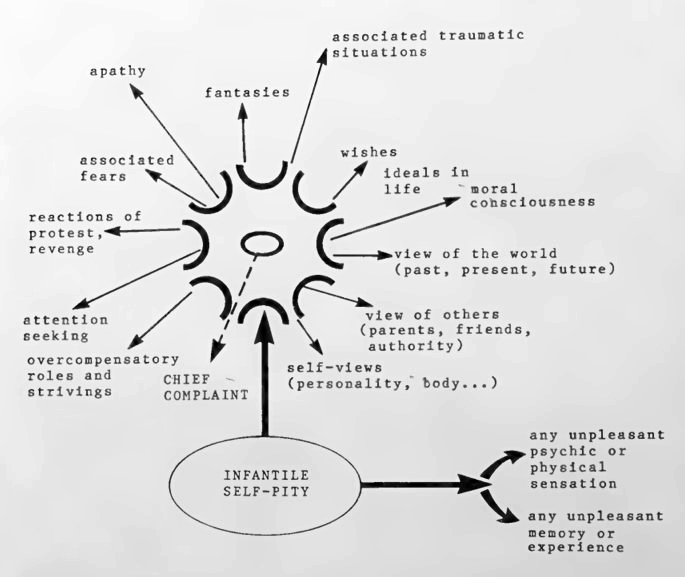
The male homosexual harbors a «self-pitying child» whose chief drama is: «I am not virile like other boys and men»; «I am less sturdy, less robust, less healthy, less strong, less courageous, less physically manly, and therefore, not accepted.» In one variant or another, this specific inferiority feeling was evident in every male homosexual I have analyzed and this corroborates the observations of Adler (Ansbacher & Ansbacher, 1958). The unmanliness complex of male homosexuals is increasingly recognized by specialists in the field. It is implicit in the case histories described by Socarides (1978a); also Bieber focuses in his later publications more than in his earlier ones on the nuclear importance of the male homosexual’s «sense of impaired masculinity» (Bieber & Bieber, 1979). In many cases we can rightly call it a psychophysical feeling of unmanliness or of being a weakling, as the homosexual feels inferior to others of his sex both as to the mental and physical aspects of virility. He feels inadequate in those things he associated in his youth with «being a real man,» he does not dare to fight — physically as well as psychologically, to conquer, to compete. As a child or adolescent he felt a painful inferiority and self-pity concerning his manly role.
Various environmental factors and childhood experiences may contribute to this drama of inferior manliness or inferior manly strength and I shall elaborate a number of them henceforth; what is of importance now, is that these factors are not the strict causes of homosexual longings but only precipitating factors which created a certain predisposition in the boy to develop his specific dramatic self-view. In some cases we gather that the relationship with the mother has been the prevailing precipitating factor, in others the attitude of the father, in many a mixture or combination of the relationships with both of them, while in another series of cases such factors as rearing by elder siblings or by grandparents have left their marks, or a special treatment due to a boy’s chronic illness. The finding is that the homosexual passed through a period of loneliness and inferiority because he found himself «different from other boys,» not belonging to their community. If he objectively was a group member, he nevertheless felt a stranger and inferior to the rest. It is impossible to overlook the multitude of childhood memories of homosexual clients that point in this direction. «As a boy, I always craved acceptance by the boys of my neighborhood. Many free afternoons, they joined each other to go into the woods near our village. What I remember of those afternoons are miserable things — they walked well ahead of me, cheerfully chatting and making fun, while I followed them at a distance, without making a noise, more or less crying to myself,» one homosexual client related. Another told that he always stayed at home because his mother used to warn him against the many dangers of romping near the railway station where the boys of his class and of his street usually gathered. «From my window, I could see them there, tumbling about, playing cowboys and Indians, and I regretted not being able to be part of them.» «I was a pampered child, who lived in the shadow and under the pressure of my mother who wanted me to be her devoted servant at housekeeping, shopping, and the like. I enjoyed her preference for me, her special attentions, but outside the home I felt miserable, a dandy who was unable to defend himself and who was certainly not accepted» — runs the condensed story of another client. «I have been reared by foster parents, but always in isolation from other children. Always felt a stranger among them,» etc. This kind of memories is more universal than those regarding the famous «mother bond», however frequent the latter may have been in homosexuals’ lives. It probably must be ascribed to the great impact of Freud’s central attention on the child’s parental relationships as pathogenous factors that this social isolation has only rather recently become the object of some study. Feeling not one of the other boys or not manly like them is very painful for a boy. Every child wants to have friends; he is already sad when he cannot join the others at occasional meetings (a birthday party, and the like), so he will be more depressed when he gets the idea that he does not belong to the community of his agemates because of his being «different,» or because the others do not regard him as their equal. This smarting feeling of exclusion triggers the defense reaction of self-pity and this may have been felt for a longer period, so that our so-called sensibilized structure is formed. The child is unable to tear himself free from his self-pity and remains attached to it with bonds of addiction. In case of the boy: «I am not so boyish, a poor weakling, not sturdy as they are, they do not see me as a man, but as worthless.» Here we have the specific autopsychodrama of the homosexual man and homosexual longings sprout from this type of self-dramatizing feelings and views. An unmanliness complaint that may haunt him throughout life.
The first and foremost consequence of this emotional situation is that the man with this complex will never find real stability and inner happiness. As is the case with all neurotic persons, the «self-pitying child» always comes back with his nuclear complaint — and with other justifications for complaining. He must reexperience his drama of not belonging to the boys, to the «men’s world.» This tragic self-centeredness is nearly always perceptible in novels and movies on homosexual heroes. Exhomosexual Aaron (1972) rightly exposed the artificial display of joy in homosexual bars and clubs. «I have visited gay bars in many of the world’s great cities, but I have never seen one which was truly gay in the best sense of the word,» he writes, and «the prevailing atmosphere is one of desperation.» Thus the term «gay» («joy») is already an inversion in itself, as other things in the mind of the homosexual may have been inverted, apart from the sexual instinct proper.
Most common in homosexuals is the complaint of loneliness. The true motivation of this complaint is not social discrimination, no more than this would be the cause of the just mentioned despair of homosexuals. It is an inevitable effect of this specific autopsychodrama. The principal complaint «I am not appreciated by the others as a man, as a member of their community,» etc., necessarily brings with it a feeling of loneliness. Loneliness means «I do not belong.» Some homosexuals have enough friends or acquaintances, yet restlessly seek human company without being able to get rid of their inner loneliness. Driven by this complaint, a homosexual can often not really feel part of a group, while his «inner boy» complains: «I am not accepted, I am a loner,» or, possibly, «They (he) will leave me tomorrow.» Unconsciously, they lock themselves in their self-pity based view of being the outsider. Some behave unnaturally, too shamefully, too inhibitedly and thereby do not succeed in reaching the others. Others cling too much to their friends and acquaintances, which likewise is an obstacle for having normal good contacts. Sometimes the «inner child» purposely destroys a good contact. A clientobserved that every time he had succeeded in conquering friends — not only homosexual partners — he became irritated with them and started provoking them. He grew silent and morose, scoffed at them until they did not visit him any longer; «It is indeed something masochistic,» he remarked. Soon after noticing that he had his friends, his «child» came with the complaint «It cannot be true that they really accept me. They always leave me alone!» This made him react with infantile irritations. His «masochism» kept his inner situation of loneliness going, providing him with material to justify his self-dramatizing.
But how does this recurring, autonomized complaint produce homosexual interests? I have left this question open so far, to emphasize that the autopsychodrama or complex of the homosexual is not a sexual matter in its essence, but a continued, specific self-drama of inferiority. Therapy of homosexuality, as a logical consequence, is not sex therapy of any kind but anti-inferiority complex therapy, or better: anticomplaining therapy. Without the elimination of the basic infantile self-pity, homosexual wishes and interests can perhaps be modified to some extent but not fully eradicated. On the other hand, a homosexual who would become free from infantile self-pity about his inferiority view, who would really become happy, inwardly quiet, etc., would not feel any more the attraction to his own sex. Let us now consider the three steps involved in the development of homoerotic feelings:
1. The boy or adolescent feels inferior as a man — not belonging to the manly world and indulges in self-pity because of this;
2. He looks up to those who, in his eyes, are manly, boyish, sturdy, strong, in short who seem to possess what he thinks is lacking in him. Maybe he regards all men as superior to him, if his inferiority complex is very outspoken, but mostly he is principally interested in more or less specific types as to age, physical appearance, demeanor or clothes. He admires them and as he is still a child, he admires them the way a child admires: He idolizes. Viewed superficially, admiration is the focusing of one’s attention on the admired person, but in fact the admiring boy is concentrated on himself. «I am not like him. I have not what he has!». His idolization of the other is a mode of complaining about himself.
We may add that this admiring attention for other boys and young men, for their strong and healthy bodies, their boyish or masculine selfconfidence and assertiveness, frequently precedes homosexual feelings vin the strict sense by some years. The self-pitying boy who feels inferior already looks too often at other boys or men, comparing himself with them, thinking and dreaming about them before the awaking of the sexual imagery proper.
3. He falls in love with his admired objects, wants to touch and caress them and to be caressed, to be near them, to be intimate with them, to feel their attention for him and their warmth. «Oh, if only he would love me!. . .,» the boy yearns. The natural extension of this need for warmth and love is erotic longing. This is not so curious as it may seem. At that particular phase of psychological development, preadolescence and the beginnings of adolescence, the sexual instinct finds itself in the initial stage of its unfolding, not having arrived at its final goal: The opposite sex. It is possible that a child, during this phase of ripening, develops sentimental, erotically oriented feelings for a member of his own sex. All the more easily when the child feels excluded, lonely, or inferior to the others and longs for warmth. Their admiring interest in the physical appearance or personality characteristics of some same-sex others then gets an erotic dimension. Erotic daydreams or masturbation fantasies become centered around the adored one(s) — the homosexual wish comes into being. Normally, a temporary interest in members of the same sex, which is possibly somewhat erotically colored, will pass by as the boy or girl grows up and .discovers the much more attractive sexual aspects of the opposite sex. However, such an interest acquires a special depth when the self-pitying child is overwhelmed by inferiority complaints concerning his sexual identity. For that child or adolescent a bodily contact with some of the adored others becomes the fulfillment of the passionate longing for love and acceptance, the summit of happiness. In the thoughts of the pathetic adolescent, such a contact would remove all misery and loneliness.
The way the pathetic child imagines a relationship of love with an idolized other is quite infantile, by definition. First, this wish emanates from a not yet mature personality; second, many boys — perhaps more than girls with this wish — have remained more childish than the average, as a result of their upbringing (see later). Consequently, adult homosexual relationships are infantile affairs.
It may be clear that the homosexual wish is something desperate, pathetic. Basically, it is just a complaint: «If he (she) would be near me; if someone like him would cherish me!» Compare it to the craving for riches or power of neurotics who harbor infantile complaints about being insignificant or rejected. Such wishes have a pleasant side: The acquisition of the desired objects is highly satisfying for those «children.» Nevertheless, these wishes are embedded in displeasure. Their satisfaction is never permanent, it is never enough, because their source, feelings of discontentment and self-pity, does not dry up. So it is with the homosexual wish. In spite of all childish excitation and the moments of elation it may bring — «jubilating sky-high» — it cannot be satisfied to the full. Its essence, unfulfilled longing, spurs a chain of inner dramas in the homosexual’s inner life.
Again, the structure of the homosexual neurosis is not different from that of, for instance, obsessive-compulsive neurosis. The obsessive neurotic may try to achieve a situation of «perfection» by compulsively performing his rituals of cleaning or checking his actions and thoughts. To him, a morbid sort of perfection is the highest goal in life, but soon after he has reached his near-unattainable level of perfection his complaints of imperfection will return to torment him anew. Similarly, the neurotic with the “self-pitying child» who feels discriminated or wronged may possibly enjoy great satisfaction when he has the luck of receiving appreciation, but his hypertrophic elation will make place for new complaints of not being recognized, etc. The women described by Maltz (1960) with their ugliness complex (a «child» complaining compulsively about her being inferior-ugly) did not experience steady contentment after fulfillment of their dearest wish, to become beautiful, by successful plastic surgery: «Friends, even family, may scarcely recognize them, may become enthusiastic over their newly acquired beauty; yet the patient herself insists that she can only see a slight improvement or none at all, or in fact denies that any change at all has been made.» Likewise, the homosexual who has found his loving friend will continue complaining about not being appreciated by him, by men in general, about not being masculine, etc., thus creating dramas in his relationship. Either he will complain about the unfaithfulness of his partner or he himself will lose interest in him and fall in love with another man. Quarrels and jealousy, dramas of being rejected by the other one, are normal in homosexual «marriages.» The more passionate the craving for other men, the more unstable the attachments.
In most cases the homosexual wish is an obsession like the perfectionistic compulsion of the obsessive-compulsive neurotic. Watch the nervous gazes of homosexuals in a gay bar; searchingly, their eyes move from one man to another, examining every newcomer. Their faces express a fear of missing the look of some other whose attention they are after (and to whom they feel inferior). They cannot satisfy themselves with the attention from only one friend, as they feel inferior with regard to manhood in general. Infidelity in homosexual affairs is for this reason so common that it is by many of them accepted as part of the game. This cannot be explained by external factors such as the fact that homosexual couples do not have children who may forge and strengthen their «conjugal» bond. The incidence of unfaithfulness in homosexual relationships is substantially higher than in heterosexual marriages, also in comparison to heterosexual relationships that are not considered by the partners as necessarily lasting.
The homosexual preoccupation cannot be compared with heterosexuality, as is often done. While it is true that heterosexual men may look at every woman they notice in the street, their feelings are mostly far less obsessive or, as one might say, feverish, than those of homosexuals. The homosexual who looks at men appears to feel, if he comes to see through it, a painful compulsion to look — the pain being caused by the inferiority complaints, although it may scarcely be conscious to him, because he primarily perceives the drink before him and not his thirst. Imagine a neurotic suffering from a poverty complex who cannot withhold his attention from every big car or beautiful house he sees, struck by the complaint: «Oh! If I could possess such a car!» Undertone: «But, alas! That will be impossible forever!»
The homosexual hunger for men is, however, comparable with some forms of neurotic heterosexuality. It is similar to the impulses of the «Don Juan» who compulsively chases women in order to feel accepted and admired by them. A woman who observed a homosexual acquaintance at a party staring at some young men described his look aptly: «It seemed as if he were in a trance.» At such moments the homosexual is actually dragged away by his «child.» One client confirmed this observation: «It is a kind of hypnosis coming over me.»
12. Some Elucidations of the Homosexual Autopsychodrama in the Male: The Preferred Partner
It is not easy to fully understand that a homosexual or homoerotic impulse is a form of infantile «whining.» Most homosexual clients initially doubt that the strong sexual urges they may feel as instinctual would be mere lamenting, complaining. Yet there are cases that the self-pity which underlies the homoerotic interest is so striking that it impresses everyone who know these people. A doctor commented to me on the suicide of a severely depressed homosexual who had been hospitalized after his attempts to attract the attention of a normal heterosexual man, with whom he had fallen in love, had failed. The patient could not possibly be talked or electroshocked out of his compulsive complaining; every time he was addressed, he responded with his stereotyped complaint: «I want that man, I want that man….» He was really frozen in the position of a crying child who in a rhythmic drone repeats his complaints: «Mama must come back, mama must come back,» or something similar. The case of this patient was extremely pathological, but actually the difference with milder cases is one of degree, the intensity of the complaining force makes for this difference.
We have seen that the features of other men who have the power of fascinating the «inner boy» in the homosexual man teach us important things about his negative self-image. The «child» adores and feels excited by the very traits he thinks he does not possess, in which he would allegedly be inferior. Some 80 percent of homosexual men inform us that they like virile traits in their partners, in physical as well as in psychic respect, e.g., the partner has to be athletic, sturdy, or tall, with broad shoulders, sometimes with a fat belly (a sign of maleness in the eyes of some «inner boys»), sometimes with long hair (which would express youthful adventurousness and happy-go-luckiness), and in general, equipped with manly beauty. Some like «normal» young men, without salient characteristics, which points to their feeling inferior as to their being «a normal young man.» Others view dominating or authoritarian men as the ideal of manliness, feeling weaklings themselves as regards their social assertiveness; or popular, socially easy moving types when the «inner boy» himself felt bashful and inhibited. It is significant that the majority of homosexuals seek partners of the age of adolescence and young adulthood (Giese, 1958; Freund, 1963). This means that they as a boy or adolescent admired those young men whom they saw as sporting, daring, strong, and courageous.
The boy and adolescent who feels the poor weakling who cannot participate in the world of — young — men may construct a dreamlike image of the «ideal man.» For some, this is a man in his forties with the manners of someone who exerts authority and has influence over people, the type of military man, or business man who is in command of things and whom people obey. To understand these ideals we must go a little into the psychology of boyhood and adolescence. The kind of heroes imagined by the «poor boy» corresponds fairly well to the kind of heroes generally admired at that age. For boys, «men» are persons who are adventurous, possess courage, who conquer and give orders. On the other hand, (young) men who are popular — sometimes this includes being popular with women, cheerful, active, smart to see, provoke the admiration of other boys.
A group of homosexuals, about 30 percent according to Bieber et al. (1962), prefers traits in their partners which they attribute also to their fathers. This should not directly be interpreted as proof of the hypothesis that they «seek their fathers» because of an incestuous wish or the like. Strictly taken, such a Freudian explanation is not acceptable; the prehomosexual boy who admired some trait of manliness in his father often felt he lacked it because his father «did not pay attention to him,» or «only criticized him.» He adored the manliness of his father at a pathetic distance, but not only the manliness of his father but of all men demonstrating the same strength. So his homosexual wish was not so much a wish for sex contact with his father as the ardent wish to take part in, or to be protected by, the masculinity of those in front of whom he felt inferior, in whose company he felt unworthy. In the last analysis, therefore, this wish was a complaint about himself. We must interpret similarly the preference shown by the majority of passive-feminine homosexuals like the ones studied by Miller (1958) for a partner who was about eight years their senior and displayed markedly virile traits. Homosexuals who as a child did not admire their fathers’ manliness, however, for instance, because of their fathers’ weak personality, because they were too submissive to their mother, usually do not seek father traits in their partners, although they too experienced a lack of attention and encouragement from him.
The majority of homosexual men communicate an aversion for effeminate partners, for the «typical homosexual» as the public thinks of them. This dislike does not surprise when we realize that the «inner boy» precisely hates his own lack of masculinity, so why should he feel attracted to it in others? Nevertheless, a small minority informs us of their interest in «somewhat feminine» young men. How to reconcile this with the foregoing considerations? The solution again lies in the view of the sad boy of other men and young men. Considering himself a poor outsider, he may imagine young men as «angels»: They move with grace and ease, are beautiful of bodybuild, without hair on their well-formed limbs, etc. So some inferior-feeling boys see them as representations of the «superior young man,» more especially if they themselves feel ugly, awkward, fat. It is only a small minority however who harbors such feelings; at most, about 20 percent of the sample of Bieber et al. (1962), but less than 10 percent of my own sample of about 200 homosexuals in treatment. And I have to amend that of those with a liking for somewhat feminine partners I analyzed, this preference was often not exclusive. For example, a man with this partner interest also had episodes in which he preferred the virile type, another alternated in his taste between a feminine type of about twenty years and an older type of man who had to be bald-headed, solidly built, and manly dominant.
Thus many homosexuals are after circumscribed physical or behavioral traits in their partner, falling for definite «types.» Those traits for them have a magic quality. They are like fetishes to them. Some, for instance, become excited at the sight of short-cut hair, upon seeing men with a special look in their eyes (which is perceived as manly indifference, independence, and daring), or by a «manly» insolent, provocative, or rebellious behavior toward others — remember that the «boy» himself felt anxious, may have been overobedient, without courage, and so on. Some preserve an infantile admiration for «manly» clothes, leather jackets or boots, belts, open shirts, wrists with manly hair, big motorcycles, military or police uniforms. A man dressed that way is attractive to them while the same man in a less spectacular outfit does not stir their imagination any more. The well-known «penis fetishism» of some homosexuals is another example of this infantile or primitive mode of thinking, in which the quality «manliness» is condensed to some concrete, superficial attribute. Often a homosexual’s preoccupation with the penis reflects inferiority complaints as to his own penis (too small, unimpressive, ridiculous); there are homosexuals who are merely, compulsively, after contacts with others’ adored penises, without knowing or perceiving the rest of their partner’s body, let alone their personality.
As has already been remarked, not all of them have an exclusive preference for one partner type. Rather frequently one hears a homosexual say that he likes two distinct types, e.g., a young man who is not yet fully adult, and an older man, representing to him two types of masculinity, respectively. His behavior to these types of partner will be different: toward the young man, he may behave as the leader, enjoying his role of being the boss («I feel a man too, now»); and near the older man he is the little unprotected boy who wants to be loved by a strong man. Basically these behaviors both emanate from the complaint «I am inferior» and in both cases it is the «inner boy» who strives for attention, love and appreciation, so basically the patient’s attitude is passive, receiving, awaiting.
One may wonder why the word «gay» was coined for — initially male — homosexuality. Indeed, many male homosexuals have a childish longing for making fun, romping, etc.; others are up to boyish mischief, or like noisy and festive reunions. We have seen that the undertone of much of this exuberance is not so cheerful, that it is often overcompensatory behavior. The «inner boy» has always wished to play and have a game of romps with other boys, but did not succeed in joining them. Frequently, he was lonely without friends, or lived under the stress of a — tenderly or firmly — domineering or overanxious mother. Such a boy may admire a joyous, «carefree» way of life, as he envisages it. A homosexual man of about 40 years told me that he experienced great satisfaction when he could roam the streets at night in the company of some homosexual friends, committing mischief like a little boy, for instance, kicking at garbage cans so that the rubbish went over the pavement. In his youth his behavior was just the opposite: He was withdrawn, shy and obedient, oppressed by the excessive care of an overprotective mother. He in fact acted out the wish of his «little boy.»[22] We understand also the preference of some homosexuals for extraordinary dresses and their exaggerated attention for the newest fashion as manifestations of their «inner boy’s» anxiety to «be with it,» to present himself as an easy mixer, etc.; many times, this was the reaction to the absence of normal participation in boyhood and adolescent group life, cofixated with the self-pity of those days.
To belong to the world of other boys and men implies having friends. The «inner child» in the homosexual is an eternal friend seeker. We can distinguish between the friend seeker in the strict sense, i.e., the homosexual whose «inner boy» craves for friendship with one of the adored other boys or playmates («friends»), and friend seekers in a broader sense, as a qualification that is applicable to all homosexuals. As a matter of fact, those who may be called father seekers, who are attracted to strong, protective men, want to meet a friend in that man, namely, a fatherly friend.[23] There are considerable differences between homosexuals in the number of actual «friends» they seek as well as in the duration of their friendships. There are differences too in the degree to which they want a steady friend, a companion for life. Some 35 percent of many clients were of the «cruising type,» contacting many partners in fortuitous contacts. This does not imply that some of them would not have wished a lasting friendship. Some who cherish this ideal are simply too obsessed with their longing for contact with men that they are unable to maintain a personal relationship of longer standing and have to change partners frequently. Others alternately live a period of running after many partners and one when they stay some time with the same friend. In general, the typical pattern is that the homosexual with a steady friend also looks for others, even if his friendship would objectively give reasons to expect that his emotional needs would be satisfied.
A few words on homosexual «love.» Not every homosexually oriented person would assert that his feelings can be indicated by this word, but many give the impression that their homoeroticism is an expression of the deepest, purest (sometimes even holiest) love. In reality, such a view is but infantile romanticism. There does not exist any «homosexual love,» only a pathetic and sometimes lyrical exaltation, a temporary clinging to each other — the love of «two babies in the wood.» It is hard for the person who harbors these feelings to become aware of it, but in the last analysis this love amounts to self-centered sentimentality, an asking for love for one’s «poor me,» who unconsciously is conceived of as an innocent, lonely child in need of warmth and understanding. This «self-pitying child» clings to his friend in a purely egocentric way — «You must love me!» — but he may show himself as egocentrically cool to his partner after a row or when he feels unjustly treated or «betrayed» by him. Considering these things, the modern pastoral advice to homosexuals to be faithful and stay with one friend only, must be called naive. This is exactly what many homosexuals cannot achieve and what others would never accept as an ideal because they are just interested in short-lived contacts and could not emotionally tolerate a homosexual «marriage,» any more than a heterosexual could.
Not a few homosexuals will agree with this sobering view of homosexual «love» as sheer narcissism and compulsion, namely, those who have lost their puerile, romantic idolization of eternal friendships and mutual love after a number of such affairs. They sometimes recognize that they just suffer from an urge for contact and sex and that there is not much more to it.
The sentimental longing for a close, loving friend or fatherly protector as well as the urge for contact with the male body is a direct consequence of childhood loneliness and inferiority feelings with respect to manliness. The isolated position in the boyhood community is in fact one of the best established data which have been found in association with male homosexuality.
13. The Boy Who Does Not Belong to the Boyhood Community
H.S. Sullivan (1953) noticed that some boys of a group of near-adolescents who did not take part in the practice of mutual masturbation that was common among them, turned homosexual in later life, while the rest developed normal heterosexual interests. The anecdote is not a justification for mutual masturbation in puberty, but illustrates a) that mutual masturbation in childhood cannot be regarded as a cause of homosexuality (at least, as a general cause), and b) that homosexuality has something to do with a boy’s isolated position among others. In my sample of homosexuals in treatment, slightly more than 50 percent engaged in some form of sexual play with other boys between the ages of 8-15 years, which underlines that this factor alone cannot be held responsible for a homosexual fixation.
The position of isolation from the boys’ world is the most salient individual statistical fact obtained by investigators of childhood factors in homosexuals, in accordance with the results of the pionner study of Bieber and his collaborators (1962). The level of statistical significance in the difference between homosexuals and heterosexuals as to this childhood item is sytematically higher than that concerning the difference between homosexuals and heterosexuals as to parental relationships. Table 13.1 gives a survey of these studies.
To put it differently: The variables relative to the prehomosexual boy’s nonintegration in the boyhood community and to his self-image of not being able to participate in normal boys’ activities and games, including competitive activities which require a certain measure of courage, have been demonstrated to be associated most narrowly with subsequent homosexuality. Clearly more so than certain attitudes and child-rearing practices of father and mother which were traditionally considered as the primary causative factors. If one would prefer a rigorously empirical approach of the problem of homosexuality, one should accept this fact as the starting point for the construction of a theory. For our view of homosexuality as a neurotic «disease» of self-pity, this empirical evidence does not yield a problem; it fits in well with the ideas we expounded. In Table 13.2 I have tabulated the percentages of my homosexual group who, according to their statements, showed certain characteristics as to behavior and parental relationships in childhood and adolescence. Of course, these percentages are not found by objective measurement, but reflect the client’s views and self-views.
Although I did not compare these percentages with those of various groups of heterosexual controls (only a small comparison as an indication), the numbers are instructive. Not fighting, not participating in soccer (the Dutch national game, comparable to baseball in the United States), and not being a daring boy appear to be the behavioral traits associated with prehomosexuality. Being fearful of fights and not playing soccer is about the antipode of «being a real boy» (certainly, in the view of boys). This kind of finding is universal. It appears in samples of clinical as well as of nonclinical homosexuals and in such different countries and cultures as the United States, Brazil, and Holland. To repeat: Why not give the most importance to this best established of variables correlated with homosexuality?
I want to emphasize that the self-image of «not belonging to the boys’ world» is not synonymous with «feeling a girl,» or «feeling feminine.» A subgroup of homosexuals do have these latter feelings, as a variant of the infantile self-view of not being a «real man,» but the majority has not. Some statistics relevant to this subject: Freund (1963) used an inventory to estimate «feminine tendencies» or a «feminine identification» in homosexual men. Questions in this list were, e.g.: «Did the subject wish to be a girl in childhood?» «Did he display girlish interest?» and «Does he consider himself feminine?» Fifty percent of his group could be called «feminine» on the basis of their total score on this list; about 55 percent had had the wish to be a member of the opposite sex. Forty percent of the sample of Bieber indicated to have had the wish to be a girl during childhood; in my group this childhood wish had occurred less frequently — in about 26 percent — and the childhood self-view «I am girlish» had been present in 43 percent. Sixteen percent of the homosexual sample of Loney (1972) had always wanted to change their biological sex. However, analyzing this self-image of being «feminine» or «girlish,» one finds that the very same trait was considered undesirable by most of them: «I am only girlish,» «I am a sissy.» In other words: this was not seen as a good thing, but more as lack of masculinity. The wish to be a girl likewise may be interpreted as a reaction to a frustrated self-image as to a boy’s gender identity. «Being a girl, I could be myself, I wouldn’t have to compete with the boys,» or «As a girl, I would have been loved by my father who is only interested in girls» (Bieber). The impression that this «femininity» is secondary to a lack of boyish self-confidence is corroborated by the finding that only a small part of prehomosexual boys had a preference for playing with girls or for playing with dolls (20-30 percent at most: Bieber et al., 1962; Evans, 1969). Furthermore, femininity does not always discriminate statistically between homosexuals and heterosexuals. Compare this with an item like «Avoided fights,» or «Did not play soccer.» The qualification «feminine» for boys is otherwise not equivocal and does not signify rightly and clearly: «Behaves like a girl.» If a boy is considered «effeminate,» or nicknamed a «sissy,» «little Mary,» etc., it means that he displays a lack of firmness and daring. One often uses the expression «old woman» in such cases and this is surely not the kind of femininity that is ascribed to the «feminine woman.» In this way we understand the correlation found by Freund (1963) between «femininity» in adult homosexuals and their childhood personality traits of «being fearful» and «superstitious» (like old women, one might say), and that reported by Holemon and Winokur (1965) between «femininity» in boys and «nervous instability.» The latter authors even qualify «effeminacy» in boys as «a childhood disease.» The terms «femininity» and «effeminacy» may be misleading by their vagueness. They seem to mean different things for different groups.
Table 13.1. Biographical Questionnaires and Male Homosexuality
|
Homosexual and Heterosexual Populationsа |
Mother Attitudes in Childhood |
Father Attitudes in Childhood |
Same-sex Peer Relationships in Childhood |
Author(s) |
|
Hom: 106 therapy patients; 16–50 yrs (clinical) Het: 100 therapy patients; same age as Hom |
Hom mothers more trying to be prime center of son’s attention,** more overprotective,** more dominating,* Hom son was confidant of motherb*
|
Hom felt less accepted by father,** more often hated him,*** Hom father spent less time with his sonb***
|
Hom more fearful, avoided fights, “lone wolf,” did not participate in group games like baseballb*** |
Bieber et al. (1962) |
|
Hom: 23 socially adapted volunteers; 24.5 yrs, education 13 yrs (nonclinical). Het: 22 enlisted men of same age and education |
Hom mothers less restrictive, more permissive in son’s socialization training (differences in factor scores) |
Hom fathers more critical, impatient, and rejecting; Hom fathers less “socializing agents” (differences in factor scores) |
No data
|
Apperson & McAdoo (1968) |
|
Hom: 43 members of a homophile organization; 33.8 yrs (nonclinical) Het: 142 volunteers; 39.3 yrs, older than Hom |
Hom mothers more demanding to be center of son’s attention;** Hom son confidant of mother |
Hom felt less accepted by father,** hated him more;*** Hom father spent less time with his son*** |
Hom more fearful, avoided fights, “lone wolf,” did not participate in group games, felt more often frail and/or clumsy*** |
Evans (1969) |
|
Hom: 46 military men; 23.9 yrs (nonclinical?) Het: 21 military men; 21.1 yrs; younger than Hom, same level of education; and: 51 college men |
Bieber scale on mother-son relationships discriminated between Hom and both Het groups** |
Bieber scale on father-son relationships discriminated between Hom and both Het groups,** even more so than other items |
Bieber scale on peer relationship discriminated between Hom and both Het groups** |
Snortum et al. (1969) |
|
Hom: 127 volunteers; 28 yrs, education 16 yrs (nonclinical) Het: 113 volunteers, matched for age and education |
Hom mothers more demanding to be center of son’s attention;*** Hom son mother’s confidant*** |
Hom felt less accepted by father, hated him more;*** Hom fathers spent less time with their son*** |
Hom more fearful, avoided fights, did not participate in group games*** |
Thompson et al. (1975) |
|
Hom: 88 members of an activist homophile organization; 22 yrs (nonclinical) Het: 105 students, same age and social class |
Hom mothers more dominant;** Hom felt less respected by mother* |
Hom fathers less affectionate, less dominant, viewed as less sympathetic, more often absent from home** |
Hom were loners, more often “sissies,” nonparticipant in competitive sports** |
Stephan (1973) |
|
Hom: 307 students, volunteers (nonclinical) Het: 138 students |
Hom mother more rejecting,* less lovingc***
|
Hom father more rejecting, less lovingc*** |
No data |
Siegelman (1974a) |
|
Horn: 37 bar patrons in Sāo Paulo; 28.2 yrs (nonclinical) Hot:37matched men |
Horn closer to mother;*** Horn loved mother more than father;*** Hom more dependent on mother* |
Hom felt less respected by father;*** Hom father less interested in son;** Hom had less a relation of friendship with father»
|
Hom did not play soccer, played more often with dolls;*** more fearful;** felt more isolated in adolescence**** |
Sbardelini & Sbardelini (1977) |
|
Hom: 575 white residents of San Francisco Bay Area; 37.0 yrs (nonclinical) Het: 284 whites, random sample from same Area; 36.3 yrs
|
Hom closer to mother; more protective; strongd*** |
Hom did not like father; did not want to be like himd*** |
Hom did not like baseball; liked girls’ activities; liked solitary activitiesd*** |
Bell, Weinberg & Hammersmith (1981)
|
|
Hom: 111 black residents of same area; 27.2 yrs (nonclinical) Het: 53 black men, random sample from same area; 26.5 yrs |
about same results as in sample above |
Bell, Weinberg & Hammersmith (1981) |
||
Note. Unless mentioned otherwise, the groups are from the United States.
aAge in means and ranges.
bThe questionnaires in this study were filled out by the therapists; in the other ones by the subjects themselves.
cThe questionnaire used here is different from the Bieber scale and seems of doubtful value for the assessment of homosexuality-associated youth factors. Compari-son of the 10 percent of the homosexuals with lowest neuroticism scores with low-neuroticism heterosexuals did not yield differences in parental relationships, but this may be due to one or more of the following reasons:
1. The least neurotic homosexuals-who may have been the same as the least homosexual ones, see the evidence from Sbardelini & Sbardelini, 1977-had the more desirable parental relationships;
2. The scales used by Siegelman are not sensitive for the detection of existing but small differences in parental attitudes between the two groups (as a matter of fact, the groups did differ on Cattell’s I, which measures a kind of overprotection. Cf. the first study of Siegelman (1972) that gives information on the same sample);
3. The homosexuals with low scores on neuroticism tried to give a «good image» of themselves as well as of their parents.
dThe authors used a specific statistical device («path analysis») to test a certain developmental model of the interrelationships between parental and so-called gender nonconformity items and homosexuality. Although they admit that from this statistical treatment «a weak to moderate effect of paternal influence» on subsequent homosexuality was demonstrated, they took pains to play down the indications of parent-child pathology as much as possible (clearly, to present homosexuality as «natural»). At the end of their book they lose sight of the fact that their path-analysis model is just one out of several alternative ones. Moreover, the underlying assumptions are not unquestionable. It is taken for granted, for instance, that maternal and paternal influences work independently, whereas it is more arguable that exactly their complementarity predisposes to homosexuality. More serious is that their «raw» data are very raw indeed: The questioning was rather superficial and the way they combined answers into composite measures makes suppression of information likely. It is interesting to experiment with statistical models, but it is difficult to see in this case why their method would be superior to a simple statistical comparison of numbers of responses to the various items between the homosexual and heterosexual groups (results are given in this table). Whatever value one wants to attach to their method of data handling, however, there is no doubt that psychosocial childhood factors also in their sample differentiated at the highest level of significance between homosexuals and controls (van den Aardweg, 1984).
*p< .05
**p< .01
***p< .001
Table 13.2. Salient childhood factors in 196 Dutch homosexual clients (Percentages in order of magnitude)
|
«Manly» social behavior |
Did not fight |
94 |
|
Did not play soccer |
91 |
|
|
Not daring |
90 |
|
|
No feeling of togetherness with father |
88a |
|
|
Not a mischievous boy; obedient, «nice» boy |
80b |
|
|
Mother overconcemed and/or overanxious |
79a |
|
|
Not a member of an informal boys’ group |
78 |
|
Prehomosexual boys feel incapable of defending themselves. They tend to see other boys as rough, more aggressive, stronger, and themselves as weaklings, losers who must flee when threatened. Often a homosexual client tells that he only rarely attacked another boy physically, even when in a game; only when he felt so much teased that he was seized by a nervous temper tantrum. Normally he was very peaceful. We may safely assume that every boy likes a sporting fight now and then, likes some sporting competition, feels pleasure in normal aggressive activities, in mastering something, conquering something. If a boy systematically avoids these behaviors this may be a sign of his lack of selfconfidence with respect to his fighting and winning capacities. The prehomosexual boy often feels: «I shall be beaten,» «Roughness is nothing for me.» This self-image is still present in the «boy in the homosexual.» «Me, playing soccer?» a young homosexual coquettishly exclaimed when asked whether he liked it. «That is something for men.» In spite of his expressing himself affectedly, he conveyed his inferiority feelings concerning his being one of the men.
The prehomosexual’s avoidance of fights thus reveals his inferiority complaints, and soccer (baseball) is the «fight» of competition in boyhood par excellence. I believe that most of these boys would have loved in their hearts to participate in those games and to experience the proud feeling of being a match for the other boys. Normal behavioral tendencies of boys do exist also in the overanxious, soft or effeminate prehomosexual boy, but suppressed because of his conviction that he is a failure in these things.
The inferior-manliness view of so many a prehomosexual boy is often reinforced by ridicule and teasing. About half of my homosexual clients reported that they had suffered from such behavior by playmates, classmates, and sometimes brothers at home. From a psychological point of view it is not so important whether these teasings had really been so terrible or that the over sensitivity of the boy made them excessively painful to him. What matters is his self-image of being helpless, without power to defend himself against «them.» Otherwise, it is well-known that precisely the easily impressed and «weak» boy is exposed to teasing, nicknaming, and mockery.
This boy, who did not feel strong and firm, was according to the anamnestic questionnaire of Freund (1963) «Often a sad child, who cried frequently,» «Fearful when he was alone at home or in the dark,» «Found himself weaker than other boys at school,» «Was a fearful child in general.» Why did he cry sooner than other boys? Probably we have to explain this tendency as the result of overprotection, of too much «babying» by the parents. Too much softness and care make a child vulnerable to hard treatment; he does not know how to defend himself and easily will abandon himself to tears. In short, a boy raised this way is more childish than his contemporaries.[24] Crying in the dark, in effect, is a reaction that belongs to the age under primary school, and certainly under preadolescence. Many prehomosexual boys could be described as too «tenderminded,» a factor that is probably associated with parental overprotection (cf. personality factor «I» of Cattell, 1957). The average prehomosexual boy, then, is probably more infantile than other boys and this may have facilitated his inferiority view of himself.
On an average, the first homosexual contacts take place between ten and 17 years. Bieber reports that 61 percent of his group had such contacts before 15 years, Curran and Parr (1957) even found that 86 percent of the first homosexual contacts of their patients occurred before 13 years. According to Westwood (1960) it was 81 percent before 16 years. On the other hand, other authors indicate 17 years as the average age of the first homosexual contact (Liddicoat, 1957; Hemphill et al., 1958). The seeming contradiction in these data disappears if we make a distinction between the first objective homosexual contact which many times was not much more than a sexual play without «deeper feelings,» and the first homosexually relevant contact, in which inferiority feelings, admiration, infatuation and craving for warmth were involved. Studying a group of socially adapted homosexuals, Loney (1972) reported that the first awareness of homoerotic sentiments took place at about 15 years, confirming a previous finding by Whitener and Nikelly (1964). He writes that this late appearance of the first homosexual feelings surprised him, but his surprise reflects the rather popular misconception that homosexuality is already present in the tender years of life. In 121 homosexual men of my total group for whom I registered the age of occurrence of the first homosexual fantasies or desires I found the following distribution:
|
Under 10 years |
0.9% |
|
10 to (not including) 14 |
45.0 |
|
14 to 17 |
49.0 |
|
17 to 21 |
3.4 |
|
21 and above |
1.7 |
|
Average: 12 years |
|
This is slightly earlier than the age found by Loney, but possibly the difference has to be explained by the difference between our questions and data collecting. Loney inquired after the first «homosexual awareness» and that is not necessarily the same as the first longing or fantasy. Frequently the boy already cherished more or less conscious homosexual fantasies some time before discovering the «true nature of it.» In any case, an average of 12 years is in accordance with the position that homosexual wishes are the result of fixation of the longings of a boy, a preadolescent or adolescent, in the initial phase of his psychosexual development. The traumatic experiences leading to the homosexual wish or complaint ordinarily took place between 10 and 17 years, seldom before. Thus at the age of beginning manhood, when a child starts comparing himself consciously with the others as to his gender identity. The boy watches the impression he makes as a young man, and the standards of the preadolescent and the early adolescent group prescribe that one should have manly courage, dare defying authority, that one should be sturdy and sporting. This is therefore the age that an anxious, not boyish boy can feel very lonely and unadjusted. We may infer that the «self-pitying boy» in the homosexual is mostly a teen-ager and agree with Bergler’s (1958) affirmation that «The homosexual is emotionally in his teens.»[25]
Furthermore, our exposition of the homosexual’s fixation to the initial stages of psychosexual development is confirmed by the evidence from various researchers that the first homosexual contacts occurred at an earlier age than the first heterosexual contacts in groups of controls (e.g., Bieber et al., 1962).
The lonely preadolescent or adolescent boy — the «lone wolf» in the expression of Bieber — nearly always fell in love for the first time with boys of either his own age, or older and seldom with younger. The first homosexual experiences likewise were mostly not with younger boys. (With younger boys: Only in 19 percent of the cases, Giese, 1958; 3 percent, Westwood, 1960; 1 percent, Bieber et al., and 7 percent, Loney, 1972. Loney notes that in this 7 percent the initiative did not come from the boy himself, which might indicate that he was not primarily interested in younger boys.) This general preference for older adolescents and young men is in line with the lonely boy’s view of the ideal young man. It is normal that boys of 10-16 years admire somewhat older boys who already show the characteristics of adult masculinity in appearance and behavior. For the younger boy who feels painfully inferior in this respect this admiration may easily turn into admiration and idolatry.
Sometimes the first amorous impulses for young men appear after the adolescent boy was refused by a girl with whom he was in love. His manly self-confidence — which in all probability was rather shaky before — underwent a fatal shock by the experience. The boy started feeling sorry for himself and in his depressive mood compared himself unfavorably to other young men who were successful with girls. He thought they possessed qualities of manliness he missed. «Oh, if only I could be like them!» — and the process of admiration of others’ masculinity was set in motion.
The center of gravity of the self-pity of the «inner boy» in most homosexuals lies in this unfavorable comparison with other men, as was clearly formulated by a client: «Do you understand? I do not feel at ease with girls, but in the company of men I am so ashamed of myself that I seem almost paralyzed.»
14. Characteristics of Mothers and Characteristics of Homosexual Sons
The «mother bond» of many male homosexuals is nearly proverbial. The evidence from studies and psychological analyses of individual cases concurs with this notion (Tables 13.1 and 13.2). The peer group factor, however, is more closely related to homosexuality than the mother factor. This is to say that we should not overestimate the importance of several more or less typical mother-son relationships of prehomosexuals as etiological factors but that we must see them more as catalyzing factors that help create their specific inferiority complex. The primary cause of homosexual neurosis is the formation of the homosexual autopsychodrama, the autonomization of inferiority complaints about one’s gender, plus the aching for love from same-sex friends. There undoubtedly exist certain relationships with mother and father that may stimulate the development of this specific self-pity addiction.
Apart from the data of Table 13.1 that compares homosexual groups with controls as to mother relationships, we may give some complementary data on the incidence of several «mother items» in homosexual groups studied by various authors. The concept of the dominant mother of male homosexuals had already been launched before Freud by the older sexologists like Magnus Hirschfeld (1953). Miller (1958), working with a selected group of very feminine homosexuals, thought that 64 percent of them had a mother who had dominated them definitely (N — 54). Westwood (1960) judged that 57 percent of the mothers of 127 homosexuals had been dominant and 44 percent overprotective and possessive (part of the overprotective mothers were also dominant). A little more differentiated is the description of the «close-binding-intimate» (cbi) mother by Bieber et al. (1962). He found that 70 percent of 106 homosexuals had this type of mother, as contrasted with 30 percent of 100 neurotic controls.[26] This may be an overestimation, though, resulting from a possible bias of the psychoanalysts who did the ratings. Psychoanalysts may tend to slightly exaggerate the presence of mother bonds on the basis of their theories which attach much value to this factor. Anyhow, later investigators found lower percentages of cbi mothers in homosexual groups (e.g., Evans, 1969, in a nonclinical sample). Nevertheless, the variables constituting this cbi relationship with mother are interesting enough: The boy was mother’s favorite son; mother was more intimate with him than with the other children in the family; the boy was mother’s confidant; the bond between mother and son was somewhat exclusive and father did not enter into it; mother treated the boy as an infant; mother interfered with his social and other activities; mother encouraged girl-like behavior more than boyishness; mother kept him dependent on her. Consequently, the cbi mother must be regarded as sort of dominant (interfering, keeping him dependent, imposing herself on him). In my sample I found in 67 percent what I regarded as an «interfering» mother, who arranged too many things for the boy and was by far the most important of the parents in his upbringing. In 79 percent mother could be called overconcemed, overanxious in relation to her son, and in my opinion this qualification is best suited to indicate the emotional attitude of many mothers of homosexual sons. They are preoccupied with this child, not in a healthy way, but neurotically, worrying over his physical well-being, his good behavior and good manners, and therefore they may interfere too much, restricting his free development, protecting him too much or keeping him coercively under their guardianship. Some mothers of homosexuals domineer with force, others with softness and sentimentality. «My mother had the kind of love for me that stifled me to death,» a client (dramatically) remarked. Similar observations by others were: «I felt her personal property — she drove me crazy. I wasn’t permitted to do anything because of her»; «She had her hysterical crying spells when I was not an obedient boy, so I often found myself trembling in her presence and I did not dare to disobey»; «Mother already thought and executed things for you before you could do something by yourself and she spoilt me terribly»; «My mother was very ambitious and I was her boy. I always succeeded in getting what I wanted from her, I whined until she gave in, but nevertheless I felt that she neglected me emotionally,» and the like. The sentiments of many prehomosexual boys were put into words by a homosexual who declared: «I felt a piece of China-ware put by her under a glass bell and which should be handled with care.»
Such communications make one reflect. They help in understanding certain facets of the inferiority feelings of the homosexual man’s «inner boy.» Mothers with this overconcernedness about their boy’s well-being and achievements often have an egocentric type of love for them. They prevent them from being themselves, from developing their own interests, their own male assertiveness; they do not give them enough room to grow and expand. Naturally, the boy feels oppressed, sometimes tyrannized as he is molded to the submissive, «nice» boy. He will lack self-confidence when he has to take some initiative because he was conditioned not to do so, and he will shun from acting independently and avoid difficulties and frustrative situations. He does not learn to fight. «I felt weak, infantile, thought I couldn’t do anything without her»; this complaint of a homosexual client rightly put a connection between his mother’s excessive interference and care for him and his subsequent inferiority feelings. How can a boy feel a boy, enterprising, with a pleasure in exploring and conquering the world around him, when he is forced into the mold of the nice, well-behaving «mama’s boy»? He sometimes does not dare to become rebellious toward her except in a powerless way. Sons of a mother with these personality traits may constantly quarrel with her yet feel incapable of escaping her influence. In some cases, the prehomosexual son had to bow to his mother’s emotional blackmail: «If you don’t behave, I will have a heart attack and that will be your fault!» Many feel unable to live without her support and approval and rely on her when confronted with difficulties. My impression is that the softly, overanxiously meddling mother provokes much less rebellion in her sons — too little, as a matter of fact — than the firmly dominant type. However, the revolt of these sons often amounts to little more than to an impotent, nervous struggle, typical of one who finds himself in the grip of a more powerful hand.
Bergler (1957) thinks that the homosexual unconsciously sees his mother as a witch. That seems too bold a generalization. The homosexual whose mother was very tender with him, too kind and indulgent, who treated him as an infant in this nonaggressive way, is not likely to be tempted to similar mother-views. As a rule, aggression (by a parent, here) breeds aggression (in the child). There are homosexuals who have preserved their childhood view of mother as the warm, protecting mommy whose beloved little boy then want to stay. Some indeed cherish a deepseated hatred for her, especially sons of the mother-hen type whose love was demanding, irritating, egoistic. Most are however ambivalent in their emotions for their mother; their «inner boy» loves her and fights with her by turns. Reactions like these are easily transferred to other persons in the neurotic’s environment. Some of these patients suffer from periodical feelings of oppression by others and then react with protest, in an emotional quest for «freedom», repeating in fact their childhood emotions in relation with mother.
The persistence of a close attachment to mother is undeniable in many male homosexuals. E.g., half of 20 men psychoanalyzed by Stekel (1921) had a clear positive attachment to her; seventy percent of 60 homosexuals interviewed by Jonas (1944) had a clear preference for mother (as compared with father). As we saw, a close attachment and even a preference do not exclude some hostility. For example, a homosexual man of 55 years had ever since his childhood been the victim of such a close attachment to his mother, until she had died at a very old age. He had never had the courage to leave his home — i.e., his mother — although he had been well aware that he lived entirely under her tutelage. She was dictatorial and he never really spoke up to her; she also had a phobic fear of life, of accidents, etc., and had always warned him against all kinds of dangers in the world, inspiring in him the same fear of disaster which made him seek protection under her wings. He felt her death as a relief (from being dominated) but soon found himself another female protector. Despite his submissive behavior to his mother he was filled with bitterness against her and almost continuously complained about her with highly venomed reproaches. No need to add that his «complaining boy» transferred the whole scale of his feelings for mother to his new motherly friend. Thus the role of the «mother’s confidant» and «mother’s companion» played by some adult homosexuals is often based on their continued inner complaining about their «weakness» and «helplessness» and on the ensuing dependency feelings, more than upon mature feelings of love of an adult man for his mother.
The mother of the homosexual is depicted as a pedagogue. Of course, it would be incorrect to lay the burden of her son’s misdevelopment exclusively on her shoulders. Her contribution to the characterological malformation of the son is not equally decisive in every individual case. Moreover, we must assume that she herself may have been the victim of an inferiority complex in a rather high percentage of the cases and that she committed her pedagogic mistakes without being aware of it. Also, she sometimes was negatively influenced by serious troubles in her marriage. Her part in the genesis of her son’s neurosis should not be minimized, but then she should not be seen as the only one responsible. That she often was a neurotic woman is unquestionable, though. The woman with an excessively worrying attitude or the woman who tries to tie her son to her apron-strings is usually a complaining type. To my knowledge, no systematic studies of the personality of mothers of homosexuals have been undertaken, but clinical experience makes me suppose that rather specific neurotic trends can be found among them more than on a chance basis. For example, the neurotic need to protect can erroneously be taken for a «strong mother instinct.» It may be a projection of their own feelings of helplessness and pitifulness onto her son. A mother of a homosexual client remarked: «Actually I have always regarded the boy as so helpless and pathetic, I have always felt sorry for him.» This had influenced her protecting ways toward him and it was very probable that she had implanted her own feeling for him in his mind. («You are helpless» becomes «I am helpless.») Some mothers of homosexuals are used to referring to their son in terms of «that poor boy,» expressing a sentimental attitude in the tone of their voice. A similar attitude was evident, for instance, in a mother who had been an orphan and was raised in an institution. Ever since her childhood she had felt like a lonely, lost girl, not accepted by the world. Those «poor girls» in adult women recognize themselves — better: project their selves — onto their boy and treat him as they would have liked to be treated and comforted in childhood. A sad girl may treat her favorite doll that way.
Among mothers of homosexual men one often encounters the women who imposes herself, who thinks she has to take all responsibility for his health and life. She likewise treats him as if he were unable to do something on his own or as if he were in need of protection, robbing him of the opportunity to learn to cope with life’s difficulties independently. She is most of the time inwardly insecure and fears things will go wrong if not controlled by her personally. She meddles in the lives of others, or always knows things better; she can have the habit of going her own way, like a child who wants to assert herself. There are a number of variants of this motherly type. Some treat their son as a nurse would treat a helpless patient; some like to play the boss, cannot tolerate other vigorous personalities around them and may have been married to men with a less dominant character and who may like to let themselves be mothered and to leave the rearing of the children to her. As said, women of this group may suffer from a neurotic drive to prove their value, to be important in the lives of others. Doubts about themselves are often at the origin of this need.
Undeniably, some mothers of homosexual men feel like poor children in their hearts, wanting attention and affection from their son. He has to be nice to her, which of course not only means that he will enjoy her special favors and approval, but at the same time he is put under special stress. A specific case of this is the mother who would have preferred a girl to a boy because she wishes for feminine company. She is tempted to raise him as if he were a girl. She may treat him as her little angel or favorite doll, a way of contact seeking for herself. She perhaps pays extraordinary attention to his appearance, his hair, clothes. He may become an understanding ear for her emotional problems, maybe the «wailing wall» for her marriage frustrations. No wonder that a boy in these circumstances will adopt unconsciously some of his mother’s ways — she is the central personality in his emotional life. He develops certain feminine traits in his way of speaking, gestures, or interests. He moreover becomes conditioned to his mother’s support and approval; the later «inner boy» is then likely to continue seeking the approval of many «mommies» (e.g., in his profession as a hair-dresser, fashion designer, but similarly in his ways with women). Mother’s way of talking is very apparent in some homosexual men: Too dramatically, or too verbosely, sometimes complainingly, drawlingly, the way «old women» may talk.
Finally, some mothers of homosexual sons had problems with their sexual identity; occasionally one encounters among them a woman with lesbian inclinations. In sum, many mothers of these men appear to be somewhat neurotic; as a rule, they incline to overconcernedness and next to that to interfering. In order to evaluate more precisely how certain personality traits or habits of male homosexuals can be related to motherly attitudes, we shall briefly deal with the effects of over-indulgence, pampering and dominant interference. .
Fifty-one percent of my clients could be considered as having been reared too softly and over-indulgently by mother. They were seldom or never punished by her, were spared troubles and efforts and no difficult things were required of them. Too quickly, mother said: «He is too tired now to continue working,» or «He cannot bear that effort,» «Going there is too far for him,» «This or that is too heavy, too difficult.» A client said: «On the one hand it was comfortable for me that my mother used to take me under her protection when I had a fight with my brothers but on the other hand, you felt like a cripple.» Obviously, such treatment reinforces a boy’s self-view of weakness, along with reactions of seeking protection when confronted with hardship, leaning on others, avoiding efforts and strenuous activities. The boy becomes overindulgent to himself.
Twenty-four percent of the mothers in my sample positively pampered the son. They eventually gave him all he cried for and instilled in him the self-view of being a little deity, superior to others and with a natural right to a privileged position. Like overindulgent mothers, pampering mothers create weak characters. Often they regard their son as their favorite, a datum that is statistically found more in subgroups of homosexuals (than in controls). In later life, the self-view of «being special,» the favored one, along with a self-pampering attitude, will persist in the «inner boy.» The latter may become indignant when he is not treated as he wishes, or when he would have to give up something to which he thinks he is entitled. To the pampered category belong those who play the role of the little «prince» who feels elevated above others. He cannot tolerate what he considers as insults — «lèse-majesté» — reactions, and may be whimsical, lacking in self-discipline, giving in to every impulse. In short, these men are what we usually call «spoilt children.»
Surely, there are many transitions between outright pampering and too soft or too permissive a treatment. In a sense, overprotection always contains elements of pampering. In addition, both attitudes make socially difficult children who, because of their demandingness are not easily accepted by playmates.
The dominantly interfering mother often insists on the boy’s good manners, his cleanness and the neatness of his clothes. She produces the inhibited boy who is very obedient, «nice to his mother,» but with little initiative in the field of boyish pranks. Seventy-three percent of my homosexual group thought to have been a «neat, obedient» boy. That is, for instance, they gave no problems of order, conformed to mother’s wishes while mostly living in peaceful harmony with her as a child. «I was sort of a dud,» «I was very quiet» — such expressions indicate compliance and submissiveness. «I was nicknamed ‘nit’,» a man remembered; his overcompliance was clearly rooted in inferiority feelings. He did not dare to speak up to others, any more than he dared speak up to his mother, or to act contrary to her wishes. Overinterference makes a child dependent, clinging, and self-doubting. By the way, the dominantly interfering mother is not necessarily a hard person, although this qualification sometimes fits. Her interference is often friendly, nevertheless compelling.
A mother of a young homosexual who had manifestly chosen the «homosexual way of life» may complain about his rebellion, adding: «And this, in spite of his always having been so nice and problem-less in adolescence.» She does not see that exactly the absence of the normal need for independence in puberty should have been alarming. When a young homosexual openly announces his decision to be a homosexual, this is sometimes a retarded adolescent protest against mother. «Now I am going to do what I want to do myself!» he may dramatically exclaim. As it is with many infantile protests in adults however, this does not mean that the bond with mother has really been cut off. The «inner child» remains sensitive to her approval and «mother» remains a very central figure in his emotional life.
The interfering mother may play a negative role in the psychotherapeutic treatment of her son. She may impose the necessity of a change on him, thereby stirring his aversion instead of his will to change. She may constantly worry about his problems and try to influence him according to what she thinks is the best thing for him to do. With badly concealed curiosity she perhaps phones him after each therapeutic session: «What does the therapist say about you? Did you make progress?» and is likely to try to interfere with the treatment itself. The meddling mother may take on, on the other hand, the role of the defender of her son’s rights to live as a homosexual. She will make a crusade for the rights of homosexuals, and to her other children she declares that «She cannot possibly refuse him what she did not refuse to them, namely, his right to love the way he loves.»
Although they were attached to their mothers with strong infantile ties, I believe that many homosexuals did at the same time, somewhere within them, suffer from the selfish side of her love for them. Primarily because they could not feel respected completely as an independent person with his own ego, will, etc., secondarily because mother’s meddling may have gone along with a certain coolness. The combination of over-attention and coolness is explicable from the egocenteredness of these women; in other words, from the impurities inherent in their love.
One aspect of motherly interference which deserves some emphasis is the restriction of the boy’s freedom of action outside the home. «Don’t be wild, you might get hurt,» «It is dangerous to swim there,» «You should not play with those boys, they are too rough, they have no manners,» etc. Maternal warnings of this kind, reflecting over-concern or overanxiousness, were reported by 43 percent of my homosexually oriented clients. «She did not allow me to do anything,» was a rather frequent complaint. As we have seen, the restriction of the freedom to engage in the boyish role and in boyhood activities will have enhanced the boy’s longing for playful contacts with friends. It was an obstacle to the formation of normal contactual habits, chiefly to the formation of a healthy self-confidence in front of his contemporaries. Feelings of isolation can turn the wish to belong to other boys and to participate in their friendships into something frantic: Therefore, homosexual friendships mean to many the fulfillment of their most intense dreams. As a result, the suggestion to «change» their orientation is often felt as an attempt to rob them of their only opportunity to happiness.
A minority of homosexual men was reared in an overstem and/or overcritical way by their mothers, or even rejected or neglected by her. Bieber mentions 10 percent aggressively rejecting mothers; I found a hostile or neglecting attitude in 9 percent of my cases. Although overprotection, anxious overconcern, and various forms of overinterference are the prevailing characteristics of mothers of homosexual men as a group, the fact that these attitudes cannot be demonstrated in a substantial minority again warns that the famous «mother bond» is not necessary for a homosexual development. This naturally must not lead to the recently committed error to dismiss any motherly characteristics as irrelevant, for the statistical relationship between mother attitudes and this sexual problem in the son is well-established, nor may we shut our eyes to so many clearly observable instances of this connection in our clinical work. Maternal behavior has often been decisive for the son’s development of an unmanliness complex. But the completion of this statement is, that other influences were also operative, first of all, the absence of normal support and appreciation by the father (Chapter 16), and in some cases, the upbringing by grandparents, or by elder sisters. In 6 percent of my cases I did not think mother’s behavior had been neuroticizing; in five of them (2.5 percent) the boy had not been raised by her as she had died in his early years or was a chronically hospitalized psychiatric patient. These boys without a mother had been taken care of in an institution or were raised by several maid-servants and all of them gave the impression of having felt lost and emotionally neglected rather than overly tied to a mother-substitute.
15. Intermezzo: Effeminacy and Pseudofemininity in Male Homosexuals
According to a popular idea, male homosexuals are effeminate, «men who look and behave like women.» This is misleading. First of all, outspoken femininity in behavioral presentation may only be observed in a small minority: In 8 percent (Westwood, 1960); 4 percent (my sample); or 2 percent (Bieber et al.). A higher percentage of homosexual men is thought to be «somewhat feminine» in demeanor, according to estimates of the same investigators: 25 percent (Bieber); 9 percent (Westwood); and 10 percent (my sample). Therefore, probably between 14 percent and 27 percent can be considered as either markedly or mildly «feminine» and «effeminate.» This possibly explains the finding of Westwood, that about 80 percent of homosexual men are possibly not recognized as such by their environment. Furthermore, we should not forget that there are «feminine» and «effeminate» men without any homosexual inclinations at all.
What do we have in mind when we speak of «feminine» and «effeminate»? If we scrutinize the observations of behavior indicated with these descriptive words we arrive at the conclusion that this behavior is not identical with that of girls and women. Mostly it resembles the behavior of the latter only superficially because it contains something unnatural, affected. If a woman would behave the way some effeminate homosexuals do, she no doubt would be called a phony: Mannerisms, affected gestures and gait, giggling, falsetto voice, hip-rolling, exhibitionistic hairdressing, and style of clothing. Effeminate homosexuals impress as role players. They seem continuously aware of themselves and of the impression they make on others; thus, they are preoccupied with their selfimage. They primarily want to impress other men, as being «charming» or «attractive.» This affectation is perceived by other people and causes irritation, as any form of affectation normally provokes irritation because of the insincerity of it. Pronounced effeminancy can be traced back to childhood. The boy assumed that role in relation to his developing inferiority feelings as to his boyishness. He began thinking that the girl’s pattern of behavior suited him better than his own. Naturally such a self-view must often have been prepared by a method of rearing that favored it, by too much encouragement of nonboyish interests and behaviors (but in some cases perhaps by rejection of the boy’s being a boy). Homosexual men as a group identified more with the pattern of interest and behavioral ways of their mother than with that of their father (cf. Chang & Block, 1960). Bell et al. (1981) likewise found that effeminate homosexuals disliked their fathers more and had less «father identification» than noneffeminates. A complete identification with the behavior pattern of the female is a boy’s flight from inferiority feelings with regard to his gender identity. Hence, we consider effeminacy in men as an infantile role that has been fixated in the autopsychodrama. We concur with Holemon and Winokur (1965) that it is «a disease of childhood.» In a group of children they found an association between high scores on interest and preference scales for measuring interests in activities of the opposite sex on one side, and neurotic emotionality on the other.
From a theoretical point of view, playing the feminine role is the first step to transvestitism and transsexualism (Chapter 23). It is often seen in homosexuals whose «inner boy» cherished the wish «I ought to have been a girl,» viewing themselves as not «real boys,» or as «being more of a girl than of a boy.» This wish, or complaint if we look at it another way, is not present in all homosexuals, though.
The markedly effeminate homosexual seems more exclusively homosexual in comparison with nonfeminine homosexuals (Darke & Geil, 1948; Holemon & Winokur). He played more girls’ games in childhood than the nonfeminine, and his first homosexual experience had more often been before the age of ten (Holemon & Winokur; compare this with the finding of Freund, 1963, that feminine homosexuals remembered homoerotic wishes of an earlier age than nonfeminines). Also, in contrast with nonfeminines, he more often had had transvestitic wishes as well as a preference for the passive role in sexual contact (Holemon & Winokur;[27] Freund, 1963). However, Bieber et al. did not find a relationship between femininity and the passive role in sexual contact. Finally, the effeminate homosexual prefers virile partners to a higher degree than other homosexuals (Freund, 1963; also: Van Lennep et al., 1954; Miller, 1958). The latter peculiarity is explicable with the rule that the «self-pitying inner boy» tends to adore especially what he painfully missed in himself.
The above rough sketch of a cluster of traits in the effeminate homosexual possesses coherence. This man already felt a stranger in the men’s world at a relatively early age, frequently, before ten years; and he played like a girl and admired virility at an earlier age than others with this orientation. His preoccupation with maleness and contact seeking with virile men is manifest from his frequent sex relations, which in fact are more frequent than those of noneffeminates (Holemon & Winokur). In a statistical analysis of personality traits of 51 of my total group I found a significant correlation between «exhibitionistic femininity» and «frequency of homosexual contacts»[28] which might point in the same direction. Putting all these, however not highly conclusive, data together, we can suppose that marked effeminacy in the homosexual indicates a serious disturbance.
It is nonetheless a bit artificial to draw a sharp line of demarcation between various types of feminine and effeminate homosexuals. Identical mechanisms seem to operate in many who display some femininity, although with less intensity. As far as «femininity» is concerned, I repeat what I wrote to the effect of effeminacy: It is not really the behavior of normal girls and women. It amounts to a lack of manly firmness and decisiveness, sometimes to «old wives’ attitudes» («silkiness,» twaddling, making hyperdramas, becoming emotionally upset for no reason, etc. — I beg the reader pardon for these not so courteous terms, but they adequately depict what I want to convey). In many cases of feminine homosexuals, the «inner boy» indeed resembles a small child who imitates the complaining ways of a worrying old woman. Herein he reflects what he perceived around him at home from the person to whom he was most tied emotionally. About 60 percent of my homosexual clients had something of this unmanly «silkiness» and they admitted to have often been painfully aware of it, especially during adolescence. What is meant by this are too «soft» manners, exaggerated and unmanly fears for small adversities, chattering too much and too emotionally, trying to be «sweet» to others. The label «femininity» is less adequate and as I said, I would prefer «old womanish» if this were not so depreciatory a term. The genesis of femininity is often not too difficult to reconstruct. For example, a psychology student who seemed to be the prototype of silky femininity owed it to his dominantly overprotective mother as well as to his position as an only boy, the beloved little brother of two elder and equally protective sisters. There had hardly been any elements in his childhood home environment to stimulate boyishness; it even seemed that he had not been allowed to cross the boundaries of the «lovely little brother» role. Would it have been realistic to expect such a boy to become a real man?
Thinking about the origins of pseudofemininity in homosexual men we cannot bypass a discussion of the results of studies with so-called masculini ty-femininity inventories. A high score on «femininity» lists indicates a preference for interests and activities that are traditionally seen as typical of women. Generally speaking, they are often the «softer» interests and activities. A high masculinity score reflects a preference for the «harder,» «tougher» activities, judged to be more manly. In a number of studies, the scores of varying groups of homosexual on the Mf (masculinity-femininity) scale of the MMPI (Minnesota Multiple Personality Inventory) were compared with those of heterosexual controls and the outcome is rather unequivocal (Doidge & Holtzman, 1960; Dean & Richardson, 1964; Krippner, 1964; Braaten & Darling, 1965; Friberg, 1967; Van den Aardweg, 1967; Oliver & Mosher, 1968; Manosevitz, 1970, 1971): Homosexuals have elevated femininity scores.
As to the interpretation of high femininity scores, it is probable that they do not signify identical things in every person who obtains them. The interpretation seems to depend on the socio-economic and intelligence level and education and on the possible patient group to which one belongs. On the other hand, the meaning of high femininity scores in homosexual men can reasonably be ascertained. They must be viewed in the light of our knowledge of the behavior pattern of prehomosexual boys. Their «femininity» in interests, etc., fits in with their nonparticipation in soccer (baseball) and with their fear of physical aggression and their avoidance of physical competition. Thus we discern two factors in the established femininity in many male homosexuals: A preference for «softer» activities and a fearful avoidance of «rough» behavior. The homosexual with a high femininity score not only expresses his preference for activities of a softer type, but at the same time his inferiority feeling concerning the manly sector of behavior. Hence, it is plausible that high femininity scores in this group are motivated by their specific inferiority complaint about not belonging to the men’s world.
Confirming evidence for this hypothesis exists. Krippner (1964) found a positive correlation between high femininity scores and an average score of pathology on other MMPI lists in a mixed group of homosexual and heterosexual college students with emotional problems. Friberg (1967) found that heterosexual neurotics score higher than nonneurotics on femininity, but lower than homosexuals. And studies using factor analysis point to a close relationship between femininity and a general factor of «Neuroticism» or neurotic emotionality (Cook & Wherry, 1950; Tyler, 1951; Kassebaum et al., 1959; Shure & Rogers, 1965).[29] All this strengthens the idea that high femininity interests in men is different from high femininity in women, namely, either a dimension of neurosis, of emotional pathology, or at least a personality trait which is intrinsically related to a neurotic disturbance.
The term «femininity» for male homosexuals then might better be changed in pseudofemh linity, or, which would amount to the same, in «softness» or «unmasculinity.»[30] If a man is remarkably pseudofeminine we are justified in considering this, at least in part, as an avoidance of the masculine role stemming from a neurotic self-image of inferiority. A part of normal male occupations and interests is excluded from the life of the pseudofeminine man, his range of activities is therefore neurotically restricted.
Connected to the «soft» interest pattern of many homosexual men is their preference for the «softer» professions, in the social, administrative, artistic, journalistic or pastoral sector. Not that these professions must necessarily be executed by weak personalities — the reader might perhaps notice that this author is a psychologist — but they unquestionably offer the opportunity for activities which do not require fighting spirit in the first place. It goes without saying that there are artists who are hardworking and manly, and religious pastors who are at once enterprising and manly as well, etc., but it is a fact that soft professions attract often neurotically sensitive or soft personalities who seek a certain protection from the struggle of life, or who may want to live in a friendly atmosphere which safeguards them against certain responsibilities and hardships. There is some truth in the observation of Bergler (1958) that homosexual artists tend to superficiality, «embroidery and decoration,» doubtless as a result of a lack of persistence and too soft a mentality. The rule is however not an iron ore.
Evidence from some studies indicates that homosexual men are overrepresented in artistic professions (Liddicoat, 1957; Hemphill et al., 1958; Westwood, 1960; Bieber et al., 1962) and under-represented in crafts (Schofield, 1965). The difference with heterosexual men however -s not striking. I think we should attach more importance to the way a profession is exercised than to the kind of profession. On an average, homosexual men are liable to avoid positions which require a good deal of fighting spirit and courage. Often they are followers or, if in command, depend on others or on stronger personalities. Overgeneralizations must not be made here, either. Some of my homosexual male clients headed a private enterprise and fought their way through life in a tough enough way.
This leads us to the group of nonfeminine, even overcompensatorily masculine homosexual men. It is true that only a minority of homosexual men show clear signs of effeminacy, yet the majority possesses either mild feminine characteristics or such traits as silkiness, softness, lack of toughness, unmanliness. The group with an outspoken virile presentation is very small in comparison. Yet also these men harbor an «inner boy» feeling inferior in the men’s world, as can be determined by a more profound analysis of their emotional life. Their virility may be an overcompensation, the attempt of their «boy» to live up to his ideals of manhood. He wants to show off as the sturdy fellow. He may cultivate body-building, be a military man, a sportsman. Possibly it is this group of men who make high scores at the masculinity pole of masculinity-femininity inventories (Aaron & Grumpelt, 1961). Otherwise, in the life of many young homosexuals may occur episodes that they try to prove themselves as men, often by engaging in some sport like judo or karate. Others want to show their virility by striving for social dominance, being the leader of a group, etc. These outward masculine overcompensations, however, are forced and not genuine and they do not eliminate the underlying inferiority complaint of being unmanly, weak, or frail (on the contrary, the more compensatory efforts, the more the matrix, the complaints from which they spring, is kept alive).
16. Fathers of Male Homosexuals
Data from earlier (Jonas, 1944; West, 1959) as well as more recent investigations indubitably attest to the deficient relationship between the great majority of male homosexuals and their fathers, from childhood onward. Homosexual males had a more disturbed relationship with their father as compared with control neurotics (Westwood, 1960: More than half of his group of nonclinical homosexuals had a negative emotional relationship with him). For more recent data, see Tables 13.1 and 13.2. Seventy-five percent of the fathers of the group of Bieber was classified as «detached»; they spent little time with their son, were not much involved in their day-to-day rearing, and had few positive emotional contacts with him. In my group I heard from 71 percent that their fathers were not interested in their daily activities and did not participate very much in their upbringing — which is nearly exactly the percentage indicated by Bieber. Thirty-eight percent of my cases thought their father was «critical of them» and 30 percent considered him as «outspokenly hostile»: A father who rejected his son, severely criticized him, scolded him, or beat him up frequently.[31]
Bieber et al. diagnosed 45 percent of the fathers of their homosexuals as «hostile,» a somewhat higher percentage than I found, but maybe their criteria for the establishment of hostility were a bit different from mine. Quite interestingly, Stephan (1973), dealing with a very different group of homosexuals, viz. young militants, reports that 32 percent felt they were «being consistently rejected» by their fathers (the same proportion I found in Dutch men in treatment).
In any case, male homosexuals in all kinds of research groups express feelings of distance from and/or hatred for their fathers. This has been reported so unanimously — also by investigators like Schofield (1965) who proclaim the normalcy of homosexuality — that it has to be accepted by every student of the problem as one of the basic data nearly as important as the central finding concerning the prehomosexual’s peer group isolation and inferiority feelings. It would therefore not be wise to play down this factor of father relationship and its relation to the etiology of homosexuality, as has been done in some publications by proponents of the normality view. As it has been firmly established, there must be an explanation for it — and the idea that the bad or distant relationship with the father would be the consequence of being a homosexual or of having homosexual interests has to be turned down because these interests only manifest themselves on an average after ten years of age, when the mentioned relationship with father is already a fixed pattern.
The role of the father in the etiology of homosexuality has certainly not been discovered only by recent statistical studies which compared various groups of homosexuals with controls. Stekel (1923) was one of the first to lay a heavy stress on this factor, thinking that it was perhaps of more weight than the classical «dominant» mother. The series of more recent statistical studies has confirmed his clinical observations. However, we may wonder how general or necessary this father-factor really is. Bieber (1976) says he encountered it in everyone of some hundreds of homosexuals he investigated clinically in the course of the years. In my group, 87 percent admitted not to have had a confidential relationship with their father, leaving 13 percent who felt that they had a reasonably positive emotional bond with him. Analysis of the nature of these positive bonds, however, many times reveals a certain aloofness on the side of the father. For instance, a young homosexual told that he had always had a friendship relation with his father; his father used to go with him for a walk; he talked with him about decisions to be taken with respect to his study, etc. He reported, however, that he was not very much moved when his father left his mother for another woman when he was about 18 years. He continued visiting him from time to time and that, he said, was quite sufficient for him. Thus his feelings for his father were not deep and he appeared to have seen him during his childhood more as a friendly neighbor than as a father. In fact, it was his mother who had exclusively determined the atmosphere at home and who had always been around as the most important educator in everyday life. It may be, then, that there are homosexuals — a small minority, to be sure — who had and have good relationships with their fathers, but notwithstanding we are impressed by the relatively superficial influence of many of these fathers on their character formation and emotional life. In my experience, these fathers are often friendly, but weak personalities who leave the process of educating their son in the hands of their wives and exert little direct influence on them themselves7.
Some additional data: Snortum et al. (1969) refer to the «pivotal importance» of the father-relationship in the boy’s development, Thompson et al. (1975) report the homosexual’s alienation from his father (which was more prominent than his emotional alienation from his mother, although the latter was apparent as well), Apperson and McAdoo (1968) draw the attention to the father’s failure as a socializing agent, and the Sbardelini couple (1977) found that Brazilian nonclinical homosexuals had a relationship of friendship with their fathers much less frequently than heterosexual controls.
After all this, we must enter into the interpretation of this striking «father factor.» The first explanation which proposes itself would be that a boy whose father was distant or psychologically absent cannot develop masculine behaviors and interests because he has no masculine example to imitate. Surely, everyone can observe that little boys like imitating the activities of their father and it is a fact that some often display the same interests, opinions, and behavior as their father. There will be some truth, then, in the assumption that a weak, submissive, or fearful father, or an old father, does not by his example encourage firmness, daring, and other manly qualities in his son. Even so, it is unlikely that the absence of a masculine model in the family can be such a crucial factor for the development of homosexuality. Several observations indicate that a boy’s outward behavior is only important in so far as it helps in originating his feeling of not belonging to the men’s world. For instance, many boys with a somewhat unmasculine (or old) father indeed do not grow to be examples of masculinity themselves but also do not experience the slightest homosexual interests. Also boys whose fathers were absent (by death or other circumstances) during significant periods of their youth need not develop deficient masculinity traits (McCord et al., 1962; see also Freund, 1963).
The idea that male homosexuals had no masculine example to imitate is, moreover, not correct for a certain percentage of them. Often the father was quite manly, but the problem was that he had little contact with the boy. Often the boy had other masculine examples in his family: One or more (older) brothers. Even in the absence of masculine models in the family one might wonder why the boy did not imitate — like most boys do — examples of virility outside the family. Do not all boys admire sturdy boys, masculine bravery, fearlessness, etc., and do they not want to be like their admired heroes? As a result, the question in the case of the prehomosexual boy is not so much that he was not provided with examples of masculine behavior, as that he did not imitate them.
The meaning of the «distant» father becomes clear when we listen to the childhood recollections of homosexual clients. This father did not give them the necessary self-confidence with respect to their being a manly creature. As we see it, then, the boy’s subjective self-view is of a much greater psychological significance than his objective, outward behavior. A boy’s so-called deficient masculine identification is the product of an inferiority feeling and the psychologically absent father fortifies such a negative self-view by his lack of personal interest.
The distant father may have been decisive in the development of the prehomosexual boy’s specific inferiority complex; in other cases it was merely a factor of minor importance, but the fact that one seldom encounters a homosexual man who had a normal feeling of belonging to the world of manliness as represented by his father warns us not to minimize the effects of the role of the father. In terms of prevention, one may consider a normal emotional relationship between father and son with the ensuing feeling of a certain togetherness, as one of the most effective means to avoid this disturbance.
Let us cite some statements of homosexual clients about their fatherrelations. «I did not have much contact with either of my parents,» one told me, «they were too old for me. My mother arranged things for me, but my father did practically not exist for me.» «My father dominated my mother and my relationship with him consisted of continuous quarrels, I felt neglected by him,» another explained. And a third: «My father always criticized me. Many times I have thought: ‘How nice it would be if your father would be your best comrade . . «Father was interested in my brother and not in me»; «My father never was the type of person I had wanted; I was mother’s favored little man, but I think I needed the attention of my father. I remember that I found it wonderful when a man talked to me in a friendly way, such as once, when a policeman gave me a friendly pat on my shoulder . . .»; «My father was a weak person; moreover, he was frequently ill. He was friendly to me but always at a distance. I have always felt a loner»; «My father did not romp with me; he did not answer my questions»; «I scarcely knew my father. He was always working» (as a lawyer in a private practice). This is the same story I have heard from many homosexual men, for example from a baker’s son: «I only met my father on Sunday, when he was not working. Then he sat in his chair, but for me he was no more than a visitor.» We may safely infer that in cases where the father was chronically ill or «always away from home or at work,» the adverse factor has not been so much his physical absence in itself as the lack of personal interest from him (according to the perception of the boy). The son did not feel like he had much of a father.
A boy feels appreciated by his father when the latter shows him some interest, even when he has to be frequently absent from the home. On the other hand, an abysmal distance is felt by the boy and adolescent wha daily sees his father but does not experience his approval and interest, or who feels that his father is annoyed by him. A client who had always lived in the company of his father stated: «He had never been a real father to me, he always kicked me away.»
On the basis of numerous similar statements we may divide the fathers of homosexual men into the following categories, which, of course, overlap to a certain degree:
- the well-known physically absent father (deceased, divorced);
- the always-working father who paid little attention to the daily routine of the boy’s education, interests, occupations;
- the chronically ill father who did not participate in family life;
- the weak, anxious or submissive father who himself behaved like a dependent child of the family, leaving the decisions as well as the education of the son to his wife;
- the old father who was not interested in little boys and did not understand their world anymore; and
- the rejecting father who did not like this particular son for some reason, sometimes because of the widely observed neurotic mechanism of «choosing oneself a scape-goat among the children.» This father, who himself suffered from a compulsion to complain, used one of his children as a favorite source of complaints, accusations, and as a target of beatings and other rejecting behaviors.
Naturally, at the basis of these various father-attitudes which led to the emotional distance between father and son, one generally finds a psychological problem or a neurotic personality weakness which, otherwise, may have been aggravated by objective circumstances such as work, or age, or a difficult marriage relationship, a problematic wife, etc. It would not be correct, however, to overemphasize the circumstances that helped create the distance between father and son. In many cases, the father «chose» these circumstances (working too much, for instance), or was in part responsible for a difficult marriage relationship.
Categories 5 and 6 deserve some further comment. The «old father» (5) may have married at a somewhat advanced age (which sometimes indicates certain shortcomings of personality or emotional inhibitions). Also, the homosexual with an old father may have been an «afterthought.» In that case, he probably had an old mother as well, a situation which favored overprotection or a lack of vitality in the family atmosphere. Further, the «old» father (and the «old» mother) can be related to the position of the homosexual among his siblings. In various studies the homosexual appeared to be one of the younger children of the family. In the group of effeminate homosexuals of Miller (1958), 62 percent were either an only or the youngest child. Fifty percent of the homosexuals of
Jonas (1944) were either an only or the youngest child, significantly more than the heterosexual controls. Of Westwood’s (1960) homosexual interviewees, 31 percent were the youngest child (but there was no control group). The homosexuals in treatment studied by Bieber et al. had been less frequently an only child than neurotic controls, but more often the youngest or one of the youngest. Slater (1962) also reports that homosexuals were born rather late in the sequence of siblings. Those Dutch homosexuals in the study of Van Lennep et al. (1954) who came from families with more than four children belonged more often to the younger than to the older half of the children and also had more brothers than sisters, in contrast with homosexuals coming from up to four-child families. Such a finding makes it clear that family size is a factor that has to be taken into account if one studies the relationship between homosexuality and birth order or position in the family. (The homosexuals of Van Lennep c. s. were not more frequently an only or the youngest child than could be expected on the basis of population statistics.).
More recently, Siegelman (1973), comparing a nonclinical U.S. sample of homosexuals with heterosexuals, found that the homosexuals had more brothers who were older by five years or more, in comparison with brothers who were 1-4 years older, again demonstrating the existence of a subgroup of homosexual men with relatively older parents. Of more relevance are the data about the age of the parents at the time of birth of the later homosexual, as have been presented for British homosexual men by Slater (1962), Moran (1968), Abe and Moran (1969), and for Brazilian homosexual men by Sbardelini and Sbardelini (1977). The mothers of British homosexuals appeared to be statistically older than mothers of control persons, but this finding was even more striking for the fathers. It is interesting to see that the Sbardelinis confirm this impression for their Brazilian sample, once more suggesting universal background factors in the psychogenesis of homosexuality. They found an age difference between homosexual men and their fathers of at least 30 years in 16 out of 26 cases,[32] as compared with the same age difference in 2 of 37 heterosexual controls, which is highly significant statistically. The age differences of mothers and homosexual sons, compared with those of the heterosexual controls, gave a more differentiated picture:
|
Age difference 13 to 19 years |
Age difference 26 to 43 years |
||
|
Homosexuals |
Controls |
Homosexuals |
Controls |
|
7 from31[33] |
0 from 37 |
11 from 31 |
4 from 37 |
|
p< .001 |
|
|
|
Two subgroups could be distinguished, then, in the homosexual group: Men with a relatively older mother and men with a young or very young mother. To my mind, these data are quite interesting and should be further explored. We may suppose, for instance, that the very young mother, who may even be only a child when she becomes a mother, lacks the maturity necessary for child-rearing and is therefore prone to pedagogical mistakes. The old mother, on the other hand, is probably overanxious with her son, but, of course, the relationships may be more complex (she married relatively late, she could not or would not have children but at a more advanced age, the child in question was not purposely planned, etc.). Older parents sometimes do appear to rear a younger son in a way that favors a homosexual development. The older father is frequently too little active and remains aloof, the older mother is too much worried and protective. Such tendencies are not necessarily the consequences of aging, but they may become more pronounced in the course of the years so that the younger children in a family are the most afflicted by them.
The excessively criticizing father (category 6) is a type apart. It is understandable that a boy with some kind of hostile father suffered from what he felt to be rejection — meaning he felt sorry for himself. Dealing with male homosexuals, one frequently hears childhood stories of traumatizing father behaviors, too much in fact, to overlook their significance. Stephan (1973) counts more stories of emotional rejection in the youth of nonclinical homosexuals than in heterosexual controls, and the rejector was primarily a male person. It is not likely that the father rejected his son because he already suspected him of homosexual inclinations, for the rejection history usually goes back far into childhood, while the first homosexual interests or experiences come much later. Actually, it is rather the other way around: Rejection by father (as we have seen, this may have been important in about 30 percent of the cases) can stir a longing for affection and warmth from a fatherly man. This has for instance been so in the childhood of the Dutch novelist Louis Couperus (18631923), who described his boyhood feelings and views in a dramatic short story, «A little Soul» (see van den Aardweg, 1965). In this narration Couperus portrays a little boy, Charley, the latecomer in the family, like he was himself, who felt disregarded by his older brothers and his father, a strong, masculine, but to him distant personality who did not bother about «that kid.» The boy was brought up by his older sisters and the maids in the kitchen. In his loneliness and grief, poor Charley once got friendly attention from a cheerful, virile uncle who romped with him and gave him the wonderful feeling that he was accepted by a man like «those others,» his father and brothers. «. . . How strongly he wished to have uncle always near him, always! And the child invented himself illusions, fantasies, in which he imagined that he lived with his uncle and played with his uncle and walked with him, always with uncle! But they were only little dreams and once, in his sick,[34] precocious emotion, he cried because of it in his bed, alone, while they merely were little dreams.» Naturally, his uncle had to go away and from now on little Charles felt even more lonely and filled with self-pity than before, and, overwhelmed by his misery, he drowned himself in the ditch behind his house. This sentimental story clearly expresses the elements contained in the psychogenesis of a type of homosexual neuroses: The feelings of contempt and nonacceptance by father (and brothers); the ensuing loneliness and self-tragedizing that eventually brought the boy to suicide; and, of course, the admiration and frenetic longings for warmth and attention from an «uncle,» a masculine, courageous, and sporting type. In addition to this the story illustrates that this longing to be always with uncle, «to live with him, always,» was felt as an impossibility. «Just little dreams.» This is a narrative of an infantile complaint, a cry for a fatherly figure — and this is not the same as a cry for the father figure, as classic psychoanalysis would interpret.
Another feature of this story draws our attention. The little boy came to admire a «fatherly figure,» about the type of person he considered his father and brothers to be. One might wonder whether such a link between the type of rejecting father and the type of preferred partner were very common. In my experience, it is not. In only 9 of 121 cases I studied to this effect could I conclude that the homosexual was a «father seeker,» i.e., was specifically aroused by men who reminded him of his father. Of these nine, six told stories of rejection by their father and/or of continuous serious conflicts with him, giving this picture:
|
Serious conflicts with father/ |
|||
|
|
rejection by father |
|
No rejection |
|
Father seekers |
6 |
30% of 121 |
3 |
|
No father seekers |
31 |
homosexual men |
81 |
|
.01<p<.02 |
|
|
|
Summing up, there are not very many pure «father seekers,» but most of them who could be labeled as such indeed felt rejected by him. This underscores the fact that the rejection experience primarily concerned the idea of being excluded from the men’s world, which was represented by father. The criticized or rejected boy felt not worthy of that world, he thought little of himself as a man. This must be inferred from the universal complaint of homosexual men about their father’s negative attitudes to them: «My father did not like me. I was clumsy and he blamed me for the things that went wrong. He often beat me and I was always the victim,» runs the story of one client. Another: «My father was a tyrant, I was deathly afraid of him, he gave me the feeling of being a nonentity.» Still another: «My father threw me away; this is how I have felt ever since I was a child. He trampled me down, he was after me particularly. I never felt I was his real son and doubted it for many years: ‘Am I really a son of his?'» Or: «My father was a savage indeed. He hated me, he beat me up all the time, until I yelled: ‘Beat me! Beat me to death!'». Certainly, these are complaints, expressions of infantile self-dramatizations and thus they may and probably will give a somewhat distorted and at least one-sided view of the reality; at the same time there must be a great deal of truth in them, too. The boy felt inferiorized by his father.
In a minor, but not negligible percentage, the rejecting father was an alcoholic. The pattern of events then seems to have been like this: Father scolds, threatens his son as well as his wife. The latter wants to protect her son or tries to compensate for father’s misbehavior and the son feels, tied to his mother, a threat to his mother as a threat to himself. I have seen some such cases where this pattern continued until the boy’s adulthood and thereafter. Yet I had the impression that the mother’s protection was more than mere reaction to father’s maltreatment, implying an over-victimization of the boy — and of herself. Thus we can seldom hold only one «external» factor responsible for the origin of the homosexual orientation. External factors like alcoholism, parental age, deep-reaching events within the family, tend to strengthen certain parental attitudes that can be seen as the primary catalysts of the inferior-maleness complex of the homosexual.
17. Parental Attitudes as Catalyzing Factors; Additional Remarks
Which parent plays the most important part as a catalyst of the homosexual’s inferiority complex? To formulate a generalized answer to this question is difficult. In the first place, it is hardly possible in most of the cases to estimate the relative weight of each of the predisposing factors separately. Some data of my subgroup of 121 clients[35] can perhaps orient our thinking on this problem. In my judgment, only 9 of them had «normal» mothers, i.e., mothers who did not display exaggerated overprotection, nervous preoccupations with their son, hysterical trends, etc. An additional four men were not reared by their mothers because of the mother’s absence by reason of death, divorce, or chronic hospitalization. As I already noted, the childhood histories of the last three were marked by loneliness and poverty of contacts within their family or institution. As a result, at least four cases of this sample illustrate that one may become homosexually oriented without the operation of maternal attitudes like we have studied. If my estimations of the maternal behavior of those nine normal mothers are correct — a direct verification was not possible as my information came from the client’s discussion of his past — we would have a total of 13 cases without negative maternal influences, or 11 percent.
As to the fathers, I already noticed that 13 percent of this same group, 16 cases, had a reasonable, although perhaps not optimal, relationship with this parent, so that it would be slightly exaggerated to suppose that the psychological absence of father is a necessary prerequisite for the homosexual development. Summing up the cases with no clearly harmful maternal impact and the ones with a reasonable father relationship we then have 76 percent left where some combination of unfavorable maternal and paternal influences must have worked. This suggests the importance of the cooperation of both catalyzing factors in the majority of male homosexuals.
It is risky to try to disentangle the relative importance of the negative influence of maternal vs. paternal behaviors in the individual case. According to my findings, in nine of 12 cases where mother could be considered normal, the father belonged to the rejecting category or had a highly conflicting relationship with his son, which raises the hypothesis that when mother behaved normally, the child became homosexually oriented only if his father’s attitudes were more negative than on an average, as compared with other prehomosexual boys. We may inspect the following figures to this effect:
|
|
Mother normal |
Mother overprotective, «binding,» interfering, etc., or absent |
|
Father rejecting or having serious conflict with son |
9 |
28 |
|
Father distant or normal |
3 |
81 |
|
p<.01 |
|
|
It appears indeed that the men with a normal mother are overrepresented in the rejecting father category. The three men with a normal mother and a nonrejecting father may seem somewhat puzzling; however, closer inspection of their father relationship revealed that father was unmistakably distant in all of these cases, so possibly it was this factor that had been most noxious. As a matter of fact, I could not be sure in any case that parental negative attitudes had been absent completely. All of this is not conclusive, but perhaps suggestive of general trends: it will he exceptional to meet a homosexual man in whose childhood none of the described parental factors occurred. A further analysis of the relative importance of mother and father factors in different groups of homosexuals, coming from different background and cultures is called for to clarify our view in this respect and also to direct our thinking on prevention.
Some criticisms have been raised as to the universality of the interpretation of Bieber et al. that a high percentage of homosexual men had a «close-binding-intimate» mother (for instance, Evans, 1969 and Stephan, 1973). The objections mainly refer to the concepts «close» and «intimate,» because «binding,» or «dominant,» or «trying to be the center of her son’s attention» were qualifications that surely applied to many mothers of homosexuals in other studies as well (Thompson, 1975; Stephan, 1973). Also, the bond of the homosexual son with his mother was often found to be somewhat or even much closer than with his father.
In comparison with heterosexuals however this intimacy with mother was far less conspicuous. In the study of Stephan, the homosexuals «evaluated their mothers as being . . . less likable than the mothers of heterosexuals.» Feelings of alienation from mother often appear much more than feelings of intimacy. I think that Bieber and his associates probably made the same observations as the later students concerning the homosexual’s often overanxious and binding mother and her role as inhibitor of the son’s initiatives and independence, but that they were not so much aware that this caused frustrations in the boy. The latter may naturally have enjoyed the special attention and tenderness he received and have felt important because of his favored position, yet was likely to suffer from the negative side-effects of this motherly, too egocentric, affection. She often caused irritation by her attempts to manipulate him and feelings of being not understood as to his natural wishes and interests. In many instances, I believe that the imposing, self-centered mother in fact could not give real motherly warmth or was too whimsy in her expressions of love. Despite his privileges with her the boy often felt lonely. It is not unthinkable that Bieber, who approached the parental relationships of homosexuals from the psychoanalytic viewpoint, overemphasized the quality of the «romance» between mother and son. In many adult homosexuals the preserved infantile tie to mother is indeed unmistakable, but that does not mean that the «inner boy» was really happy with it, that is, emotionally satisfied.
Do parental attitudes as we dealt with always further a complex of the homosexual variety? According to the evidence from questionnaires on life-data, this is not the case. This evidence however is not complete and needs refinement. Portions of heterosexual control groups indicate to have been subjected to overprotection, «binding,» pampering etc. by mother or to lack of attention from father, in the same way as homosexual men. It is dubious if the combination of both types of parental attitudes or ways of upbringing occurs frequently in nonhomosexuals, though. As we have seen, this combination is rather typical of the homosexual male population. Otherwise, the percentages of heterosexuals concerning the isolated parent-relationship factors which so often are encountered in homosexuals are far lower. But perhaps we must not worry too much about the exact percentages obtained in homosexually and heterosexually oriented groups for these parent-relationship factors. Questionnaire data as reported by Evans, Thompson, and Stephan do not reflect the «objective reality,» but reveal trends (apart from the fact that they are heavily influenced by the respondent’s self-view and view). Many persons, if questioned about the way they were reared, are not aware that they were overprotected or pampered, or that they lived under their mother’s tutelage. Incomplete self-insight, but also unwillingness to be frank and the tendency to represent oneself in a favorable light make questionnaire responses inaccurate. Considering my personal experience with questionnaire research with homosexuals, I am inclined to think that they tend to give a weakened image of childhood pathology. Upon more detailed questioning with repeated interviews, the way it is done during therapeutic conversations, there often comes more problematic material to the fore than when the interviewee is asked only once to fill out a question list. Of course, blurring of pathological elements may also affect the heterosexual controls. Nonetheless I suppose that it is generally stronger in homosexually inclined people as they often have more reasons to be self-defensive and to minimize possible abnormalities and irregularities. What may be assumed so far, then, is that although isolatedly operative catalyzing factors do not always condition the deviation, a combination of several of them considerably enhances the chance of its occurrence.
18. Other Catalyzing Factors for the Self-Image of «Being Weak, Unmanly»
The study of factors that spur a homosexual development is not only meant to satisfy our theoretical curiosity, but has a practical goal as well: Its outcome may give ideas on prevention. We shall pursue this study for a little while and enumerate a number of factors which, in addition to or in combination with the ones mentioned — and rather rarely on their own — help in shaping the inferiority view of unmaleness.
First of all, we have a pathology-favoring factor of parental discord. It needs no elaboration that this considerably enhances feelings of loneliness, alienation, depressions and unhappiness in children. Parents who do not live in harmony transfer their marital problems to their children, inspire quarrels among them, and mostly are unable to spend enough of their attention and love to the child’s everyday experiences, problems and frustrations. It was not rare to hear from a homosexual client that he felt lonely at home and retreated into himself, or that he suffered from the unhappy atmosphere caused by disharmonious parents. As a rule, children from such homes are more vulnerable to frustrations in the outside world and lack healthy comfort and understanding for their hurt feelings when they meet with contactual problems at school or in the neighborhood. Many children in the phase of developing the typical weakling and outsider view of themselves did not have the opportunity to be comforted, but had to stay alone with their growing self-pity and that mostly is tantamount to unconditional surrender to this powerful impulse, so that the «sensibilized structure» or complex came into existence. One of the main reasons why some children who seem to have all the chances to develop a homosexual neurosis are prevented from doing so is the timely presence of sympathetic understanding, principally from their parents, and possibly by another trustworthy adult to whom the child dares express his sorrow and who can give sufficient comfort and encouragement to counterbalance his self-pity.
Here we touch on a point of eminent importance in relation to prevention. The personal interest of a parent, some older member of the family, or a teacher who is prepared to spend enough time and energy to help a child who obviously is not integrated into the peer group in overcoming his barriers, must be rediscovered as the most potent preventive medicine. It certainly would cost a lot of energy and require the ability to establish a personal bond of friendship with the unhappy child as well as the capacity to communicate an optimistic mentality, but it should not be seen as impossible. We shall speak about it a little more in the chapter on prevention (Chapter 41).
Parental disharmony of a more serious nature is a catalyzing factor for many other neuroses besides homosexuality, so that we find more neurotic problems in such a family than homosexuality alone. The incidence of severe marriage problems was in any case high in the groups of homosexuals studied by Jonas (1944), Nedoma (1951), and Miller (1958). Liddicoat (1957) discovered disturbed marital relations in 60 percent of the parents of even well adapted homosexuals, Bieber et al. in an even higher percentage of his homosexual clients than of his heterosexual control neurotics. I myself noticed profound marriage problems — frequent fights, absence of normal contacts between the partners in everyday life, separation, and divorce — in about 40 percent of the total of 200 cases, and in spite of the high frequency of marriage problems (which however was not yet so high in the youth of these clients as it is nowadays) in the total population, I think this is more than on an average.
The prehomosexual’s loneliness was not infrequently reinforced by his psychological position within the family. We have mentioned the case of the «afterthought,» who by his position may stand isolated among his siblings. He becomes used to being alone, feels therefore all the more pitiful, and is often deprived of the opportunity to learn the usual skills and habits of social intercourse with other boys (his brothers), and this in turn leaves him less prepared to adapt to the boyhood community. But still other psychological factors may stimulate a boy’s loneliness among his siblings. One that is seldom mentioned in the psychological literature is the boy’s self-comparison with his brother(s). «My brother,» I often hear a homosexual client say, «was quite different from me,» or «was just the opposite of me.» Mostly, the client saw himself as withdrawn, fearful, shy, while his brother was stronger, had more friends, or was more sportsmanlike. «I am the inferior one,» the boy comes to think, «I am not so strong, so capable, so sturdy, healthy, popular, etc.» Male homosexuals statistically seem to come more than by chance from families with a preponderance of male siblings (Slater, 1962; Stephan, 1973), which may promote rivalry. Evidently brothers compare themselves one with the other as to virility and more especially the younger boy tends to look up to his older brother(s) who in his eyes already possess features of adult manhood, independence or courage. I found this negative self-comparison with a brother as to some aspect of masculinity in 36 percent of my 200 cases and in some of them it seems to have been highly decisive for the development of this complex. E.g., a man with homoerotic obsessions was preoccupied with the image of healthy young men with rosy cheeks — «exactly the type my brother was.» As a child, he felt inferiorized by the appreciation of a brother by his mother because of his sportsmanlike appearance and health, whereas he himself was sickly and hated his pale complexion — and heard many remarks about it. Another young homosexual had been one of a series of younger brothers who were all — as he described them — tall, big, strong, and more aggressive. He always felt inferior because of his being physically weaker, smaller, and less athletically built. We are reminded of the position of the «benjamin,» the boy who does not feel he belongs to the other brothers, or who feels the «least among the boys» of the family. The correlate of this may be what we sometimes call a «brother seeking» homosexual wish.
The feeling of being singled out by brothers is sometimes deepened by their scorn and ridicule: The factor teasing. Sixteen percent of the militant nonclinical homosexual young men questioned by Stephan (1973) reported having been «rejected» by a brother; in my experience this is mostly an older brother to whom the younger one looked up with a mixture of admiration and a longing for acceptance.
Forms of teasing are not merely reported in connection with brothers, but also with other boys, at school or in the neighborhood and this certainly has been a mighty predisposing factor in a substantial percentage of the cases. Stephan found that 25 percent felt «consistently rejected» during some phase of their childhood and adolescence by «male peers.» Added to the 16 percent who felt rejected by a brother it makes for a total of 41 percent with stories of rejection by nonadult males. It is interesting that this percentage, obtained with young American militants — average age 22 years — is very similar to the one I tabulated for my group of slightly older Dutch homosexuals in treatment (average age 29 years), namely 51 percent. These similarities in background factors in groups coming from different cultural settings and with differing attitudes towards their homosexuality are not explicable by chance but disclose the universality of the teasing factor as a predisposing one. Naturally, teasing and rejection are subjective concepts. What is deeply humiliating to one may be a mild form of ridicule or irony to another. Children who are overprotected, but more in general, children who feel insecure are oversensitive to teasing. Many homosexuals «cried easily,» according to anamnestic evidence (e.g., Freund, 1963) and in its turn this was mainly brought about by maternal overprotection and interference, when I generalize from my own data.
We establish the interwovenness of the predisposing factors. Overprotection and overconcernedness, among other things, stimulate hypersensitivity to teasing; the boy does not defend himself too well, and at the same time it promotes behaviors that makes it more probable that he will become the object of teasing. He behaves like a coward, or like a «sissy» and surely there are few things that provoke a boys’ group contempt and ridicule as much as being infantile and pusillanimous. The poor boy who is the victim of these mild or more severe forms of teasing is likely to create a self-drama of utter rejection. Childhood stories of persecution, like so many other childhood «memories» brought in the therapeutic session, must be viewed as a compound of the «inner child’s» self-dramatization and the reality, in proportions that often cannot be determined with exactitude.[36]
Stephan (1973), whose study we have cited more than once, mentions that 75 percent of the respondents felt rejected by father, brothers, other male relatives, or peers. He comments that «in spite of this rejection . . . more than half (60 percent) of the homosexuals reported having been sexually aroused by other males as children.» This strikes him as a paradox. However, if we keep the notion in mind that the boy felt inferior as a man, the seeming contradiction is solved. Children who feel criticized often develop a wish to be cherished and loved by those who criticize them — or a wish to be like them. Let me conclude with some examples of childhood memories of teasing:
«I was teased for my red hair and freckles»; «They nicknamed me Miss«; «They ran after me, yelling in choir: ‘Girl, Girl!»‘; «I was teased by the other boys who called me ‘old skeleton’ because I was thin and tall»; «I was harassed by a group of boys of my neighborhood and had often to find roundabout ways to reach my house.» One client formulated his dramatic self-view relative to his rejected position in childhood with a beautiful image: «The weakest hen in the chicken-run is always picked.»
The «self-pitying child» in the homosexual frequently reinvokes this feeling of rejection and being left alone by «the pack,» as an autonomized complaint. It is this complaint which makes him oversensitive to what is perceived as harsh treatment by others, as nonacceptance by the group, or as rejection and «discrimination» by society. One may often hear a homosexual compare his social position to that of Jews and Blacks, as if he were to face the same sufferings. Actually, however, despite incidental black periods in history when homosexuals were indeed persecuted by religious fanatics, such a view is overdramatized. While there are reasons to sometimes complain about being treated unjustly, about a lack of normal understanding and a too moralistic approach, the comparison with the fate of the Jews in the last war, or with Blacks and their history of immeasurable suffering is out of proportion. It would be necessary to objectively study the history as to homosexual discrimination — for instance the history concerning Nazi persecutions — but I am sure that in what is often contended at present by the homosexual emancipatory movement on this subject the truth is contaminated by overdramatism. I do not know to what extent homosexual people were systematically persecuted by the Nazis, for instance, but certainly not in a way comparable to the extermination of the Jews. The claim of being discriminated upon is also used wrongly when some homosexuals in fact only meet unwillingness to regard their condition as normal. These persons try to compel the others to agree with their views, threatening that they will otherwise be accused of the sin of discrimination.
A history of physical illness, operations, sometimes medically prescribed restrictions of behavior which hindered normal social intercourse of the boy with his comrades — all of this can be seen as a separate factor facilitating the weakness self-view. One hears about anemia, asthma, bronchitis, an oversized heart which imposed a special regimen and thus isolated the child from others; such children called for extra attention from the family, caused extra anxieties and overprotective measures by the mother. We may wonder if physical disease or handicaps would often be detrimental for a boy’s view of manliness if not accompanied by the quite understandable attitudes of over-protection and pampering of the parent(s). Physical ailments in the childhood of homosexual men do seem to have created an atmosphere of overconcern, overcarefulness with infections, physical injuries, etc., and restrictions of the boy’s activities were the consequence of it.
Some of the reported physical problems seem to have been psychosomatic in origin, which means that they may have been themselves the products of overprotection or imbalancing emotional factors within the family. What can we think of overly worrying mothers who are concerned about what they readily think is «bronchitis» in their son, who soon believe their child is «allergic» to something, susceptible to colds, easily tired, etc.? Would they not by their worrying, if not induce, at least greatly strengthen his conviction of being sickly? We see again how interdependent the catalyzing factors perhaps are.
Overconcerned maternal attitudes were still in other cases the reaction to a boy’s being «so thin,» «meager,» «frail,» having «so small an appetite.» These are in themselves harmless attributes of a boy making him the «problem child» of the family. More than once I heard a homosexual client express his irritation with his mother’s ways of treating him as sickness-prone, for instance, because she made him eat more than he could digest. «She always over-fed me,» one man complained. This habit of hers was apparent time and again when he had a meal with her. Some mothers thereby indeed well-intentionedly created in their son the habit of eating too much so that he became too fat.[37]
I could establish a history of continued, real or psychosomatic, illness in the childhood of 17 percent of my total group.
The last catalyzing factor to be discussed is a self-view of ugliness, often in the sense of unmanliness: Feeling abnormally frail, having too soft or too rounded forms (over-eating may have been the cause!), having thin legs, not having a hairy chest, having an unbearded «baby face,» a high-pitched voice, being skinny, etc. In adolescence, similar physical characteristics and the way they are viewed by the child and his environment may heavily contribute to the self-image of virile inferiority. The boy will admire those who in his eyes are gifted with the physical symbols of manliness, ruminating about his own «unmasculine» or «unattractive» appearance. Some of my clients felt inferior to other boys because they really had a handicap in their physical presentation such as being crippled, wearing heavy glasses — being squint-eyed — having a small stature, or being a stammerer.
19. Homosexuality-Related Complaints (1): Not Being Able To Face Life, Anxiety, Hypochondriac and Obsessive-Compulsive Complaints
A neurotic complaint which crops up from time to time in the mind of most male homosexuals is «I cannot accomplish this or that,» «I am not equal to this or that task,» «I shall not succeed.» The «self-pityingboy» in them complains that the world is too difficult for him to master, or that efforts he has to make are beyond his power. A predictable consequence of it is that the «child» they inwardly are hesitates to begin with a work or enterprise, and is soon discouraged when confronted with adversities or frustrations in the work he undertook. Many men with this neurosis, therefore, behave like weaklings and do not accomplish what they should. Their failures, of course, are amply used by the complaining drive to justify renewed self-pity: «Now you can see that I really do not succeed, that I am a failure indeed.» By their complaining, they are not persistent, capitulate too soon due to adversities instead of working themselves quietly and steadfastly through them. Feeling inadequate to perform what would well be within their capacities, they may lean on the initiative and willpower of others, seek a protected environment (with respect to work and study) and function at a level which is lower than their abilities would indicate.
This kind of inferiority complaint is logical in view of the basic complaint of the homosexual man: «I am not strong.» The boy whose mother arranged too many things for him was molded into a passive, dependent and often lazy person who learned to think about himself as someone who is not able to face life. It is correct as a description that many homosexuals have a lack of will-power but in some this is not so much a «character trait» or an unchangeable attribute as the result of deep-seated inferiority feelings. The same feelings or complaints can be assessed in the minds of those homosexuals who have learned to skillfully avoid failure and maladjustment in social and professional life by choosing the easy way of doing things, é.g., exploiting their flair of making good social contacts instead of working hard and persistently, trusting their own capacities and achieving things on their own.
Shunning physical and mental efforts results in superficiality — one does not penetrate deep enough into work or problems if one does not spend energy. Thus we might speak of a certain «thinking laziness» in the case of some homosexuals which emanates from their inferiority complaints. They avoid struggling with intellectual problems, do not work them through critically and exhaustively and are content with superficial conclusions. Bergler’s observation that homosexual artists have a tendency to «decoration and embroidery» (Bergler, 1958) refers to this very attitude. There are happy exceptions to this rule, but the great majority of men with a homosexual neurosis display on avoidance from effort, a symptom of their underlying passivity, and this is also true for those who have a satisfactory social and job adjustment. One should not be deceived by the complaints of some who always exhibit their «being so busy,» «being occupied» and «being tired by working so hard,» for these complainers are not likely to be the most active and dynamic people one might think of. They spill their energy more in agitation and feeling sorry for themselves than on regular, constructive work.
Not only an over-protective or over-arranging mother helped shape this specific lack of power of action, but also a father who discouraged the boy by his criticisms and disapproval. «My father always called me a failure,» this complaint illustrates the origin of the ensuing self-vision «I am a failure» in not a few cases.
Associated with the latter complaint is the lack of normal self-assertiveness seen in many men with homosexual feelings. The «self-pitying inner child» feels unable to defend himself, or does not dare to engage in a sportive or healthy type of «aggression» that is appropriate to the adult man. He may try to be friendly, even submissive, to win the sympathy and avoid a fight, even when this would be the adequate response to a situation. Naturally the «inner boy,» with his hurt feelings, has aggressive impulses, but he tends to express them in a roundabout way, in cynicism, in silent obstruction, sometimes by intrigues, but more seldom in an open manifestation.[38] He is too scared to fight and therefore it is correct what some authors have said on homosexuality, that it has something to do with a «deficient regulation of aggression.» The fact is that a manly fight in self-defense or to achieve justified goals is avoided by the man whose «inner boy» thinks of himself as a loser or a failure (read: who complains about being a loser . . .). By the way, the inhibition of the normal feeling of his manly capacities and strength and of the enjoyment experienced in functioning with self-confidence as a man has a direct bearing on the homosexual’s rudimentary and often near-absent erotic feelings for the opposite sex. It appears to be only possible to feel the charms of the female for a man who feels a man; in his contact with a woman, a normal man feels really the «stronger pole.» How old-fashioned this may sound to our ears which are used to hearing that there are no inborn manly or womanly behaviors or attitudes. For our study, it is relevant to note that the basic complaint of being not strong or not manly inhibits the natural feeling of manly strength in the situation where it normally flourishes most: The erotic relationship with a woman. We can put it also as follows. The homosexual does not feel a grown-up male; the word «feel» has to be taken quite literally, it is a psychic as well as physical sensation. But then, if not manly, how does he feel? Like a child; psychically and physically, like a boy who feels a pathetic weakling. Not like a happy boy who enjoys his strength, who uses it to conquer resistances (we may call this «normal aggressivity»). If someone has difficulty in considering things this way — for it is true that the idea of innate psychic differences between men and women is far from being an accepted dogma — I would offer, among more existing arguments, the following observation: The homosexual man who has overcome his infantile self-pity often attests to his feeling of restored manly aggressiveness, his pleasure in feeling the freedom to behave with more power, more firmly, than before. I have learned, in the course of the years I treated homosexuals and thought about the things I observed, to see that there is an irreducible self-experience of being a man (a woman, respectively) and that this is a natural part of the adult self-sentiment of the human person. This may sound to some like the statement that man has two eyes, but we need not be ashamed to re-establish simple and to some, obvious truths in the realm of psychology because our modern, but still so immature science of personality psychology, sometimes neglects elementary truths which have always been known, and on the other hand, has introduced quite a number of new «truths» which on closer examination have only a weak foundation in reality.
Excessive care and protection generates the self-view of being a defenseless creature who has not enough vitality and resources to face the difficulties and dangers of life; life is felt by those who have developed this self-view as a threat instead of a positive challenge. The future is viewed with distrust, it may bring unexpected dangers. A view like that is characteristic of many so-called anxiety neurotics, people suffering from various states of panic («phobic complaints»). Male homosexuals may have many symptoms in common with these anxiety neurotics. They may display a «fear of life,» may easily panic, expect disaster on their way and therefore try to avoid «risks» as much as they can. The basic complaint which inspires their nervous, distrustful, or phobic way of life is of the form: «I will be the victim, because I cannot stand up to dangers.» Their «inner boy,» in thinking about his future, already imagines himself as a failure, as sick, or dead, and indulges in this self-dramatization. Where the anxious care in the family often concerned his physical well-being, he frequently complains about his being threatened by serious diseases or chronically «feels» whatever physical discomfort. It is not exceptional either to see a homosexual troubled by hypochondriac obsessions because his fundamental complaint of not being healthy or strong is akin to feeling the victim of a disease, of heart disturbances, cancer, or infection. Phobic complaints (fears of danger) and worries about one’s health (hypochondriasis) overlap in many cases. Always, however, is the object of worry or anxiety a justification for neurotic self-pity. Complaining about oncoming disaster need not obligatorily be centered around concrete calamities, but may as well be a feeling of a vague, indefinable, threatening evil: «Something will happen to me!» One homosexual client used to imagine himself dying (from whatever cause) and, having died, being transported in the funeral procession, surrounded by his friends and relatives. He was persecuted by the idea of death or horrible threatening events, and woke up sometimes in the night, sweating, and in his agony of terror screamed for help, comfort and protection. On the one hand, then, you might say that he suffered from fears. But that there was more, was apparent from other reactions of his. His friends, who knew his preoccupation with his health, recognized his desire to talk about his physical condition as infantile attention seeking. If someone told him «You look very well,» he seemed irritated; whereas his eyes became vivid if one said «You look pale,» or «Are you ill? You do not look too well these days.» His «inner self-pitying boy» enjoyed these latter remarks as expression of commiseration («Poor boy, how suffering you are . . .») and the former were felt as neglect («So he does not understand how I suffer»). At first glance, one would say that this behavior towards his friends was incongruent with his fear of death, because of logical reason someone who fears illness and death has to be glad when he is informed that he looks all right. The compulsion of infantile self-pity can make intelligent people think as if they are devoid of the capacity of reason. They often express logically quite inconsistent ideas; this is Freud’s «affective idiocy» which is so frequently observable in neurotic complainers. These ideas make sense, however, if studied from the point of view of the complaint drive; the purpose, so to say, of this force is not to free oneself of misery, but to immerse oneself in it. So this man’s fears of death and evil could be diagnosed with the old term «anxiety hysteria,» i.e., it was something beyond mere panic, namely the need for feeling the poor, dramatically ill person. We come across an important point that is too much overlooked in modem theories of neurotic anxieties and phobias. Neurotic fears do not stand alone, but are embedded in infantile self-dramatization.
Cancer or heart preoccupations and fears and worries about all kinds of diseases are not uncommon in neurotics and many homosexuals have their share of them. Take the simple, but illustrative example of a young man with homosexual problems who stubbornly complained of his alleged, dangerous syphilis. He regularly consulted his physician, but could be reassured by him only for a short while. Finally, the doctor gave in to his nagging and handed him pills, in an attempt to soothe the cornplainer’s panic. Now the complaint compulsion sought a new outlet: The client began worrying if he really had swallowed his pills and to check it, he took them while watching himself in the mirror. Again, the justification for complaining changed: «How can I be sure that the medicinal substances in them will be sufficiently absorbed in my blood, so that they can work?» The resistant drama «I am dangerously sick» was part of his «selfpitying child» because he had always thought about himself as weak, susceptible to illnesses, which dramatic self-image I considered as the consequence of his mother’s view of him with respect to this topic. She herself was inclined to dramatic anxieties over her physical condition — «Do I have a cancerous tumor?» she pondered when suffering from recurrent headaches — and had transferred this view to this son, for whom she had always felt a particular affection. The connection between parental anxious outlook and a prehomosexual boy’s panics is also clear from the next case.
«My father,» this man related, «used to tell horrible stories about people who suffered from diseases and about accidents, and my mother on her part warned me constantly against traffic accidents. I thought life was gruesome.» His dramas: he lost consciousness when he had to receive an injection, did not dare to enter a class-room where a human skeleton was exposed, panicked in many new or unexpected situations. Others cannot stand the sight of blood, are caught by fear of a heart attack when they have to climb stairs, do not venture in a car as a driver, worry about getting a cold — and pay a sickly attention to the protectiveness and warmth of their clothes, feel they cannot tolerate alcoholic drinks — «Too strong for me,» or complain of feeling tired after normal efforts, even without having made any effort.
A few lines must be written on the relation of obsessive-compulsive complaints to homosexual neurosis. As was analyzed by Rachman (1976), obsessive-compulsive rituals like cleaning and checking are reactions to anxiety of anticipated criticisms. This expected criticism however is primarily self-criticism. The matter becomes clearer when one recognizes the content or chief theme of the complaints of these neurotics: «I am not perfect,» or «I cannot do anything well,» «I am always imperfect.» It is not our aim to deal with the manifold phenomena which are connected to obsessive-compulsive neuroses, but the overwhelming feeling is to be inferior because of «doing things wrong,» «being imperfect,» «being bad» ( — unworthy of love). The obsessive-compulsive neurosis belongs to the group of self-criticism neuroses (Chapter 5). Understandably, this type of complaining breeds anxieties and worries over possible misbehaving, failing, being constantly guilty. Many obsessive-compulsive rituals, checking, overpreparations, endless corrections after the accomplishment of a work or task, infantile or «magical» incantations to ward off punishment or failure , are attempts at perfecting what was allegedly done wrong, or at preventing mistakes. These measures are repetitive actions because they cannot annihilate the soon-recurring complaint «I am imperfect.» It can never be good, for that would mean there was no more reason for complaining. Complaining about imperfection may relate to every field of life and work: Cleaning, washing, domestic work, writing, reading, and mental activities as remembering, planning, calculating, and so on.
The infantile perfection ideal is often a copy of ideals the child perceived at home. A critical father or an overexigent mother can induce in a child the self-view of being a failure, inaccurate, morally bad. But the selfimage of being unable to perform something well can as well be provoked by parents who, out of overconcem, take too many things off the child’s hands, who do everything for him or have too much comment, criticism, instructions when the child does something on his own. They transmit the implicit message: «You are incapable of doing something well,» «You are not able to do anything without the help of others.»
This brings us to an understanding of the indecisiveness and hesitations of many homosexuals and of their other perfectionistic habits like neatness manias or over-precision. Their «inner boy,» complaining about his imperfection as a result of parental criticisms or excessive interference, may whine about imperfections in questions of detail, their room or clothes may be cleansed to the utmost, dramas are made about imperfections in the arrangement of furniture, books, papers. Others overcheck their financial expenses from fear that they might waste something or out of the complaint that they were not or will not be economical enough.[39] Fortunately, severe obsessive-compulsive neuroses do not occur very frequently, but mild tendencies of this kind are operative in numerous persons with a complaining habit. They feel insecure (inferiority feelings make one doubt oneself) and thus open to perfectionistic tendencies. The overprotective and overanxious influences, especially from the mother of a category of homosexual men, facilitate the kind of worrying about «being not neat,» «not well-mannered enough,» «not model,» that lead to perfectionistic manias.
Some are scrupulous, with a «child» lamenting: «Poor me! I am morally wrong! I committed a serious mistake!» They are too easily impressed when accused of something wrong, too quickly excuse themselves, feeling guilty toward others all the time. A short comment on feelings of guilt: Not every feeling of guilt must a priori be regarded as neurotic, thus liable to be overcome. We have to look closely at these feelings and distinguish them from normal guilt or repentance. The criterion for neurotic guilt is that the.person is egocentered, pities himself about his not being perfect. Normal, and sometimes healthy guilt is a more constructive feeling, a realistic awareness of the lamentable character of a deed or series of deeds, accompanied by the wish and decision to make up for it; the normally guilty-feeling person stops complaining and starts acting. I do not pretend that all has been said with these indications, I merely want to remark that when confronted with normal feelings of guilt, we must not treat them as neurotic symptoms. The problem of guilt and homosexuality is a chapter in itself. Many overt homosexuals do feel guilty «somewhere,» and I think this is only dimly conscious to them. They are inclined to reject — repress — them.
20. Homosexuality-Related Complaints (2): Loneliness, Depression, Restlessness, Jealousy
Complaints about loneliness recur periodically in many homosexuals. This is not unexpected, as the «not belonging boy» continues to be on their mind. One can be alone without complaining about it to oneself, but one also can have friends or find oneself in good company and yet feel desolately lonely. The loneliness complaint is often, in large part, a form of self-pity. «Nobody loves me,» «I am the poor outsider,» etc. Not seldom does this complaint lead to a real phobia for groups: «They find me ridiculous, they do not accept me.» That these loneliness feelings are spurred much more by masochistic (self-tormenting) impulses than by objective situations of rejection and nonacceptance becomes apparent when we take into account some very common observations. Many times, the homosexual himself refuses, although not purposely or consciously, to participate in social activities when he has an excellent opportunity to share them. At other times he destroys a good relationship, and this too, against his conscious wishes. A homosexual man observed that he had systematically sabotaged the happy companionship with the members of the family with whom he lived, refusing to join them in a game of cards or a trip, and this despite his persistent complaining about his loneliness; however he, or his «inner child,» naturally had his pseudoreasons for this behavior: The others did not deserve his interest because of their many shortcomings and character faults. Another repeatedly turned down the annual invitations of a befriended family to join them at Christmas; nevertheless, he spent the day feeling sorry for himself because he felt deprived of the companionship and human warmth other people enjoyed on those days. He knew his friends were slightly insulted by his refusal and he knew that the times he went there were usually happy times. He wondered why he had the crazy habit of declining their invitation and why he did not invite them to his apartment.
Craving for contacts on the one side, and seeking isolation on the other is a neurotic contradiction within many homosexuals. The explanation is that their «inner child» must complain about his not being accepted, about his being dramatically pushed aside. How would it be possible to complain if one would enjoy companionship and togetherness? Seeking contact is one thing, enjoying it when you find it another. In the latter case the «child» will return with his loneliness feeling or with his feeling not understood. He gets irritated with the others with or without a clear justification, he will provoke frictions with the predictable outcome: being left alone, feeling pitiable. He possibly will be tempted to say something naughty which disrupts the good atmosphere and thereby the feeling of togetherness. He will be seized by an impetus to leave the company for no obvious reason or just lose interest in the others. These are all phenomena which are reported by homosexually oriented people who analyze their emotions and they point to one thing: a pathological need to create the circumstances for the «I am lonely» complaint. It may be selfevident that the preferred area for such «neurotic arrangements» is the partner relationship. Here we can see how much homosexual contact seeking is a way of complaining. Normally, the best contacts end in disillusions; there is a quasi-mathematical pattern in that. For its being carried by complaintive yearning, the whole behavior of seeking and maintaining contacts never leaves the programmed orbit of frustrations entirely. A man who is not driven by this type of complaint will not have too much trouble finding companionship and he will be able to.enjoy it when he finds it. He moreover will «invest» in social contacts, more than many neurotics can do, which means that he will take on an active role and take initiatives. In contrast, some «self-pitying children» remain passive, waiting for the others to give them sympathy. Egocenteredness, passivity and self-pity merge in loneliness complaints as in many others.
Ail neurotics have something depressive, more or less visible, in their overt expressions, and not always virulent. I stated that neurotic (primarily nonreactive) depressions often amount to self-pity and that is the reason that the majority of homosexuals suffer from incidental or recurrent depressive states. Some show a generalized depression in all their attitudes: They lack the vividness of happy and content people, walk slowly, talk slowly, are inhibited in their plans and interests, feel life as rather worthless and senseless. They seldom smile and it costs a lot of energy to break through their depression and make them laugh. These people are really sick and pathetic. Some manage to enjoy life to a degree, but confess that when alone, they feel oppressed by the darkest and most miserable feelings of despair. They are imprisoned in it; it is by far stronger than their healthy thoughts and feelings. Still others have reasonable or even quite happy episodes, to fall back on their depression gradually or suddenly. These depressions, there can really be no doubt about this, come from within. This is the inevitable conclusion everyone must reach who has spoken to many of these men and learned that their life circumstances have more often than not practically no connection to the onset of the depressive outbreaks, apart from partner problems. Tragedy radiates from their eyes, their gestures; it is as a cloud that surrounds them. A depressive neurotic may at least temporarily avoid such negative feelings by working hard, seeking many social contacts or other distracting activities, but his latent depression is perceptible in his restlessness and nervous tension or in his hectic, agitated manners. He is not really happy, inwardly not really glad. So some homosexuals seem exaggeratedly cheerful, witty, quick to laugh and smile, but most of the time this is childish role playing, meant for the outside world. This role is apparent in that it is stereotyped. They have to alwaysbe funny. The «Am I not adorable? Am I not funny?» game. If we come to know them in a more personal way, they often appear rather worried, or tormented, gloomy, melancholic, or cynical about life. «Gay» may apply to the outward behavior of a subgroup of homosexuals, for the rest it is the opposite of joyful. The long distance between «gay» and happiness may also appear from the well-known phenomenon that homosexual longings will arise when the person feels dejected, alone, or frustrated by some event. He reacts with «poor me» feelings to these disappointments and in the wake of that his pathetic yearning for erotic comfort presents itself. This is in line with the general rule that frustrations in life trigger a person’s specific childhood complaints (inclusive of their associated wishes and compensatory reactions). So life frustrations trigger the typical lonelinessplus-craving complex of the homosexual neurotic. In the case of bisexuals we can often see a correspondence between more happy moods and heteroerotic interests, as well as between depressive feelings and homoerotic strivings. There is a logic in this pattern.
Oscillations between excessively happy mood states or euphoria and depressions or childish — or puberal — emotions may have become fixated in the «child in totum.» The euphoric or hypomaniacal way of behaving corresponds to feelings of inflated ego-importance or superiority; the «child» imagines he is able to conquer the whole world. This reaction may be stirred if this «child» smells success, thinks he is about to impress others or to win. He simply lets himself be taken away by his intoxication of victory. His thinking is unrealistic in his high as in his low moods, and therefore this euphoria is fragile. A misfortune, a minor set-back may reverse it into the opposite. This we can see frequently during psychotherapy, although mostly in a moderate way. At one time for instance the client may be overly optimistic, everything goes extremely well, all problems have been overcome or nearly so, but at the next visit he is completely down and out, all confidence is lost, etc. These persons have to be «carried» a long time, as an experienced therapist once aptly said. They must be sobered down in their elations as much as talked out of their pessimisms. The effort to resist all kinds of depressive and fatalistic impulses is one of the most energy-draining aspects of therapy for client and therapist alike.
Restlessness and a feeling of «being chased» is a common symptom of inferiority complexes, for the «inner child» can never find things good the way they are. Happiness is always in another place, time, in other circumstances. Something has to be changed or completed before one might be happy, etc. The effect is a dissatisfied seeking and searching, a following of any new impulse that seems promising, chasing illusions. It may sometimes wind up in a chaotic life-style. The behavior of a dissatisfied child, who constantly tries out new toys for a while and then throws them away, disappointed. This makes for unpredictability of behavior and inconstancy in opinions, work or relationships. This is typical of many homosexuals, probably more so than of many other neurotic people. Seventy percent of my homosexual male clients were restless and inconstant. One important reason for restlessness in homosexuals is the eternal want of a friend or partner, the essence of the homoerotic drive. Many discover that this restless craving does not subside when they get attention from one, though. Irresistibly, their eyes are pulled to other men they meet or see in the street. A similarly compulsive obsession of looking at women in a heterosexual man would have to be called neurotic as well since it would be based on similar inner dissatisfaction. In the homosexual, it is a never-ending comparison of the «inner boy» with the admired others and a cry for love; never fulfilled, it keeps the sufferer in an unsatisfied mood.
Jealousy is a component of most neurotic complexes. Based on the complaint «I am not like them, poor me!» or «They (he, she) have this or that, but I do not, poor me,» it is an egocentric attitude. The attention is focused on the poor self, his lamentable fate, his underprivileged position. The «inner boy» in the homosexual harbors the complaint that he does not receive the appreciation of and does not belong to other men, which may take the form «My friend does not love me as he loves other men.» Or he complains that the man whose love he wants is not interested in him, but perhaps in a girl — so he becomes jealous, may even hate. The fundamental childhood complaint of being slighted and excluded generates a variety of jealousy manifestations in homosexual partnerships. In its turn, jealousy, that special form of infantile complaining, enhances inner restlessness.
21. Homosexuality-Related Infantile Attitudes
With the fixation of the «self-pitying child of the past» in the mind of the homosexual, a plethora of infantile attitudes or views have been cofixated. First of all, of course, are his attitude towards himself — «I am not masculine» — and its complement, his view of other men or of specific types of men. Further, he continues behaving towards his parents as the child of old. The proverbial mother bond or mother fixation of male homosexuals is a good example of such an infantile attitude. The «inner child» carries on his feelings of submissiveness, excessive obedience, dependence, or irritation. He thinks that he cannot live without her support or consent, without her protection so he clings to his view of her as his protector who will help him in moments of danger or decision making. He may stay at home from fear of standing on his own feet, to fly from the protective nest mto the threatening world. He may sometimes feel relieved when his mother has died because he never ventured to free himself from her meddling powers, but soon afterwards seeks another female person whom he places in the same mother role. If his feelings for mother were colored by hostility, or rebellion, he is inclined to generalize his protest attitudes to many interpersonal situations and to constantly affirm his independence. If he as a child enjoyed mother’s favoritism and admiration, he will pursue the lovely-son role with regard to women in general, viewing them as a possible category of admiring mothers, etc.
Infantile attitudes concerning father and father figures survive, too. The past irritation towards father or the hostility felt in childhood continues to be operative in many homosexual adults. The best way to assess these emotions is during a confrontation with the parents in an everydaylife situation; if they live on, they will show up then — feelings of being inferiorized, neglected, underestimated, and their correlates: attentiongetting and other compensatory strivings. These feelings are easily transferred to other men in authority positions, or to men in general, as the «child» repeats his basic dramatic sentiments in countless interpersonal situations.
The characteristic complaint of not belonging leads to continued attitudes of fear for those nonaccepting others and, moreover, to overcompensatory behavior. The «inner child» is recognizable from actions and imaginations like coquetry, vanity as to physical appearance, clothes, achievements. He is eager to make a «smashing» impression on others (while the real effect is more likely that they find him somewhat peculiar). This «child» thinks he has to be special. He pretends to be something he is not and suggests that he has an interesting social position, important relationships, or tries to be very popular and enjoys his real or imaginary success.[40] In still other cases, the anxious «inner boy» tries to avoid everything that might give the impression that he would not be virile, so he plays, even overplays, the role of the «man.» Some of these «children» do indeed believe in a way that they are superior, prolongating their childhood overcompensatory fantasies about themselves. We might proceed that way, demonstrating that in part the homosexual sees his world and fellowmen from the infantile point of view. Consider, for example, his ideas of happiness in life and of the goals in life which would be worth striving after. They are likely to be puberal: riches, power, influence, veneration, many friends (who admire me), romantic fantasies of warm, intimate friendships lived together with an admired and loving friend. The «inner child» cannot accept, nor understand, that accomplishment of these ideals would automatically bring boredom and new complaints. He daydreams. As he complains about his actual life, he creates a make-believe world of his own. The interior of the apartments of homosexual men is often characterized by this puberal irreality: twilight, many «special» or «interesting» objects, effects that must be exciting for the adolescent mind. Some make a show of their presentation, seeing themselves through the imagined admiration of the others. Showing off with an exceptional car in extravagant suits, with special manners. They play someone they want to be, sometimes to the point of not distinguishing any more the frontier between their imagination and reality.
We shall end with some observations on three more variants of infantile attitudes which frequently are linked with male homosexuality: selfpampering, attention and love seeking, and the attitude towards women.
Self-pampering (self-indulgence) is a legitimate child of self-pity. One such infantile self-pampering habit, frequent masturbation, is common in homosexual neurotics. Through it, the self-directed «child» tries to compensate for his pitiful loneliness and lack of joy in life. Partly as a reaction to fierce condemnation of autoerotic practices in the past, it has become normal to say that «Masturbation cannot do any harm,» but this is not true. Though it is argued that masturbation can serve as a temporary «relaxation» method, it in fact augments an infantile self-centered interest and thereby undermines a person’s capacity of real joy. For many complainers, masturbation means self-comfort for the «poor me.» In therapeutic conversations, we should discourage this self-pampering practice and clarify that it reinforces the complex. Otherwise, any physical pleasure may be sought as self-comfort for the «self-pitying child»: Eating, drinking, smoking, drug-taking, etc. The self-pampering person has no will power to limit his sensual enjoyments, because he refuses to stand the hardship felt when he would say «No» to himself. This is all the more true for the self-pitying person, who thinks he is entitled to some pleasure or comfort because «He needs it so much» and «Already has so few reasons to be happy.» Self-pampering breeds weakness of the will. Neurotic self-pity makes one easily give in and wallow in pleasant impulses, but also avoid physical and psychic efforts. This can be seen likewise as self-pampering: to protect oneself unduely from less agreeable activities and experiences. Many people with self-pity therefore are quick to complain about a little hardship. The homosexual, with his weakness complex, often demonstrates this type of complaining to a high degree. He in that case cannot stand a little cold, a little pain, a little discomfort. He pampers himself by lying in bed for too long a time, shunning a long walk or ride or long worldng hours, etc.
The silent supplication of «inner self-pitying children» is generally: «Love me, appreciate me, be interested in me.» The homosexual’s «inner child» is often obsessed with this hunger for attention and love. His infantile ego depends on the approval of others, sometimes to the point of obsequiousness. He may be too keenly aware of the reactions of others with respect to him, wants to be found sympathetic by them. Like the child of old, he plays the «nice boy,» but he can as well try to become the prime or exclusive object of the others’ attention. This «child» wants to be treated with softness and kindness, with total acceptance and is therefore oversensitive to criticism and unkindness («Poor me, I am not loved»). The «child» often does not want to be addressed with his family name, but with the more personal and safer «Peter,» «Henry,». He feels uneasy in the adult role and if treated as a loved boy he is less insecure. The childish ego places itself without being conscious of it in the center of the attention and tries to subtly manipulate a contact so that the other will give him the wanted warmth and appreciation. If not treated along these lines, the «poor boy» feels rejected, injured, and may become furious. The «strategy for love acquisition» need not in every individual homosexually oriented person dominate his contactual behavior, but analysis of many different personality types among homosexuals has taught me that it is functioning in the infantile part of the mind of the majority. The eyes of these men can express eloquently a need for attachment, can take a beggar’s expression, or something «sticky» which may especially be seen when they find themselves in the company of admired males.
Men are envisaged by the «child in the homosexual» through the glasses of his inferiority feelings. Many homosexual men do not feel at ease in the company of other men. They may see other homosexuals as less threatening because they are not expected to be manly in their company. Among other men, however, the «boy» thinks he must compete in manliness, but is incompetent. The consequent logic of the «child of the past» notion clarifies that also here the «boy» lives on as he lived in adolescence, when he was inclined to escape from male groups and to retreat from «tough» activities. In about 30 percent of the cases he even felt more relaxed in the company of girls.
In as far as the homosexual man is mastered by his «child,» his attitudes toward women are boys’ attitudes as well. In front of women he feels and behaves either the way a boy does towards his sisters, consequently as a comrade, or he sees them as care-taking, protective, understanding, domineering, or meddling types, like a mother or an aunt. He may go along very well with women, but he does not see them as members of the other sex in whose eyes he is and wants to be the man. Because of the absence of the self-awareness of being a man, there is no malefemale tension in his relating to the opposite sex. Many women perceive this lack of interest and indeed do not experience «the man» in him, and this applies to much more than solely the sexual aspect. The «inner boy» is, after all, a stranger in that part of the human world of man-woman relationships, he does not understand very much about them. The «inner boy» becomes nervous if he perceives — or, perhaps more often, imagines — that he is expected to approach a girl or a woman as a man. He has excessive ideas about a woman’s expectations. He may think quite childishly that he has to court her immediately. She may activate his most sensitive feelings, mainly his feeling inferior as a man and that can make him panic and want to flee. The relationship between man and woman, inclusive of its erotic side, depends on the emotional maturity of both. The homosexual is especially crippled in this area due to his fixation to the emotional world of the adolescent, where the attraction of the opposite sex still is rather unimportant.
The feelings of homosexual neurotics for both men and women are thus marked by distance. The «outsider drama» within them impedes the experience of belonging, of togetherness. They often hate marriage and feel contempt for it, because they do not understand the feelings of the man-woman relationship and because marriage appeals to their inferiority feelings. Some homosexual men, on the other hand, are perhaps overanxious to be married, which can be a differing consequence of the same complaint of inferiority and not belonging. They see a family of their own as an absolute condition for happiness, not on the basis of a quiet ideal and because of their feeling attracted to marriage for its intrinsic values and out of love for a woman, but driven by an infantile, complaint-inspired wish to conform to the way of life of «the others» («Me too» behavior).
A neurotic personality is a mixture of adult and infantile motives and behaviors. It would be unrealistic to try to reduce all feelings and thoughts of neurotics to an infantile source. A person may decide to study medicine because he is interested in the functioning of the human body and in diseases, because he wants to help alleviate human suffering (adult motives, if they are not too sentimental), and because he is fascinated by the social status and materialistic aspects of the medical profession (infantile motive). Similarly, a homosexual who wants to change or to marry may be guided by both adult and infantile considerations at the same time. Our task as therapists, and the task of the client who investigates himself in order to enrich his self-knowledge, is to distinguish the infantile from the adult motives. Criteria for this distinction shall be laid down in the section on therapy (Part IV).
As the «inner child» repeats his past impulses, it is logical that he also expresses them in the same way when the person has grown up, though in many situations somewhat inhibited of course. We can therefore recognize the «child of the past» in observing the present emotional expressions of the client, his way of looking in the first place, his way of speaking, reacting. The «child» who was used to lamenting theatrically about his sufferings, with many tears, outbursts of rage, etc., continues his specific style of complaining and whining throughout life. The shy, withdrawn child who felt pitiable in silence will be present in the same form in the later adult. We must discern the individual personality of the «child» in the client, with his unique ways of expressing and behaving, if we are to understand the peculiarities of the individual’s neurosis. We start with trying to answer the questions «How did he behave and what was distinctive of him when he was a traumatized, grieving boy (or adolescent)? How did he then view himself and his environment?» We can expect to be confronted with the same views in the present. The same «I» is still alive.
22. Dreams of Homosexuals
Freud called the dream the «royal road» («via regia») to «the unconscious.» He speculated that instinctive motives of an infantile sexual nature lie behind the imagery and happenings of a dream. The dream would thus be a fulfillment of unconscious sexual wishes. Unpleasant dreams as nightmares and anxiety dreams would fit in this scheme, too, he thought; they would be attempts at wish-fulfillments of sexual impulses, which were rejected by the conscious mind of the dreamer. Anxiety would result from the conflict between the forbidden sexual impulse and its rejection by the conscience.
This theory has been often enough criticized, especially where it tries to account for unpleasant dreams, It is perhaps alluring and romantic, but escapes verification. What is unconscious cannot be the object of scientific study. Freud’s ideas of the unconscious and of the sexual wishes living there are dogmas, not testable suppositions. But we must not reject his dream reflections entirely. For one thing, the principle of wish fulfillment is quite a plausible explanation for some dreams. It is a verifiable fact that man’s imagination can create the fantasy representations of the things he likes or wants; numerous examples can attest to it. Let us only think of a sexual wish which seeks its imaginary gratification in a dream, or of dreams of concentration camp prisoners which often were about freedom and delicious meals. These are, of course, examples of normal, nonneurotic dreams. The normal sexual wish and the hunger of the starved prisoner have nothing to do with sick inclinations, they quite naturally lead to mental representations of their objects. Still, the wish-fulfillment principle might be applied to neurotic dreams, if we interpret the idea with a certain flexibility. Let me cite an example to make clear what I mean.
A homosexual client reported the following dream which he had dreamt more than once, although with minor variations. He was standing before a former college teacher of his and felt a mixture of admiration for this man’s strong, dominant personality and at the same time despair because he perceived in his teacher an attitude of criticism and contempt toward him. He acutely felt an emotion of inferiority and the sensation overwhelmed him painfully. He felt hopeless and longed for the appreciation of the teacher which he was unable to acquire. The dream thus was an expression of his inferiority complex, but it is feasible to envisage it too as the fulfillment of the dreamer’s autonomous need for self-pity, the creation of an impulse of self-tragedization. He was taken away in his dream by the complaint: «Oh! I am never respected and loved by such a man! Poor me!» Is this too speculative an interpretation on the grounds of our theoretical notions? I do not think so, because we do not put in the dreamer’s emotions what was not experienced by him. He indeed noticed that he awoke from these dreams with a feeling that bordered on crying. Analysis of his adolescence grief confirmed the view that these dreams were repetitions of his «inner boy’s» drama: He had felt rejected by men with a strong personality, primarily by his father, and the teacher made him think of his father’s behavior in several respects. We recognize in these dreams the drama of his childhood loneliness and the pathetic longing for love from exactly those men he experienced as critical of him. Certainly, as one might observe, this was a bitter dream, but does that qualification satisfactorily cover the whole emotional experience? That would not do justice to the gratifying aspect of the poor-me feeling experienced by the dreamer. The dream thus was not only bitter, also sweet, hence, bitter-sweet. There was something in these pathetic feelings that was attractive to the dreamer, and we must identify that element as self-comfort, or as the «sweetness of melancholy,» a narcissistic satisfaction proper to infantile self-dramatization. That this is not purely theoretical can be inferred from the dreamer’s observation that he desired, as it were, to immerse himself once again into the sorrow of his dream after he awoke: «It was as if I deliberately tried to revel in my sorrow again, because instead of shaking off the painful experience I invoked the scene anew, once again going through the feelings of humiliation and grief.» Admittedly, not in all instances of neurotic dreams of being hurt, ridiculed, inferiorized, etc. will the subject be aware that he had an urge to wallow in the unhappiness of the dreamt situation — with the «purpose» to indulge in self-pity — but one can collect enough examples of the conscious recognition of it to conclude that a good many neurotic dreams are motivated by a wish for self-pity. Stated differently, these dreams satisfy the need for self-pity. With this rephrasing we in fact have substituted «wish» by «need» or «urge»; without accepting the Freudian interpretation of the unconscious we indeed agree that the impulse for these dreams comes from without the person’s regions of consciousness and will, that it works compulsively. But, as I think, not as a consequence of repression but of addiction.
What happens in the neurotic’s dream, then, is by no means different from what happens in his waking life. Here too he must constantly select negative sensations, experiences, perceptions, thoughts or images — or even create them out of nothing — in order to satisfy his need for drama. «I can hardly refrain from provoking stories of illness and things like suicide, becoming crazy, and so on from the people with whom I have a conversation,» a client remarked «It seems that a conversation that would not dwell on such subjects but on happy things is to me unsatisfactory.» Or: «I am impatient when the talk is cheerful, but feel better when it turns serious» (that is, complaintive). This same thread runs through countless neurotic psychic manifestations. Many neurotic clients discover that they impair, seemingly on purpose, their experiencing a situation of happiness. When they are occupied with their work, they long for the day off when they will be able to accomplish some job at home, in the garden, or something pleasant in their private lives. However, when the day has come, they cannot manage, whether by an increasing lack of enthusiasm or by the urgent feeling that they «should do other things first» (mostly unnecessary things). The need to create dissatisfying situations is likewise visible in many marriage relationships. When there is a period of mutual understanding and contentme at, the neurotic will find something in his partner to criticize, to quarrel about, in any case, he seems to feel at ease when there is mutual alienation, sorrow, tension, when the partner is in tears, etc. Then he also has pseudoreasons for complaining that he himself is not loved, is wronged, has the worst circumstances. In short, imagining unpleasant situations in the dream is no special case. The compulsion to complain works in the neurotic dream as in waking life.
Consequently, it is no surprise to learn that the main themes of neurotic dreams are well-known complaints: being inferiorized, slighted, neglected, rejected, held in contempt, ridiculed, being a failure. A man who had bought a new house dreamt that upon entering it, the walls fell apart, totally decayed. Another client dreamed of being persecuted. A woman who was sewing a beautiful dress dreamed that it tore as soon as she touched it while it appeared to be of paper (disillusion), etc. And then we have the aggressive dream. In it, the dreamer argues, quarrels, fights, acts violently, but mostly in reaction to injustice or threat, so those dreams have their source in a complaint. Inquiry about the emotions felt in these dreams can mostly make the dreamer recall the source-emotions of frustration and misery which preceded the aggression. Here too, the situation is similar to waking life in which a neurotic likewise may seek reasons for trouble-making and querulous behavior.
The theme of neurotic dreams is sometimes identical with the chief theme of complaining of the waking life. Some dreams reveal most explicitly the central or principal complaint of the «inner child,» including this «child’s» specific reaction tendencies to this complaint. In those dreams the personality of the «child» presents itself in all its aspects, so that they contain valuable diagnostic material for the therapist and the client himself. They have been named «key dreams» by Stekel (1935) and «spotlight dreams» by Hall (1959); by learning them to know, we have crucial information of the neurotic’s infantile ego.
In a literary work of 1891 (Les Cahiers d’André Walter), novelist André Gide narrates a key-drama which enables us to grasp the essence of his «inner complaining boy»:[41] «… In a dream full of visions, golden fields unfolded, slopes of valleys which are refreshed by the course of a river flowing in the shadow of willows. And in the river I saw again the children noticed at X, who took a bath and plunged their frail torso, their sun-browned limbs in that enveloping freshness. I became furious that I was not one of them, one of those little rascals of the streets,[42] who maraud the whole day in the sun, and in the night stretch themselves in a trench without bothering about the cold and the rain; and, when they catch a fever, plunge stark-naked in the freshness of the rivers — and do not think.» Upon awaking, he adds: «. . . I would like to take a bath too, near them, and feel with my hands the softness of the brown skins. But I was alone; then I shivered from head to foot and I wept about the elusive flight of the dream …» This is clearly a dreamed complaint: «I do not belong to those free, adventurous boys, I am an outsider to their playful community, poor me!» The lead theme of this self-pity dream is the little, but expressive sentence «I became furious that I was not one of them»; the dreamer’s «inner boy» wallows in self-pity about his being a lone wolf and violently protests against this slighted position. The dream discloses also Gide’s characteristic reactions to this self-view, namely, admiration as well as envy of the free, undomesticated boys with their brown skins, symbolic of their natural way of life. He himself felt inferior in all these aspects, a boy whose mother kept a tight rein over him, who did not allow him to romp but pressed him to behave himself, to be obedient, the model boy. The dream shows his «inner child’s» desperate anger — «I became furious» — and indeed, throughout his life Gide was beset by vehement, rebellious impulses against everything he saw as authority, duty, coercion — in short, impediment of his frenetic wish to romp, commit mischief, play like the other boys, and be together with them. «I am not permitted to play with them,» this was his childhood self-dramatization as well as his life’s steering complaint (van den Aardweg, 1967).
As a second example of key-dream may serve the following. The dreamer was a homosexual man of about 30 years old:
In it, I felt rather ashamed about this very dream. I lived again with my parents and older brother and I had the strong impression that they acted in close harmony together. For a reason that I do not remember, my brother attacked me from behind, speaking Spanish words.[43] I was helpless and nobody chose my side. In my dream, my mother was a vague figure, very ill, but in spite of this, I assaulted her out of revenge. She was without defense, but I did not restrain myself, I continued beating her. I even set on my father, whom I actually like. I said to him: «You are too old! Too old! A man of your age should never produce such a young child! I was always too lively and too enterprising for you! I was always too much for you!» I had the impression that the three of them formed a group of older persons and that I could not penetrate in their midst and I thought: «I am young and without importance, therefore, they do not want to speak with me about their important things. Oh! I wish I were equally adult and mature!»
The chief complaint of this man’s «inner boy» was about being abandoned, left alone and not understood by his older parents. His brother had not shown much interest in him either and used to ridicule his little brother. From the dream one can gather how bitterly and aggressively he complained about what he perceived as injustice to him.[44] By the way, his homosexual longing consisted of the wish for an understanding friend, and besides that it was remarkable that he had always played the role of the «older, wiser guy» in front of his age-mates in puberty. All this was fixated in his autopsychodrama.
Some neurotic dreams reflect the behavioral or fantasy tendencies of overcompensation or self-comfort of the «child.» To this category belong dreams in which the persecuted victim suddenly can fly, escaping from danger, or in which he is the hero, the crowned king who is applauded, etc. Often the dreamer of such dreams will notice, however, that the satisfactory outcome of his adventures did not totally annihilate the underlying emotional strain and anxiety. The misery feelings from which overcompensatory imaginations stem remain somewhere in the margin of the dreamer’s consciousness.
As to the interpretation of dreams, it seems to me the safest method to carefully inquire after the dreamer’s experienced emotions both during and after the dream. Emotions give the best clues to understanding the content and meaning of the imaginations. This is essentially a method based on observation (of what went on in the dreamer’s consciousness). We thus maximally avoid alluring «Hinein-Interpretation,» inventing our own story instead of putting into good descriptions what the dreamer went through. This principle is in accordance with what I regard as the most realistic dream-explanatory rules like those of Stekel (1935), Boss (1953), Hall (1959) and more recent theorists (Kramer, 1969).
Further, this is not to introduce a new school of dream interpretation, merely to point to the fact that many neurotic dreams, thus also dreams of homosexuals, are self-pity-motivated. Otherwise, not every dream of a neurotic person is neurotic. To complicate matters, some dreams seem to contain both neurotic and normal elements, precisely as is true for mental activities in waking life. I agree with dream researcher Foulkes (1966) that the dreamer’s mental state is to be seen as a continuation of his waking mental life. That makes us expect whatever variety of thinking and feeling in the dream except some forms of abstract reasoning. Dreaming is of course a concrete way of feeling and thinking, a «primitive way» if one prefers, but still the notion of a continuum between waking and dreaming mentations is more appropriate than that of a sharp line of demarcation between both states of consciousness. For this reason too, we cannot hold that dream analysis is indispensable for self-insight. It sometimes can clarify an «inner child’s» emotions, supporting the self-knowledge collected by other means, but is potentially harmful as well. The complaining model of neurosis makes it clear that the client can become unduly interested in his «important feelings» if he considers his «unconscious mind» as something deep, fascinating, etc., and abandons himself to narcissistically enjoy his explorations into his deified soul. Simply, selfanalysis of dreams easily deteriorates into a new method of feeding one’s self-pity.
I believe that the compulsion to complain is always demonstrable in the dream life of the neurotic person, provided we would have access to a sufficient number of his dreams. Theoretically, it may be possible to assert the degree of neurotic emotionality, and the degree of therapeutic progress, by measuring the amount of complaining in the dreams or the percentage of complaint-dreams; perhaps we find an indication of this in the study of Hauri (1976) on the dreams of depressive patients). Anyhow, it is important for the client in anticomplaining therapy to be aware that certain dreams that awaken him from sleep or leave an unpleasant mood can be manifestations of his complaint need, so that he can fight the self-pity inherent in them. He must know that the complaining habit may operate at night as during the day. It is common that someone who feel asleep in a happy mood has an unpleasant dream of being persecuted, inferiorized, or failing. In such cases it looks as if the complex tries to restore the balance, claiming back the ground he may have lost during the day. Certainly, a great deal of so-called morning moods or morning sicknesses spring from the need to complain. The self-pity mood in which the person woke up often had its beginning in a self-pity dream.
23. Bisexuality; the Married Homosexual
Probably at least half of the men who consider themselves homosexuals are not, nor have been, completely devoid of some heterosexuality. As with many of these items, it depends on the method of investigating what percentages one obtains regarding so-called bisexuality. The simple Kinsey-list is widely used as a «measuring instrument»; the subject rates himself on a seven-point scale as «exclusively heterosexual,» «predominantly heterosexual,» over «as much heterosexually as homosexually interested,» to «exclusively homosexual.» Using this scale, several investigators diagnosed between 50 percent and 65 percent of male homosexuals as «exclusives,» therefore between 35 percent and 50 percent indicated signs of heterosexuality (Evans, 1969; Loney, 1972; Sbardelini & Sbardelini, 1977). It would be justified then to call the latter 35-50 percent bisexuals in a sense. If we would designate as bisexuals all those homosexuals who ever had any heterosexual impulses like heterosexual dreams, fantasies or amorous feelings in puberty, the percentage would be up from 50 percent. This has been reported by Bieber et al. for homosexual patients who gave evidence of some heterosexuality in their fantasy life during therapy. Seventy percent of my total group appeared to have had some heterosexual feelings, according to their introspective evaluation. Freud (1935) went even further when he wrote that «the blighted germs of heterosexuality . .. are present in all homosexuals» and I think that much pleads for this opinion, be it that those seeds may lead quite a dormant life. Several times I have heard from a so-called exclusive homosexual that he had had a clearly heterosexual experience at some time of his life or other. For example, a 60-year-old man wrote to me that he could agree with the theory that the homosexual possessed in principle all reflexes of heterosexuality, because even he himself, who had never felt otherwise than homosexually, once had felt attracted to a girl, though only once. «It was a question of perhaps only 15 minutes,» he related, «but it was strong and unmistakably erotic. It was as if at that moment my normally tightly closed circle opened, a flash of light. Afterwards, it closed itself again for ever.»
Similar experiences by «exclusive homosexuals» mostly indicate that at such moments they underwent a profound mood change. In our terminology: Their adult ego awoke, temporarily suppressing the dominance of the «child.» These experiences are often accompanied, or maybe generated, by the feeling of being manly. Another man: «I once had heterosexual feelings after I had joined, much against my liking, a wrestling game at the sports-school. After the tough struggle, sweating all over, I felt a real man and had not the slightest interest in the naked bodies of the other men around me under the shower. It was then that I felt my first longing for a female body.» We recognize the connection between weakened inferiority feelings as to his manliness and heterosexuality, the same order of events that is observable in successful treatment. The sometimes told experience of exclusives, that they felt heterosexual interests after having drunk a substantial portion of alcohol, is in line with the observation above. Alcohol apparently inhibits — sometimes, in some homosexuals — the «inner child’s» feelings of inferiority and anxiety and thus opens the gate for the normally suppressed heterosexual impulses.
We may suppose that most homosexuals possess a rudimentary heterosexuality. The custom is, however, to restrict the word «bisexual» for those with more or less pronounced heterosexual interests. Most authors judge 20-35 percent of male homosexuals bisexual in this sense (Henry, 1955; Westwood, 1960; Bieber et al., 1962; Siegelman, 1972; Sbardelini & Sbardelini, 1977). Interestingly, the proportion of bisexual lesbians is probably higher (Loney, 1972; Sbardelini & Sbardelini, 1977). One might naturally distinguish between bisexuals with equally intense homoand heterointerests and other groups, following Kinsey’s classification. It is not sure if this is very realistic, though. In the majority of bisexuals the intensity and frequency of homosexual impulses seem to prevail (a like opinion was expressed, for instance, by Freund and Bergler). Moreover, bisexuality is not a constant and immutable condition, but there is much inter-person variation during life, dependent on such factors as the strength of the complaint drive, but also the person’s conscious decision to identify himself as more or less of a homosexual. With which side of his sexuality will he identify most?
Often the homosexual side increases at the cost of the heterosexual during adolescence and early adulthood. The young person gradually loses his initial heterosexual feelings and becomes more and more fixated on members of his own sex, for instance, after a frustrated heterosexual· love affair. Of importance here may also be the young person’s feeling unable to cope with the adult responsibilities in life; in general, neuroses may sharply increase at the threshold of adulthood, when one has to assume adult roles and to display adult self-confidence. A similar development may take place during married life. The initial amorous feelings for the partner fade away, either as a consequence of disharmony or by the increase of neurotic complaining. On the other hand, I know some men who experienced a gradual shift in the heterosexual direction, notably as a result of growing self-confidence in life and a good marriage relationship, but such reports seem to reach us only exceptionally. Maybe, however, therapists underestimate the occurrence of this kind of development because they see the cases who did not succeed in overcoming homosexual interests in marriage.
Would it not be possible to objectively measure the degree or intensity of homosexuality and heterosexuality? Attempts to construct objective homosexuality-vs.-heterosexuality tests have been made, but it still seems too early for a conclusive judgment, in spite of some promising results. Freund and his collaborators devised a direct method for assessing sexual interests by measuring the changes in blood volume of the penis at presentation of homoand heterosexually stimulating pictures (Freund, 1958, 1963). The objectivity of the method is however not quite certain. It seems that the subject can exert voluntary influence on his penile reaction with this type of test (Zuckerman, 1971). Which psychological tests cannot be faked, after all? There are other points of doubt as to the validity of this objective test, but for our purpose it is not useful to go into the details. I hope the matter will be cleared up, but at present I do not believe that we can rely on any test, psychological or physiological, like we can rely on the thermometer for measuring the body temperature. In the meantime, we resort to the subjective method of interviewing. We inquire after the nature of masturbation fantasies, erotic day-dreams, sexual dreams, the habit of watching people of both sexes in the street and in company, after reactions to parts of the body of members of the opposite sex (in case of the male homosexual: Is he excited by female breasts?).[45] We bear in mind that also these answers need not be objective, are liable to be influenced by momentary moods, or by the client’s «set» to depict himself as only slightly homosexual or, on the contrary, as completely and irreversibly homosexual. The tendency to complain about himself can lead to exaggeration as well as shameful minimization of a symptom.
Some authors believe that only bisexuals can change, and this only partially, i.e., their homo-hetero-balance could shift in the heterosexual direction, but without a fundamental annihilation of the homosexual source. And the exclusive homosexual would have no chance. For this reason, he is sometimes called a «nuclear homosexual.» For him the only option would be full acceptance of his unchangeable condition. This view is theoretical, though. Indeed, a correlation has been established between bisexuality and success in psychoanalytic and behavior therapy (Bieber et al., Feldman & MacCulloch), but the relationship is not impressive. For one thing, changes of «exclusives» have been reported as well (Poe, 1952; Bancroft, 1969; Liss & Weiner, 1973) and part of the effectively treated cases of Bergler (1959) and Hatterer (1970) must have been exclusives. In my experience with anticomplaining therapy, the relationship between bisexuality and treatability is not simple. It is true that some heterosexual interests facilitate a change, but by no means in all cases. Why? Possibly because bisexuals as a group are less neurotic than exclusives, but also this relationship is not linear.
The second objection to the idea that only bisexuals can change is that the reports of authors like Bieber and Feldman are not unequivocal. It is difficult to infer from their data to what degree their clients had changed, or how lasting the change had been — after more years, improvements as well as deterioranons may have occurred. I think that it is premature to make definite statements in this area, apart from the observation that bisexuality as an isolated factor must not be overestimated as a prognostic sign in therapy. By the way, the reader will have understood that in speaking of bisexuality we have in mind the person’s feelings, not his manifest sexual behavior. It is not necessarily a sign of heterosexuality when a homosexual practices heterosexual intercourse, for instance.
It is not correct either that married homosexuals are always bisexual. How many homosexuals do marry? A conclusive answer is not possible, we can only give the percentages of married men encountered in several studies: In the groups of Curran and Parr (1957), Miller (1958), W oodward (1958) and myself it was 15-25 percent. These were however clinical groups, consisting of men seeking some help and as marriage problems because of homosexuality are one reason for such a step, these percentages are perhaps overestimations. This is confirmed by the percentage of married homosexuals given by Westwood (1960) in his study of socially adapted, committed homosexuals: Eight percent. Let us assume for the present that at least one-tenth of homosexual men are married; for lesbians, this portion could be higher.
Bisexuality, in all its shades and grades, is a neurotic condition. The prefix «bi» indicates that two, mutually inhibiting «action centers» exist in the brain: The adult ego, from which the heterosexual feelings arise, and the «self-pitying child,» who creates the homointerests. The «child» in the bisexual does not entirely dominate the domain of the sexual emotions, as contrasted with the exclusive homosexual. In an analogous way, the domain of executing actions in the mild obsessive-compulsive neurotic is not completely controlled by a «compelling child,» while the complaining in severe cases is so strong that it totally inhibits normal performances. The coupling of the homosexual side and the complaint drive in the bisexual is obvious, as is the tie between the heterosexual side and adult emotionality. Homosexual «phases» of bisexuals frequently occur during periods of depression and frustrations, in other words, during periods of enhanced complaining. The outbursts of homosexual imagery in married bisexuals, to take an example, do not result from boredom with normal sex, as is sometimes supposed, but from neurotic feelings of displeasure, caused by whatever cause, or arising without external occasions. In his happy moods the married bisexual feels more heterosexually, although, on closer observation, he is liable to be too passive and somewhat infantile in his sexual approach even then.
In this connection, I must call the attention to the interesting phenomenon that there is no «peaceful coexistence» between homosexual and heterosexual feelings. The one excludes the other, one does not feel at the same moment one is sexually aroused equally attracted by both sexes. The homoand heterointerests may in some cases oscillate rather rapidly, yet sex objects of the two sexes are not present in the imagination at the same time. A client may report that he felt aroused by a woman, for instance, his wife, but that in the course of the process of making love or at sexual intercourse itself, his consciousness was suddenly occupied with the image of a man. The reverse occurs too: At the supreme moment a heterosexual fantasy may substitute the homosexual with which the person had started (I heard of this especially with respect to masturbation.)
It seems that on the whole, the bisexual is the least neurotic of homosexuals. At least, that he harbors the mildest form of the unmanliness complaint (He may harbor quite other ones, in other fields). In their study of male and female bar visitors in Sao Paulo, the Sbardelini couple found a positive correlation between scores on a «neuroticism» test and degree of homosexuality, as measured with a five-point Kinsey-list. Thus the more neurotic, the more they tended to feel homosexually.[46] Maybe the results of Myrick (1974) point in the same direction; he found that «overt» homosexuals (bar patrons) were more exclusively homosexual than «coverts» (who had homosexual wishes, but did not practice them). Amazingly, the «overts» had more problems of social adaptation and less self-esteem. Myrick interprets this as the consequence of social stigmatization or discrimination, but it is at least as likely to think that the overt or manifest group contained the more severe neurotics. In a factor analytic study of 51 homosexuals in treatment, a part of the total group commented on here (van den Aardweg, 1973), I found a strong relationship between the degree of homosexual feeling at the onset of treatment and a factor «Neurosis»; typically, the high-neurotics had less heterosexuality and were also less assertive according to a rating scale. Other data that are relevant to this discussion are those by Darke and Geil (1948), Freund (1963), and Holemon and Winokur (1965). They found that nonexclusive homosexuals play more often the active role in homosexual contacts as compared with exclusives. Moreover, the bisexuals were less frequently labeled «feminine.» We can combine these findings with evidence by the Sbardelinis to the effect that the more heterosexually oriented the homosexual is, the less likely he is to have been a coward in childhood, or a boy who never fought.[47] For lesbians, a similar relation was found between childhood items concerning their lack of girlishness and exclusiveness of later homosexuality.[48] Bisexuals also had «less desirable parental relationships» according to the questionnaire studies of Bieber et al. and Evans (1969).[49] Also, the bisexuals in the Bell-Weinberg-Hammersmith study (1981) had more satisfactory father relationships than the more exclusive homosexuals. These data may lead us to the following psychological sketch of the bisexual: He possesses the typical childhood items about gender inferiority, however, to a milder degree than exclusives. He is in comparison to the latter group less neurotic, and his behavior less feminine, less passive, less marked by fears. The situation seems mirrored for the lesbian woman with bisexual inclinations.
Although not all married homosexuals are bisexual, it is plausible that bisexuality lowers the marriage threshold in some cases. Does marriage affect the homosexual propensity? It is easy to err in this matter to one side as much as to the other. Few counselors nowadays will advise that marriage will solve the homosexual problem, but it is also a fact that our time tends to underestimate the possible positive influence of married life in some cases of homosexuality. Whether this influence is a healthy one depends on several factors, the most important of which are the person’s conscious intentions and will, the severity of his overall neurosis, and the nature of the relationship with his partner. I have had contact with more than one homosexual whose marriage had been a great help in avoiding homosexual adventures and in abandoning himself to other neurotic inclinations. The situation of many married homosexuals is identical with that of other married neurotics. It is sensible to warn a homosexual as well as his future marriage partner of the difficulties they will almost certainly face if they decide to marry, but it must not be an iron rule to discourage such intended marriages. I also think it irresponsible to insist on divorce in cases of marriage where the homosexually oriented partner ran into trouble of whatever kind because of his sexual longings. We must not overlook that a marriage relationship normally does not break down all of a sudden and that a development in the wrong direction can in principle be halted in more than a few cases, provided the person(s) involved are prepared to sincerely work their way through the problems. Regarding marriage problems because of homosexuality we often hear that the neurotic has gradually given in to his homosexual wishes (at first, in masturbation fantasies), after a period of relative harmony with the partner. He gives in to many neurotic worries, also when the relationship remains rather harmonious. Lack of enjoyment in heterosexual contact may certainly be a source of heightened complaining, as well as frustrations within the marriage relationship or outside of it, but that is not always the case. Anyhow, neurotic moods begin to prevail. The «child» has perhaps been pushed to the background of the mind during the initial stages of the relationship, courtship, and marriage. As soon as life becomes normal and the novelty of married life and possibly the first infatuation and tender feelings have lost their shine, the old emotional pattern reappears. Circumstances of life, the partner’s personality, frictions that are perceived as rejection, trigger the complaint drive. In the wake of selfpity, the «child’s» self-comfort fantasies of idealized same-sex figures and eternal friendship enter the stage. In many marriages, self-pity reactions occur after real or imagined rejection; the «child in the homosexual,» however, has in such circumstances his specific ways of «regression.» Remember, this «child’s» addiction to pathetic yearning and seeking situations of rejection makes him especially sensitive to every sign of withdrawal of the attention and love. But it may also go this way: «She loves me indeed, but, alas! she shall never be able to fulfill my deepest affective longings!» So the full attention of the homosexual partner is not with the other — he in fact is so self-centered that he often does not give love himself — it is only «Me.» If in the end the homosexual, after what he himself sometimes thinks are «heroic struggles» gives in to his «nature» and seeks homosexual contacts, he is increasingly tempted to dramatize his situation: «I cannot help being what I am! I cannot possibly act differently, I cannot commit emotional suicide!» Confronted with the idea of what he does to his partner and children, he does not really penetrate in their emotional lives, but sees and feels primarily himself: «How terrible for me that I have to make my wife suffer!» He himself is the central victim. His compassion for his family is often not sincere, but poorly masked self-pity and at the same time an attempt to run away from adult responsibility. Some put their wives in the role of the relentless mother who does not understand him, requires too much of him, does reproach him for his nature in a rigid, moralistic way, etc. He accelerates to the summit of self-dramatization. From now on, the whole attention must be directed to this «poor boy» — or «poor girl» — and his problem. First of all, the partner must accept him or her completely as he or she «is.» This is the condition posed by the «child» for continuation of the marriage, a sort of unconscious tyranny. This philosophy is unfortunately propounded, too, by several current schools of marriage counseling and by «contact groups» for married homosexuals. It can but lead to the dissolution of the marriage because no partner can lastingly accept the other’s unfaithfulness, whatever arguments may be advanced in defense.
The only constructive way out is a decision on the part of the neurotic partner to primarily orient himself on the happiness of partner and children. More often than not this is a realistic option, provided that the homosexually afflicted person is convinced he has to take that way. There are enough examples of older persons who on the basis of their good will have managed to avoid homosexual contacts and despite their being troubled by their feelings and problematic periods of marital disharmony still can look back on a reasonably satisfactory relationship with their marriage partner. In some instances — I have no idea if this occurs seldom or not — the conscious fight for maintaining the bond of marriage has driven the homosexual fantasies away in the course of the years, as I have heard from some people. Also, we can compare the situation of the married homosexual who has «irresistibly» fallen in love with a same-sex person to that of the heterosexual who, qually after a period of a deteriorating relationship with his partner and of feeding his self-pity, thinks he has met the «wonderful woman who really has been created for him,» and with whom he is deeply infatuated. Both kinds of love relationships are equally infantile and, though passionate and rewarding to the «inner child’s» craving for warmth and understanding, are follies that will have an end. The resistance to giving up what is in fact a puerile whim can be as stubborn in the immature (married) heterosexual as in the married homosexual.
Many marriage relationships between a homosexual and his partner have had serious shortcomings from the onset. We must however be careful not to take at face value a homosexual’s gloomy retrospective view of his marriage, as he unconsciously exaggerates the bleak facts, omitting the more positive ones and more especially his own neglect of his duties, out of his viewpoint of the innocent victim. It certainly happens that a homosexual man marries because of his «child’s» longing for protection, or urged by feelings of helplessness when there is no mother around to look after him, or because he wants to be «like the others.»[50] These motives may have played their part, but not always exclusively or even predominantly. Real affection may as well have influenced the marriage decision; the partner choice is often determined by a convergence of infantile as well as deeper, healthier motives.
It would be interesting to study more systematically the personality of the wives of married homosexuals — and of the husbands of lesbian women. With respect to the male homosexual, it may be supposed from our knowledge of the «helpless, or mother-dependent boy» that he sometimes chooses, or let himself be chosen by, a woman who likes to be the boss, or to pamper and protect. If such a man is in the process of overcoming his infantile personality it is probable that he no longer passively accepts her meddling or over-caring ways because he feels more of an independent man himself. In these relationships, therefore, some «hierarchical» conflicts are bound to rise between the partners as the therapy is more effective. This need not be an unsurmountable obstacle, provided the man does not exploit the personality weakness of his wife as a new justification for complaining. As a rule, a recovering neurotic person improves the affective relationship with his partner; he learns more patience; in other cases he learns to overcome his fears to impose himself normally as the manly pole in the relationship.
Some wives of homosexual men display a lack of self-confidence regarding their femininity and attractiveness and disbelieve that a man might desire them. Thereby they are insecure in men’s company and feel more at ease with men who do not seem demanding as to their feminine qualities. The woman with the overdeveloped «mother instincts» who handles the man as a pathetic boy has already been mentioned; she may be of the sentimental type or of the more strong-willed nursing type. It is otherwise hazardous to base our diagnosis of a woman’s «domineering» personality solely on the information of her husband, because his view of her may be distorted by his viewing himself as the victim of her attitudes. Then we have women who by their vanity fall for the too charming and flattering manners of some homosexual men. Also a too short period of courtship may be responsible for disappointments in this area, especially when the young woman is rather naive and had insufficient time to get to know her boy-friend. Some young girls who married a homosexually inclined man and knew of his handicap have thought they could by their warmth and love cure him of his ailment.
Concerning the husbands of lesbian women, my information is scarcer. Yet in some cases the man proved to be a rather introverted and dependent type of person, in some others he probably was slightly neurotic, but not more so than many other married men.
24. On Transsexualism and Transvestitism
It is not the objective of this book on homosexuality to deal extensively with the topics of transsexualism and transvestitism, but I think the self-pity theory has to make a few completions to what is known of these conditions and therefore I shall not ignore them. (Male) transvestitism, the inclination to dress like the opposite sex, whether or not coupled to the intention to behave as a woman, or to be sexually desired as a woman, is more frequent among homosexual men than among heterosexual men.[51] To start with an example of the heterosexual variety: A man felt only sexually aroused and capable of intercourse with his wife after he had dressed in female underwear, especially with the brassiere. Questioned about his feelings and thoughts when doing so he said he was practically not interested in his wife’s body, but fully concentrated upon himself, feeling as if he had the body of a sexually attractive girl. He always had dreamed this kind of fantasy when masturbating. This is an example of transvestitic autoeroticism, based on identification with the opposite sex. His case seems representative of a series of similar ones; it goes back to adolescent fantasies of how a girl would feel sexually, preserved in the mind through fixation of the whole personality of the «child of the past.»
It can be verified on closer examination that these are self-comforting imaginations of a «complaining child»; as a consequence, they must not be studied or treated isolatedly but as part of a neurotic emotionality.
Why does a boy develop such fantasies of sexual identification with a girl? Does that mean that he wants to be a girl? Sometimes that was true indeed. Yet it may also have been an expression of the boy’s self-view of being not strong, making him flee to passive, self-comforting dreams which in fact are more auto-erotic than connected with other people. It was not the wish to be a female that made him seek this fantasy, but he only identified with the female’s passivity — of course, the way a boy envisaged that, i.e., in an infantile manner. As far as I have seen these men in my practice, I believe this kind of fantasies of a transvestitic, whether autoerotic, heteroerotic, or homoerotic in nature, are invariably linked up with an inferiority complex with respect to manliness. For this reason, they belong to the family of complexes from which also homosexuality sprouts. In the homosexual complex however, we have the additional elements of admiration of other men’s masculinity and craving for their attention. It is not astonishing that many transvestites have homosexual wishes too, in view of the similarity of the root of these complexes.
Transvestites often want to be a girl or a woman. A number of them may be called transsexuals (Benjamin, 1954); according to the ordinary definition, they are men with a strong wish — or the strong conviction — to be women, so that they desire to be «reassigned» as to their sex, surgically and socially. But this definition may give the wrong impression that transsexuals are solely marked by that wish, men who want to be rebuilt into women. It is in reality a symptom of a most serious and generalized emotional disturbance. It is not true that the transsexual would physically be a man but with the «mind» or «soul» of a woman. He is severely neurotic, suffering from a specific obsession.
Transvestitic wishes result from inferiority feelings as to the role of the man. This explains the great overlap among homosexuality, effeminate homosexuality, transvestitism and transsexualism. Rejection of one’s sexual identity and preference for the sexual identity of the opposite sex is a sign of deep dissatisfaction with one’s own natural gender. There is always a childhood drama involved in the form: «I am not a man; Oh! If only I could be a woman!» Notably the male transsexual has become fixated to this self-tragedy, his wish of sex-reassignment is an obsessive, chronic complaint. „
The next generalization to be made is that both transvestites and transsexuals were loners as a child, felt unaccepted and inferior at home, more especially in the group of their same-sex playmates. The boy who was brought up «like a girl» or developed for other reasons too much the ways of «an old woman,» often in a feminizing, weak, and soft environment, felt uneasy in the company of other boys and thus started thinking about himself as «being more of a girl than a boy.» He discovered that he felt more relaxed when playing with girls and performing feminine activities, whereas he thought himself incompetent to meet the demands of the world of boys and men. In that situation the child can come to wish that he were a member of the opposite sex. This wish appears more frequently in prehomosexual boys than in other boys. Bieber and his associates found it in 40 percent of prehomosexual males. Gundlach and Riess (1968) report that also 48 percent of a large sample of socially adapted, nonclinical lesbians had wished to be a boy in their young years, more than heterosexual women. These findings underline the narrow association between beginning «transsexual» wishes and a child’s feeling inferior in his gender role, his not being integrated in the community of his natural sex.[52] The step from this inferiority feeling to the complaint: «I ought to be a girl!» — in the case of the boy — is not big. It is typical childish thinking, day-dreaming, comparable to the fantasy of a child who feels pitiable/rejected in his family and imagines himself the son of an outstanding father («Actually, I am the son of a Bourbon, but am only reared in this family . . .»), and who identifies also behaviorally with the role of the important figure he imagines himself to be. The child in his pathetic fantasy re-creates himself into a different gender identity in the belief that this new personality would solve his sorrow. «I am already more of a girl than a boy,» his thinking goes. «How wonderful it would be if I could forget all about my gender and change into a girl!»
From these observations it would seem plausible that male transsexuals were «girlish» or «effeminate» in childhood. This was observed indeed by Stoller (1968), but Person and Ovesay (1974) do not agree with him. They notice that»… many were mother’s helpers and derived pleasure from housekeeping.» In a certain sense this is a sign of femininity, that moreover has been reported by other authors as well. But Person and Ovesay did not assess outspoken effeminacy in the childhood of their transsexuals. These psychiatrists rather accentuate the importance of the boy’s childhood loneliness, social isolation and feelings of depression. I believe this loneliness indeed was central in their entire youth, mainly the consequence of their marked outsider position. They felt deeply inferior, had no friends, a situation that is not divergent from that of prehomosexual boys. Probably this way of looking at it can resolve the seemingly contradictory observations of Stoller and Person and Ovesay. Effeminacy for a boy is a reason for a position of «apartheid» among other boys, but he can be brought in a similar position by other factors both within and without his family. The boy’s lacking self-confidence as to his being a real boy is as well evident from the noneffeminate cases of Parson and Ovesay, as they write: «They participated in rough-and-tumble behavior when required, but with an inner sense of abhorrence.»[53] This means: They did not like it at all, it was felt as contrary to their interests and/or habits. Thus their social isolation went along with a view of «being different.» Their abhorrence from tough or boyish behavior cannot be seen as separate from another factor that is familiar to us from our study of childhood parental attitudes in homosexual males: The absence of personal appreciation from father. This factor is mentioned by Stoller as well as by Person and Ovesay. The rather «desperate»[54] attempts (Person and Ovesay) made by transsexuals during puberty or early adulthood to undertake some activity «regarded as distinctly masculine» (joining the army, a football team, etc.) point in the same direction: They suffered from an unmanliness complex. We know these attempts from the stories of other homosexuals who try to overcome their deep-seated unmanliness feelings, too. Probably the distance between the observations of Stoller and Person and Ovesay is not so great; the latter did not observe the exaggerated, affected kind of femininity in the majority of their group, but their attention was drawn to another behavioral peculiarity. Nine of their ten subjects were very shy persons, «always pliant and agreeable in their relationship with others,» extremely gentle and self-effacing.» Put differently: Feeling inferior with special emphasis on lack of assertiveness. I recognize the descriptions when I reflect on the transsexuals I have interviewed; in my opinion, these men, if not showing overtly feminine interests, yet display a conduct that can be described as «old womanishness,» «unmanly softness,» «pusillanimity.» They are cowards in social respect. Undoubtedly, these self-effacing, neurotically humble transsexuals, who were not yet operated upon, would make high scores on femininity inventories. The (not operated upon) transsexuals I saw indeed believed delusionally to have a female mind (whatever they may think that is), but their outward behavior was not marked by a show of femininity, rather by submissiveness and «old woman’s» manners (worrying and whining about details, the orderliness of their apartment, clothes). They did not dare to defend themselves in a normal way and this had always been their policy, passively fleeing from difficulties. They were obviously beset by self-pity and egocentric in their thinking. Their childhood drama was centered on loneliness, being excluded from the group, therefore, feeling different from others, and an absence of contact with their parents. Not uncommon seems to be a history of being teased.
My view is somewhat at variance with the explanation by psychoanalytically oriented authors like Person and Ovesay, who hold early separation anxiety from the mother responsible for the wish to be a girl. The childhood frustrations of the transsexuals I studied however, led me to believe that the child’s painful position amidst other children had been a far more powerful traumatizing agent. Nevertheless, some reported feeling slighted by their mother in addition. The similarity in childhood traumatization between transsexuals and homosexuals makes it explicable that more than 50 percent of transsexual men are also homosexually oriented (Sulcov, 1973).
Although this explanation of the transsexual wish differs from the one of Person and Ovesay with their classic emphasis on parent-child relationships,[55] it fits in well with their observations. First, they make the important statement that the idea expressed by many transsexuals that they «actually would be a girl, a woman,» does not present itself as a real and sober intellectual conviction, but as a symptom of wishful thinking. They describe that this idea gradually develops from a childhood wish. «As children, our patients were envious of girls and indulged in fantasies of being girls, but none actually believed he was a girl.» Being envious means: «I want to have something the other one has, but that I do not have,» or «I want to be a girl, but I am not.» Also, their pathetic and stubbornly emotional attempts at convincing the whole world that they are women (at a later age) accentuates the wishfulness of the idea, as does the exaggerated display of «I am completely reborn,» «Look how feminine I am!,» after operation. It is «as if» behavior. We must see through it and recognize the «complaining child of the past» who continues his original complaint: «Poor me! I am a misfit as a boy! If only I could be a girl!» Following the law of the compulsion to complain, this chief complaint does not fade away after the «child’s» dearest wish has been gratified. Witness of this is the continued obsession with the fear of still not being a real woman, in spite of everything. As Person and Ovesay put it: «After surgery, he is first obsessed with the anatomical results, then centers on how to be more feminine in both appearance and behavior.» The basic complaint remains («I am not a boy; if only…»). Surgery does not resolve neuroses, a transsexual neurosis no more than an ordinary ugliness complex. Take the «inner child’s» main complaint away, fulfill his most cherished fantasy of happiness or self-actualization — of becoming rich, recognized, admired … of becoming a girl — and the effect will merely be that he continues feeling sorry for himself, even about the very want that has been eliminated. «Yes,» the neurotic will think, «I am famous and recognized now, but not really,» «I am not poor any more, but I can become poor again at any moment,» «I am a woman now, but not enough of a woman.» Through the sensitivity of operated transsexuals to the slightest doubt as to the genuineness of their new gender and through their need to constantly prove their femininity transpires the unchanged complaint: «I am, alas!, no real girl!» At the same time, these behaviors indicate their continuing infantile egocenteredness. They remain highly «I»-persons as well as chronic complainers.
In Appendix A I shall summarily deal with some other sexual neuroses in men with the purpose of demonstrating that many of them can be conceived of as members of the family of inferiority complexes of the same kind as homosexuality. The interwovenness of homosexuality, effeminacy and femininity in homosexuals, transsexualism and transvestitism has been clarified in the view of the common denominator of the complaint of inferior maleness. The overlap in these syndromes is again shown by the data of Miller (1958): Thirty-five percent of his group of passive-feminine homosexuals were transsexuals, and 84 percent of them reported to have cherished transvestitic wishes before the age of ten. The overlap of erotic infantilisms related to gender inferiority feelings is not restricted to the homosexual variety. Many cases of impotence, Don Juanism, exhibitionism, and sado-masochism maybe regarded as belonging to the same broad category of unmanliness complexes.
25. Homosexual Pedophilia
The most adequate definition of homosexual pedophilia was perhaps given by André Gide, a pedophiliac himself: Sexual interest in boys who do not yet manifest the marks of adult manhood (Gide, 1918). The criterion in this definition is subjective; it lies in the view of the afflicted person himself: How does he see his object? For example, a young man of 17-18 years without markedly manly characteristics may be interesting to a pedophiliac, although he is usually attracted by boys of around 12 years of age. (To differentiate them from other homosexuals, men who are sexually interested in adolescents and young men are sometimes called «ephebophiliacs.»)[56] Where the majority of homosexuals are not aroused by boys or adolescents because their «child» is specifically fascinated by manly features, the distinction between homosexuality and homosexual pedophilia is not quite absolute. In some cases the interests oscillate between young adolescents and adults, in others between boys and adolescents, and in more exceptional ones a man may at times feel attracted to boys, at other times to adults.
What factors determine whether a boy becomes a pedophile homosexual and not an ordinary homosexual? One possibility is that the differences in sexual object are related to different parent relationships in childhood. According to Mohr et al. (1964) the feelings of pedophiliacs towards their father had been more positive than those of other homosexuals, towards their mother, however, more negative. My attention was stirred by the childhood recollections of pedophiliacs concerning a very strict, or overcritical mother who did not allow them enough freedom to play, to explore, who prevented them from inviting friends home, etc. On the other hand, there are instances of a pampering, overpermissive mother to whom the boy was tied. But both mother types have in common that they restrict the contacts of the boy with other children. What struck me most in the youth circumstances of pedophiliacs was exactly this factor of inhibition as to their normal boyish enterprises. The father was probably seldom the restrictor, but more detached, as with other homosexuals. This inhibition, whether in the variant of forbidding activities or of keeping the boy away from others by inducing anxiety for the outside world or tying him overly to the mother figure, surely conditioned his feeling lonely among his age-mates and impeded friendships. Here we have the most conspicuous psychological childhood factor in pedophiliacs: They nearly all relate having been lonely and outsiders in the boyhood community. Often they did not even have one friendship, or merely a temporary one (which made them feel all the more desperate after its termination). As a result, their childhood drama should be located before the entrance of adolescence, mostly in the last years of primary school. From their inferior and lonely position they admired other boys, judging them more «boyish,» «fresh,» daring, insolent perhaps, playful, more rough and tough — in short, to them appealed the same quality of «boyishness» that is also charming to the adult, with the difference however, that the prepedophiliac’s admiration was not accompanied by an amused smile but by a hurting feeling of inferiority and loneliness. «I am not like them! Oh! If only I could be their comrade!» Adoration, therefore, mixed with self-dramatization. The adult pedophiliac then harbors this «complaining child» who preserves his dramatic selfcomparison with other boys. In effect, he indeed may have been different from other boys, more feminine (in the sense of less daring, more submissive), more well-mannered, less adventurous, and the like, and this as an effect of the way he was reared.
The specific elements of the «inner boy’s» self-view are mirrored in the traits he exults in the other boys. If he is enchanted by naughty or mischievous boys — like Leonardo da Vinci probably was — he has felt too much of a «well-mannered, well-educated» boy in childhood. If he feels particularly attracted to the games and tricks of boys, he has felt too buttoned up (like André Gide). Further, the admiration of the pedophiliac for the global quality — the so-called Gestaltqualität — of «boyishness» concerns the behavior as well as the bodily appearance of boys.
Pedophile wishes are primarily a yearning for intimate togetherness with the idolized and inaccessably superior other boys, an outcry for belonging. Imagine yourself this pathetic «little boy» in the adult pedophiliac, looking up to the other boys whose friendship he painfully misses. This is the inner situation of this neurotic man, when he plays the father role towards boys, the teacher, youth leader. His fatherly affection hides an infantile begging attitude, something the man can verify if he searches his mind. The case of pedophilia is truly exemplary for the «inner boy» theory or autopsychodrama, for here we see most clearly that a second personality survives even with the same contact and sex wishes as in childhood. Not the grown-up, but a «boy» within craves for the appreciation of other children. The personality of the pedophile homosexual bears the marks of infantilism, the «boy» is apparent from many of his behaviors. What Gide said about himself (in his Journal, 1906) that he «Never was a man, and would remain but a child grown up» was an adequate description of the psyche of all people with this neurosis.
Loneliness is perhaps the most salient complaint of pedophiliacs. They are so tied to the role of the «poor one» who does not belong, that they automatically put themselves in advance in the position of the outsider, retreating from other people, not socializing, etc. This behavior in its turn justifies new loneliness complaints, repetitions of the childhood feelings of rejection, and as these are intrinsically associated to craving for company, they trigger the pedophile erotic obsession.
The overall impression as to the socially isolated position of the prepedophilic boy is once more confirmed by my finding that, as compared with nonpedophilic homosexuals, the pedophiliacs were more often an only child or came from families with no more than three children.[57] Moreover, some came from families which lived socially isolated. One of these men had been a bargeman’s child, another the son of a notable in a small village and his isolation resulted from its divergent manners and habits. Circumstances like these enhance a boy’s difficulty in adapting to group life, but still, this maladaptation had been prepared by predisposing factors of upbringing at home. As for the social isolation factor, one invariably hears stories of having been teased, having felt ridiculous in front of other boys, thus of the tragic impossibility to have a steady friend.
The view of the sexual object of the pedophile homosexual differs from that of other homosexuals in that the latter admire manliness, the first boyishness. This is why the two types only overlap to a small degree: As soon as a boy begins showing traits of physical masculinity in adolescence, the pedophiliac loses interest in him, while on the other hand, the nonpedophilic homosexual is ordinarily not interested as long as a boy shows a boyish appearance.[58]
Often, public opinion associates pedophilia with serious acts of aggression toward children. Fortunately, only a small minority of men with homosexual pedophilic inclinations commit crimes such as rape or even murder, but in some cases aggressive and sadistic tendencies exist together with the erotic drive. Naturally one might say that some heterosexuals also manifest criminally aggressive impulses, but I think the percentage of aggressive pedophiliacs is, although small in itself, larger than that of aggressive heterosexuals. This may be understood from our analysis of the motives of pedophiliacs: seeking love and acceptance on the basis of autonomized self-pity because of not-belonging and rejection. The very feeling of rejection can easily engender hatred, a desperate kind of anger, the lust for revenge, and this appears to be more often the real cause of murder by pedophiliacs after having sex contact with a child than fear of being exposed, as is regularly maintained in the newspapers in such a case (and put to the fore by the perpetrator himself to justify his deed). The «inner boy,» already filled with envy of the other boy, may grow desperate when he notices that his victim does not like him and his approaches. The same powerless rage rises in him that can rise in any child who feels hurt by rejection and humiliation: «You boys always have despised me, never liked me!»
It is well-known that an anxious, shy boy who never fights the way it is normal among boys may become furious and blindly aggressive if he is teased to the limit. All of a sudden he loses self-control and awareness of what he is doing and becomes mad, acting out in destructive violence. As a rule, the deeper the experience of humiliation and inferiority, the more dangerous his reactions of vengeance may become.
The Jürgen Bartsch Case
A tragic example of a pedophiliac who was driven to repeated sadism and eventual murder of the boys who were the object of his sexual desire was Jürgen Bartsch, the German butcher’s son. whose criminal process in 1967-68 became a notorious courtroom case. His childhood and adolescence, analyzed in detail in court, was an uninterrupted story of isolation and rejection from the boyhood community. The groundwork for it had certainly been laid at home, although without his parents’ being aware of the failures in the upbringing. Jürgen was their only and adopted child, and, as they explained in court, they had «always protected him»: «Perhaps we paid too much attention to what the chief doctor in the clinic told us when we picked him up as a baby. The doctor said we should never permit him to leave the home, nor to join the other children of the neighborhood. Maybe it was because of this that it was so difficult for him afterwards, to find friends and . . . maybe the whole thing started with that. I can see the mistake.»[59] I quote the entire statement of Jürgen’s foster-father because of its plainness and clarity (Zeit, 1967).
Without being able to logically construct the chain of psychological events between the contact-inhibiting situation at home and his adopted son’s later crimes, the unhappy man put his finger on the right spot: Overprotection by overconcemedness, not at all a rare phenomenon with parents of adopted children, had been the starting-point of the emotional disturbance. He declared moreover: «We were very much attached to the little boy, perhaps we cherished him and looked after him a bit too much. With one’s own child one cannot be so anxious as with another one’s, as we were with Jürgen, and especially my wife» — once again, we imagine how the boy was discouraged from making contact with playmates, bound by the double-row necklace of too much maternal affection and prohibitions against playing in the world outside the home. His position as an only child in the family enhanced the effect of social deprivation, as he had not the normal experience of getting along with other kids at home (see the remark above on the relation between pedophilia and being an only child). Jürgen’s shyness when he finally had to enter the boys’ world is in view of this quite comprehensible. He himself declared: «I was always alone. Also, I never trusted myself to sing something in front of the others. That was noticed by the others, they noticed that I was shy. But I did not complain, you don’t do that at that age.» The latter phrase is peculiar because no doubt a child who «suffers from it,» as he said, must have complained and felt self-pity. The very fact that Jürgen Bartsch pointed to this reaction of self-pity indicates in itself that he actually had that feeling, but that he probably did not express it overtly, e.g., to his parents. A child must feel sorry for himself when he is that lonely and not accepted by the boys, so I think it self-evident that he locked himself up with this psychic self-comfort, gradually becoming addicted to it. As in so many other cases, various factors apparently contributed to his inferiority feelings: Being rather small, and, later, the onset of poliomyelitis, the illness however disappearing after some time. Then began the darkest period of his childhood: When he was about 12 years, he was placed in a boarding school, where he was very lonely, had no friends, however yearned for them and their sympathy, like any boy in similar circumstances would do. He fell in love with one Detlev, a boarding-school comrade,’ the first and only friend he could ever find. Note the position of the boy whose only contact at the time was another boy; this must have determined his exaggerated adoration of the other’s boyishness and his clinging to him: «Detlev was taller, I was very small at that time. I was jealous when Detlev played with others, then I became irritated. [60] Now I know that was wrong, but at the time I had no one else.» The perceptive reader must have heard the self-pity inherent in this dramatic childhood story. Furthermore, he will have understood the boy’s wish to be the exclusive center of the other’s attention; lonely and sad children are oversensitive to the least sign of weakened attention for them from the ones they love and admire. This boy clung to his friend as many other prehomosexuals and perceived any interest in others as rejection, lack of friendship for him (likewise, a classic mechanism in homosexual relations). Then he complained bitterly. Once accepted, thereupon rejected. Jürgen’s jealously engendered violent revenge reactions toward his friend and once, when they walked together near a railroad track and a train approached, the jealous boy was seized by the sudden impulse to push his friend under and it was only by sheer luck that Detlev escaped death.
The tendency to be the prime center of somebody’s attention and admiration exists in many neurotics, independent of the type of neurosis. For instance, the «self-pitying inner boy» who complains about not being recognized may strive at being the center of the whole group, the boss, the one to whom everybody should listen and he becomes jealous upon seeing that others around him receive attention, admiration and honor. His frustrated striving to be the «center of attention» may not only make him hate his rivals but also those who withhold their sympathy to him. However, only few whose attempts at acquiring love and appreciation fail will completely act out their impulses of revenge, but will react in milder though likewise mean ways. Why do some not merely inwardly cherish hostile desires towards those they see as their maltreaters but cross the frontier between imagination and reality and try seriously to hurt or even kill?
First, one must feel very deeply insulted and be overwhelmed by desperation before being able to commit an aggressive crime. But then, people who kill are often lacking in sufficient self-control or self-disdpline, not rarely are they pampered or permissively reared children. They are used to give in to their strong wishes ever since they were a child and have deficient moral feelings. To my mind, this applies to many criminals I have examined in prison and it likely applies as well to Jürgen Bartsch. The young man continued as the poor one he was in his past seeking the friendship of boys, for instance, childishly impressing them with his possessions, his bicycle, and the like. However, at the same time he hated them because of their inaccessibility, as he saw it. He longed for them all the more because he felt the lonely outsider, and simultaneously wanted to make them suffer for what they had done to him, and in his imagination he elaborated the tortures which he eventually practiced on his victims. Although the concrete methods of torture he used before killing his «friends» were inspired by the visual impressions of his professional occupation — Jürgen became a butcher, like his foster-father — the proper cause of his sadistic pedophilia was self-pity and anger because of the rejection by other boys.
This man really has a double personality. On the one side, he was the «poor boy» whose self-pity spurred on a terrible need for revenge, on the other a normal young adult who deeply repented his crime but felt unable to liberate himself from his compelling inner devil, his persistent erotic and murderous urges. His end was tragic as was his life; sentenced to lifelong detention in a reform school, he had himself castrated after about eight years because his murderous fantasies about boys kept harassing him as before. He died shortly after the operation.
I believe that it is useful for the student of sexual crimes committed by pedophiliacs to examine Jürgen Bartsch’s psychobiography. It contains valuable elements on the etiology of the sadistic and aggressive component which sometimes accompanies the erotic drive of these men. Besides, this case dramatically illustrates the importance of a child’s taking part in the social life of his age-mates and the danger of a severe isolation during the tender years of childhood.
Appendix A. Other Variants of the Unmanliness Complex: Impotence, Don Tuanism, Sadomasochism
The following remarks do not pretend to be exhaustive but are aimed at better understanding the factors common in homosexuality and other neurotic sexual problems. Homosexuality not infrequently goes along with partial impotence, for instance. This failing may just be a justification for complaining, the «inner child’s» masochistic obstruction of his wish. Sometimes it follows from the «child’s» disappearance, namely, when the person breaks out of his neurotic «trance» of craving, etc., and realizes that what he dreamed about is in reality a hoax («What after all is so interesting in this man?).
Impotence in heterosexual contact may be due to a person’s secretly cherishing deviant, infantile erotic fantasies which inhibit his normal heterosexual reflexes; these fantasies may be homosexual, in which case we rightly can use the designation latent homosexuality, but they can also be directed to the opposite sex and then we have no justification to think of associating them with homosexuality. Some men, for example, imagine erotic scenes with older women, who pamper them. Some have sadistic or masochistic imagery, etc.
A case in itself is the womanizer or Don Juan. He often suffers from neurotic preoccupations with his manliness and continuously — inwardly — complains that he is not a first-rate fellow like the others. His inferiority complaints, however, do not lead to erotic admiration of other men, he is concerned with his unmanliness in front of women. Here is the main difference between the homosexual and the Don Juan (who, otherwise, may suffer from impotence): The homosexual always felt inferior in the eyes of other men, the womanizer in the eyes of women; the latter therefore seeks the appreciation of women. The childhood — or adolescence self-pity of the womanizer — his hurt pride, we may also say — was about being inferiorized or humiliated, or about viewing himself in a like position, by girls or young women. The highest narcissistic pleasure, then, for the «inner boy» in the womanizer is to «conquer» a woman, especially one of the kind he views as very much exemplary for her femininity, a «sex bomb,» because this would bring him the feverishly wished-for recognition. It is the very unmaleness complaint which can produce periodical or chronic impotence in some of these women chasers. At the crucial moment, when the boy wants to affirm his manly greatness, his self-pity takes over command of his mind: «Poor me, I am not able to perform like a man,» and as said with reference to impotence in general, he thus creates the frustration that can serve as self-pity justification. A client with this disturbance, whose behavior and manners were unnaturally, overcompensatorily «firm» and «manly,» told how he could get tears in his eyes when he heard on the radio a men’s choir sing: «Those strong voices, I am so envious of them — they are really manly in their contacts with women, I feel.» These neurotics consider success in performing the sexual act with as many women as possible as their highest goal in life. Without being able to compete with other men, etc., you have no worth, their «inner boy» infantilely thinks. Anamnestic investigations in such cases may reveal an adolescent period of teasing by girls, of loneliness and frustration with respect to their possibilities of dating a girl, an inferiority self-image as to ugliness, being a small, unimpressive fellow, etc. One of them said: «I never was popular with girls my age, neither at school nor in my club, because, in contrast to other boys, I had nothing to offer them. I was small, thin, and had no money to spend on them.» Another: «I always felt humiliated in the presence of girls, because I had no guts, having been overprotectively brought up by my mother.» At this juncture, I must add that I also analyzed a Don Juan whose complex was intrinsically related to his feeling not really loved by his mother; it seemed as if he wanted to re-enact his feeling rejected by a woman in combination with his craving for warmth from her («She does not love me»). Possibly there are more background factors.
Some unmanliness complexes can be subsumed under the term «borderline homosexuality.» Here, the sexual fantasy centers on situations with another man, but without the patient’s being much interested in the body of the other person. For example, a man indulged in erotic fantasies of being taken across the knee and beaten by an older, somewhat rough sort of fellow, by way of punishment for some mischief he would have done. This was obviously a wish-fulfillment of the «poor boy» he formerly had been. Excessively protected by a very friendly father he had been treated as if he could not do anything by himself. His father’s attitude had much to do with the death of his mother when he was very young. «He has already missed so much,» seemed the lead-motive of his upbringing. He had felt sorry for himself because he found himself so «soft, nice, but such a weakling.» He had never been beaten by his father, and he thought this implied that he was not considered a normal boy. In reality not daring to do the kind of forbidden things every normal boy sometimes does, he imagined that he too, had done some mischief and was punished for that by a manly, rough man like his uncle whom he had once seen beating his son. Thus this masochistic fantasy afforded him the pleasure of feeling respected and recognized as a «real boy» by a man. The too soft way he was treated at home had predisposed him for these childish daydreams, more than the incident that he saw his uncle punishing a cousin.
Sexual sadism, practiced by a subgroup of homosexuals, sometimes rests on the identification of the aggressor with his victim. He feels sorry for the other, viewing himself in his position and this pity, disguised selfpity in fact, arouses him erotically. Masochism and self-pity can have similar connections. The onset of those fantasies has mostly been in puberty. In the initial stage of developing sexual feelings, a variety of intense emotions are capable of evoking them. Strong narcissistic feelings such as pity and self-pity, fantasies of abandoning either oneself or another to martyrdom have certainly this effect. As Arndt (1958) remarked, the sadist’s narcissistic pleasure of feeling sorry for himself via the roundabout route of identification with the poor victimized other is not limited, as in masochism, by the sensation of pain because not he but the other is to feel that.
«Beating» (and being beaten) as a method to seek homosexual gratification may as well express the lust for domineering the type of young man who was unattainable in childhood.
Appendix B. Neuroticism (Neurosis-) Tests and Male Homosexuality
The following observations are chiefly for the reader who is interested in psychological tests. It is a datum that research with a variety of tests with neurotics provides an interesting argument in favor of the compiaint-theory of neurosis. It can be shown that, in spite of numerous attempts to find an «objective» test for the diagnosis of neurosis, only one kind of «subjective» test, viz., the simple questionnaire, has proved sufficiently valid. Notably the schools of Eysenck (1952,1957,1960; Eysenck et al., 1957) and Cattell (1957; Cattell & Scheier, 1961) have undertaken many studies with physiological tests, perceptual tests, memory tests, learning or conditioning tests, etc., in order to discover an objective measure of the neurotic condition. The outcome must have been slightly disappointing to the investigators. Some tests sometimes gave a good discrimination between neurotics and control persons, but the general line was that, when repeated, the results could not be confirmed. The reader may be convinced that if it really were certain that an objective measurement of neurosis had been attained, every psychologist and psychiatrist would use it, as it would be very useful for practical purposes (selection, assessment of emotional stability for predictive ends). The history of the bodysway suggestibility test is an appropriate illustration of the disillusioning course of the search for an objective neurosis test. This test is a simple device, in which the subject is blindfolded and then suggested that he is going to fall, whereupon his swaying forwards or backwards is registered by an appratus that reacts to changes in the length of a thread attached to the subject’s collar. Initially, neurotics swayed more than controls — were more «suggestible» (Eysenck, 1957). A subsequent investigation, though yielding significant differences in body-sway between neurotics and controls, was already less convincing (Eysenck, 1952), while later experiments failed altogether (Claridge, 1960). However, what has been found over and again is that «subjective» questionnaires which contain a series of questions about the examined person’s emotional and/or physical wellbeing did achieve what the objective tests did not: Distinguish between groups of neurotics and groups of controls. In the words of Eysenck himself: «The evidence . . . shows quite clearly that under suitable conditions questionnaire responses can be relied on to give excellent discrimination between normals and neurotics» (Eysenck, 1952). We have to give this peculiar result a little more thought.
First, as Eysenck said, the questionnaires mentioned are reliable «under suitable conditions.» This refers to the subjectivity of these tests; the testee can, if he likes, fake it. He may give an image of himself which is desirable, or pretend emotional health by answering the questions that inquire after unpleasant or discomforting emotions with «No.» On the other hand, he may represent himself as very ill, emotionally or physically, by systematically affirming the negatively formulated questions about his well-being. He may «dissimulate» or «simulate.»
Second, these tests can in no way be considered as giving the exact measure of a person’s level of emotional instability (or of the other pole of this dimension, his emotional health). Even if he tries to be sincere, i.e., to answer in agreement with his feelings, F is test score gives only a rough indication of his level of neurosis. Not everyone with a low score on this type of test is actually not neurotic, nor is everyone with a high score a severe neurotic. The tests proved to discriminate between groups of neurotics and groups of controls, a score on such a test is not comparable to the measurement result of a thermometer. Nevertheless they are widely used by psychologists, simply because no better instruments are available.
Third, I want to emphasize that these tests do not measure «anxiety» as is sometimes supposed. In effect, several objective, physiological tests which are supposed to measure the level of anxiety precisely did not consistently differentiate neurotics from controls. To put it differently, the various types of syndromes of neurosis did not appear to be characterized by high anxiety levels, and this speaks against the generally adopted theory that being neurotic would be about the same as «being anxious,» «nervous,» etc. I do not deny that many neurotics suffer from anxiety symptoms, but merely state that there is no solid experimental basis for the idea that anxiety would be the essential or central factor in neurosis. This rouses the question: What information do the results obtained with these questionnaires with neurotics convey; what do they really measure?
Many questionnaires of this type exist, usually called «neuroticism» questionnaires: Several scales or sub-questionnaires of the MMPI (Dahlstrom & Welsh, 1960), the MAS (Taylor, 1953), the Cornell Medical Index (Brodman et al., 1952), some scales of the 16 PF (Cattell & Stice, 1957), of the MPI (Eysenck, 1959), and the EPI (Eysenck & Eysenck, 1964).
They have been given different names, but factor analytic studies have made it clear that all of them are so highly correlated that they rightly can be thought of as being more or less identical, measuring the same general factor of «neuroticism» or «neurotic emotionality» (Dahlstrom & Welsh, 1960; Bendig, 1960; Eysenck & Eysenck, 1969; Guilford, 1975). Their similarity is otherwise easily detectable when one studies the nature of the questions of which they consist. For the greater part, they are of this form: «Do you often feel lonely?» «Do you frequently feel tired?» «Do you easily feel irritated, hurt, anxious, nervous . . . etc.?» Thus, we might say that they inquire after a person’s psychic or emotional well-being, but in a way that is not objectively verifiable. What is the meaning of «often,» «easily,» and so on? One person may think he «often» has a headache when it occurs once a month, another when he has it once a week. The neuroticism questionnaire therefore gives an estimate not of the «real» degree of psychic and physical discomfort, but of the person’s view of it, in other words: of his self-image of the degree to which he is suffenng. The questions of the neuroticism lists are necessarily vague, i.e., not objectively measurable, complaints. Consequently, the one who tends to comply with them manifests his tendency to complain about himself.
This interpretation has been supported by psychologists like Hofstee (1963) and Wilde (1969); the latter concluded from an item-analytic study of one of the Eysenck neuroticism questionnaires that the high-scoring person, the neurotic, has the self-concept of being a weak, inferior one with many undesirable qualities, in short, tends to see himself as a «lame duck.» Strictly speaking, the person with a high neuroticism score is the one who consents to pathetic and compassionate statements that are implicit in these questions about himself: «Do you suffer?» — «Yes, I do.» The neuroticism list provides him with the opportunity to complain since the questions suggest: «You do not feel very well, do you?» Neurotic persons often are already inclined to complain about themselves upon the simple question: «How are you?» (Many clients attest to this when they observe their feelings the moment someone asks them this question.) Therefore, the probability is even greater that they will start complaining when confronted with such suggestive questions as «Do you frequently suffer from feelings of tiredness?»
It is a too much neglected fact that neuroticism lists are the only tests which distinguish between neurotics and nonneurotics.[61] Hence we can suppose that what is measured by them is the only thing that has been empirically demonstrated to be associated with neurosis, namely, the fact that neurotics tend to complain about themselves. The outcome of research with psychological tests thus coincides with the complaint theory.
Neuroticism Questionnaires and Male Homosexuality
On the grounds exposed above, we are justified in calling neuroticism questionnaires lists of complaints. The next question to be answered then, concerns the relationship between male homosexuality and scores on these lists.
Table B.3. Neurosis Questionnaire and Male Homosexuality
|
Homosexualsa |
Heterosexual Controlsa |
Detailed Findings |
Author(s) |
|
MMPI (Minnesota Multiple Personality Inventory) |
|||
|
20 young Air Force men, predominantly homosexual (nonclinical) |
20 young Air Force men with some homosexual experience; 20 young Air Force men with disciplinary problems; 20 young normal Air Force men |
Hom higher than all Het groups on F, Hy, Pd, Mf,Pa,Pt, Sc ** Η, D, Si.* Horn peak on Sc |
Doidge & Holtzmann (1960) |
|
40 college students; 29.4 yrs (nonclinical) |
40 college graduates; 28.0 yrs |
Hom higher on Pd, Mi;** Sc, Ma* |
Dean& Richardson (1964)b |
|
76 university students; no details (nonclinical) |
50 university students with emotional problems |
Hom higher on Mf** both groups had T scores above 70 on Sc, Pt, D |
Braaten & Darling (1965)c |
|
12 Dutch convicts; 19-56 yrs (clinical) |
12 delinquents, matched in pairs with Horn for age and IQ |
Hom higher on D, Mf, Pa, Pt, Sc** |
van den Aardweg (1967)
|
|
25 reformatory inmates, «insertees» (passive role); 21.9 yrs (clinical) |
25 reformatory inmates; 22.8 yrs; older** and with higher educational level |
Insertees higher on Mf** Hs, Hy, Pd,Pt* |
Oliver & Mosher (1968) |
|
25 «insertors» (active role), ref. inmates; 21.0 yrs |
same group |
Insertors higher on Sc**Hy,Pd, Pt* |
|
|
27 volunteers from a homophile organization; 36.5 yrs; education 15.3 yrs (nonclinical) |
22 volunteers, matched for age and education
|
Hom higher on D, Mf, Sc, Pt, Pd**
|
Manosevitz (1970)
|
|
32 volunteers and a random sample (17) from a homophile organization; 34.2 yrs; (nonclinical) |
64 volunteers, mostly members of clubs; no difference in age and education with Hom |
Hom higher on F, D, Pd, Mf, Pa, Pt, Sc, Si;* lower on K |
Manosevitz (1971) |
|
16 PF (Sixteen Personality Factor Test)d |
|||
|
100 Australian convicts; 30 yrs (clinical) |
American 16-PF standardization group (Cattell & Stice, 1957) |
Both Hom groups higher on O, Q4, A, I, L* lower on C, G* |
Cattell & Morony (1962) |
|
33 random Australian «contacts» of the above group (nonclinical) |
|
|
|
|
44 volunteers from a homophile organization; 22-47 yrs, education 14.4 (nonclinical) |
111 volunteers; higher education and older than Hom*** |
Hom higher on I, Q2, O;** lower on C, G,*** Same results when Hom were compared to standardization group |
Evans (1970)e |
|
30 English applicants for behavior therapy, «without severe disorders»; 25 yrs (clinical) |
American 16-PF standardization group (Cattell & Stice, 1957); 100 Scottish normals (McAllister, 1968) |
Hom at least 1.0 sten score higher than both Het groups on B, O, Q4, M, I; lower on C, H |
Feldman & MacCulloch (1971) |
|
NSQ (Neuroticism Scale Questionnaire)f |
|||
|
300 members of a homophile club and random contacts; |
131 college students; younger than Hom*** |
Hom higher on total NSQ;*** higher on three |
Siegelman (1972) |
|
36 yrs; middle class (nonclinical) |
|
subscales and lower on fourth |
|
|
84 English volunteers, part of them members of a homophile organization; 38.4 yrs (nonclinical) |
62 undergraduate and graduate college students; same age and education as Horn |
Horn higher on total NSQ;*** higher on three subscales |
Siegelman (1978) |
|
MMQ (Maudsley Medical Questionnaire) |
|||
|
19 Dutch applicants for therapy; 26.8 yrs (clinical) |
19 applicants for therapy; 19 normals; no age differences between Horn and Het groups |
Horn higher than both Het groups;** Hef therapy group had higher MMQ scores than normals |
VermeulVan Mullein (1960) |
|
MPI, EPI (Maudsley Personality Inventory, Eysenck Personality Inventory) |
|||
|
Dutch random sample (N = 31) from homophile club; 30.0 yrs (nonclinical) |
Dutch MPI standardization group |
Hom higher on N** |
LiongA Kong |
|
12 Dutch convicts; 19-56 yrs (clinical)g |
12 matched convicts and Dutch MPI standardization group |
Hom higher on N and Ns*** than standardization group; no differences with Het convicts |
van den Aardweg |
|
37 English applicants for therapy; 32 yrs (clinical) |
English EPI standardization group |
Hom higher on N*** |
Feldman & MacCulloch (1971) |
|
30 English applicants for therapy; 25 yrs (clinical)8 |
same as above |
Hom higher on N*** |
|
|
37 bar patrons in Säo Paulo; 28.2 yrs, college level (nonclinical) |
37 volunteers, matched for age and education |
Hom higher on short-form of MPI-TV, though not significanth |
Sbardelini & Sbardelini (1977) |
Note: Unless mentioned otherwise, the groups are from the United States.
aAge indicated with means and ranges.
bProbably due to the fact that MMPI manuals too exclusively present scales Hy, Hs, and D as neurosis indicators, some authors are not sufficiently aware that it is not these scale but Pt, Sc, Pd, and Ma which are thé most valid ones (having the highest correlations with the Neuroticism factor).
c3oth homosexuals and heterosexuals scored high on Sc, Pt, and D; if the homosexuals would have been emotionally normal, one would have expected them to make lower scores on these lists than their «emotionally disturbed» heterosexual controls. The same applies to the equal MPI scores of homoand heterosexual convicts (van den Aardweg, 1967).
dA study by Visser (1971) using a Dutch translation of the 16 PF is not included because the too low reliability coefficients of the subscales makes the translation unacceptable.
eThe score profile of the homosexuals was more similar to that of the normal standardization group than to that of a group of anxiety neurotics. According to Evans, that would mean that they were «mildly neurotic at most» (p. 215). However, it is dubious whether a refined statistical procedure like profile-similarity comparison can be applied to scores of neuroticism inventories (which are not interval but ordinal scales). Moreover, we do not know to what degree the anxiety neurotics were representative for neurotics in general; hence, if one would accept the validity of the profile-similarity coefficients, one would only be justified in saying that these homosexuals were «mildly neurotic in comparison with anxiety neurotics.»
fNSQ: A 40-item questionnaire, fractured in four little subscales of highly questionable validity (Scheier & Cattell, 1961).
gThese samples are already mentioned above in the Table. hSee footnote number 63.
*p< .05
**p< .01
***p< .001
From Table B.3 it is clear that homosexuals do make high neuroticism scores,[62] which corroborates experimentally the theory of homosexuality as a complaint compulsion. It may be emphasized that not only homosexuals from so-called clinical samples (persons who were selected because of their having problems, psychotherapy patients, etc.) score as neurotics, but also nonclinical, socially adapted homosexuals who were not contacted because of their having problems.[63] As a consequence, there is no reason to assume that only homosexuals in treatment or those who cannot accept their condition would be neurotics.
The trendy discrimination, or social victimization explanation of the psychoneurotic emotionality of homosexuals is chiefly propagandis tic.
Perusal of the psychological development of individuals with this orientation discloses a history of emotional instability and interpersonal maladjustment prior to the onset of homosexual interests. It does not amaze to find that the incidence of psychoneurotic items like depression, anxiety, lack of self-acceptance and psychosomatic complaints in homosexual samples drawn from cultures with varying degrees of social tolerance for homosexuality (United States, Denmark, Holland) was everywhere the same (Weinberg & Williams, 1974). Neither does it amaze that the investigators, whose apparent aim it was to put homosexuality in a favorable light and blame society for the homosexuals’ neuroticism, tried to avoid the self-evident conclusion that «something» within the person with this orientation is responsible for emotional disharmony. More openness to reality has been shown by Dannecker (1978), a self-declared homosexual, who criticized Weinberg and Williams for their unwillingness to accept an intrinsic relationship between homosexuality and emotional instability in the same vein as he criticized attempts by prohomophilia authors to explain away the statistically evident relationship between homosexuality and unfaithfulness to the partner, or promiscuity.
Part III: Lesbianism
26. The Complaint of Being Inferior as a Woman
Lesbianism, like male homosexuality, is definitely a neurotic condition. The lesbian woman harbors a «self-pitying child (adolescent)» who sticks to the inferiority complaint: «I am not so womanlike (girlish) as others,» or, somewhat varied: «I do not belong to the world of women, or to some (special) women.» She adores, from a self-view of impaired femininity, the personality and/or body of other girls or of some adult women, especially those whose traits she thinks she is lacking and those whose love she thinks she can never get. Her problem is, as with the male homosexual, greater than lesbian feelings. The latter are the symptom of a childish personality that governs her mind to a remarkable extent. Her attitude of self-pity is often conspicuous, her looks may be pathetic, worried, or tormented, hostile, indignant, rebellious. She generally manifests her compulsion to complaining when she can talk without restraint, and the themes of her emotions are familiar for the student of homosexuality: Loneliness, rejection, unfulfilled longing. The «pathetic girl» in her can be recognizable from her exalted, idolizing view of (certain) other women, from her attempts to win the attention from admired friends, her clinging to such a friend like a poor destitute child, her fear and jealousy, her desperation after a relationship broke off. Her life is often marked by restlessness, dissatisfaction, personal dramas. In addition, many display a lot of other neurotic complaints such as anxieties, worries, psychogenic somatic complaints and episodes of depression.
All rules and phenomena of the mechanism of the autopsychodrama apply to lesbianism as to male homosexuality. For all the outward behavior of firmness she may sometimes manifest, and despite her role of the bohemian for instance, or of the professionally efficient career woman, the lesbian preserves a frustrated «girl» whose emotional development is arrested and carried on by deep self-pity. Because this «child» feels inferior as a girl and not appreciated by certain women, she cannot really accept the adult «female role,» and is likely to reject this. «Feminine things are nothing for me,» she may think, but in fact this means she feels inferior in that area, or ridiculous. This is not to say that the underlying complaint as depicted here is immediately clear at first glance for every lesbian woman. Some are only dimly aware that something tragic is going on within them, but repress every indication of their being «not normal» from consciousness. Others do feel complexed, but only succeed after some time to see through their conflicting emotions. To avoid misunderstanding. The lesbian woman need not think she is not a woman biologically, only that as a woman or as a girl she is inferior, and that she is not appreciated in the female world.
Perhaps it sounds acceptable that women who complain about their lack of femininity or feminine beauty, or who adore certain woman-types in their environment, are enchanted by womanly or good-looking women; but how about the lesbians who are after the attention of expressedly motherly women (and who moreover are mostly older than they are themselves?) These women indeed seek a mother to compensate for their sorrow of not having enjoyed the normal attention and support from their own mother in childhood. Their «inner girl» longs for a woman who provides them with the kind of warmth and protection that is normally expected from a mother (and, as a correlate of this, they «Do not want to become grown-up women» in relation to her). But at the same time she adores that woman from the viewpoint of her own inferiority feelings. The expression «seeking a mother figure,» therefore cannot be taken too literally. The «inner lonely girl» is also in love with the model woman she sees in her admired friend.
The lonely child she was in adolescence may have admired a girl who was beautiful and attractive to boys; however, she may as well have been fascinated by an older woman to whom she attributed the traits of the «ideal woman»: Happy, cheerful, sporting, gracious, socially easy going, warm, understanding. Older textbooks of psychology mention the socalled phase of gushing many girls go through in puberty. They gush about their female models who can be embodied in a teacher, a youth leader, an older girl who is popular with the boys, etc. The reader who wants to better understand the feelings of lesbians should analyze the typical books and stories devoured by preadolescent and adolescent girls. There he may encounter the world of girls with their strong «eternal» friendships, their adoration of what in their eyes are models of womanliness, their disillusionment when they feel left alone or rejected by their friends. The «lonely girl» in the lesbian still finds herself in this phase of emotional development, longing for the appreciation and acceptance by friends of her sex and by adored females of an older age, because «I do not belong to them!» The «poor girl» here is comparable to the «poor boy» in the male homosexual. The latter may long for fatherly acceptance by a man who in his eyes is a model of manlihood; the loneliness complaint, therefore, is most fundamental in the inner drama of both female and male homosexuals.
Basically the lesbian longing is not a happy feeling but as one oman formulated, «A sort of homesickness,» a nostalgic feeling the in dulgmg m the feeling «Poor me, I am not loved. …»
27. Lesbianism: Predisposing Factors in Childhood
Our explanation of lesbianism as a variant of the «self-dramatizing child» or autopsychodrama concurs with evidence from a number of biographical studies. First of all, the factors that prove most clearly associated with lesbianism are: A history of social isolation and loneliness in preadolescence and adolescence, often in combination with a defective female role pattern or avoidance of the female role.
Table 27.4 calls for some comment. It should be emphasized that according to Thompson et al. and the Sbardelinis the items discriminating most between lesbians and controls were those on playing baseball (soccer), having no fear of physical injury, and not avoiding fights. «Not playing with dolls» (Sbardelini & Sbardelini) completes the picture of the prelesbian girl who typically behaved somewhat aggressively, daring and unladylike. We must not forget that such statistical differences between prelesbians and other girls do by no means say that every individual lesbian possessed a similar cluster of traits. Nevertheless, the differences that were repeatedly found in the best investigations put us on the track of important causative moments. The outstanding study by Gundlach and Riess (1968) confirms the «tomboyishness» of even three quarter of prelesbian girls — which is in accordance with our theory that lesbian feelings are rooted in an inferiority self-view as to womanliness. Behaving ungirlishly goes along with being a «lone wolf,» as is apparent from Table 27.4. Again, I want to stress the similarity of the social position of prelesbians and prehomosexual boys; they did not belong to their same-sexage-mates. It is a pity that not all investigators of factors in childhood probed this social-relationships dimension, but this probably flows from their exclusive concentration on the parents as the prime causative factors, a psychoanalytic bias. It seems even a not too unlikely possibility that the strength aof lesbian interests corresponds to the strength of the infantile self-image of being «unlike other girls,» witness the correlation reported by the Sbardelinis between the item «did not play with dolls as a girl» and later degree of homosexuality (r = .52, p < .01), and between items like «did not avoid fights» and «no fear of physical injury» on the one hand, and later exclusiveness of homosexuality on the other (r = .36 and .37, respectively). By contrast, correlations between parent-child interactions and later degree of homosexuality were insignificant. This nonconformity to the normal girlish role, then, was not something emotionally neutral to the girl, but frustrating (she felt unable to make friends, suffered from a sense of isolation during adolescence, etc.). Thompson et al. speak of the prehomosexual adolescent’s emotional distance from other people in general, «perhaps alienation.» Put differently, the biographical questionnaire studies reveal a typical psychotraumatizing self-image in the prelesbian girl.
The «self-pitying child of the past» being preserved, we must expect that the negative self-view as to gender identity has been cofixated with this self-pity. Indeed, lesbians view themselves as more masculine and less feminine as compared with heterosexual women (Gundlach & Riess, the Sbardelinis). «Feminine softness and ‘passivity’ is nothing for me,» the «inner girl» continues thinking. Dealing witn «effeminacy» in male homosexuals I concluded that high «femininity» in men is a pathological sign, i.e., does not reflect genuine and, as it were, quiet feelings of being more than normally feminine, but rather a childish role: «Manliness is nothing for me,» based on inferiority feelings. The situation is mirrored in the lesbian woman who behaves remarkably «mannish.» She too, is not herself, but plays a role in which avoidance or rejection of the female role is often a component.[64] The astute observer will notice the frustration behind the too manly ways of some lesbians, as well as their worried selfcenteredness. Many of them continuously observe themselves, preoccupied with the impression they make on others. Like other neurotics, lesbian women may feel more at ease when they have not to play the adult role, as they see it. Hence their preference for «only girls» situations, where they feel among themselves.
Many girls may have been tomboys in childhood, but this has passed by. The prelesbian girl, however, is going to see it as an expression of her being different from other girls, in the sense of being inferior. Naturally, this view may have been encouraged by the explicit or implicit treatment given her by others, notably by her parents and siblings: «You should have been a boy,» «You are more of a boy than a girl,» etc. A lack of interest in and approval of her as a girl furthers her forming a self-concept of inferior womanliness.
In Table 27.5 I have collected research data obtained with questionnaires pertaining to parent-child interactions that distinguished between lesbians and nonlesbians. The lack of appreciation felt by many a prelesbian girl from the side of her parent(s) as indicated in the Table often relate to her being a girl. Before commenting a little more on this table, however, another observation must be made concerning the relationship between the degree of lesbianism and the inferiority complaint of being unwomanlike.
The Sbardelinis found that their lesbians were exclusively homosexual for only 40 percent, which is less than the percentage mentioned by most authors for male homosexuality. In the same line is the finding of Gundlach and R«ess, that lesbians felt less fear or disgust of the genitals of the opposite sex than homosexual men (Gundlach & Riess, Research Report). I have no statistical data on the question of whether exclusive lesbians would feel more masculine than nonexclusives, but it seems likely. The lesbian women I had in treatment and who did not impress as masculine in interests or behavior were all nonexclusives, although they did suffer from inferiority complaints as to their feminine being.
Table 27.4. Social Relationships of Prelesbian Girls (Questionnaire Studies Comparing «Nonclinical» Lesbians to Other Women)
|
Statistically Differentiating Items |
A u thor(s)
|
|
¾ of 221 lesbians were tomboys; «The plight of so many lesbians was that so few could find real friends» (around puberty) |
Gundlach & Riess (1968) |
|
84 lesbians played baseball more frequently; avoided fights lessphysical make-up more athletic; played less with other girls in adolescence |
Thompson et al. (1975) |
|
35 Brazilian lesbians played more soccer (than heterosexual controls); participated more in competitive games; did not avoid fights; had less fear of physical injury; did not play with dolls; isolated position in the family; went more through a period of loneliness during adolescence
|
Sbardelini & Sbardelini (1977)a |
|
229 white and 64 black lesbians had more often wanted to be like boys; had liked boys’ and disliked girls’ activities
|
Bell, Weinberg & Hammersmith (1981) |
Note: The first two studies concern U.S. women. No data on peer relationships in the following studies: Bene (1965), Kaye et al. (1967), Kremer and Rifkin (1969), Swanson et al. (1972), Siegelman (1974b).
aThe lesbians in this study tended to have played more frequently with boys in childhood (p < .10).
Table 27.5. Questionnaire Studies of Parent-Child Interactions in Prelesbian Girls (Items Differentiating Lesbians from Heterosexual Controls)
|
Mother Rela tionships |
Fa therRela tionships |
Author(s) |
|
Mothers of English lesbians less loving (tendency, not significant at .05) |
Lesbians more hostile to and afraid of father |
Bene (1965) |
|
Lesbians in psychoanalysis did not differ on a number of motheritems from other neurotic women |
Lesbians had a more negative relation with father, who was seen as «discouraging her development as a female»; their fathers were more possessive of them |
Kayeetal. (1967) |
|
Lesbians had poorer contacts with their mothers |
Lesbians had poorer contacts with father |
Kenyon (1968) |
|
Lesbians more frequently ignored |
Lesbians less favorite of |
Gundlach & |
|
and neglected by mother who treated them more impersonally and with less love |
father; their fathers more indifferent to them and less affectionate |
Riess (1968) |
|
Mothers of adolescent lesbians |
More fathers of lesbians |
Kremer & |
|
more overburdened |
hostile and emotionally distant |
Rifkin (1969) |
|
No difference with heterosexual |
More «abusive» fathers |
Swanson |
|
patients in treatment |
among lesbians in treatment |
etal. (1972) |
|
Lesbians felt less accepted by |
Lesbians accepted their |
Thompson |
|
mother |
father less; father preferred the girl openly to mother («overacceptance and rejection at the same time») |
etal. (1975) |
|
Mothers of lesbians more |
Fathers of lesbians less |
Siegelman |
|
demanding, less loving |
loving, more rejecting |
(1974b) |
|
Lesbians had less often a |
Fathers of lesbians did |
Sbardelini & |
|
«relation of friendship» with mother |
not spend much time with daughter; lesbians felt less respected by father |
Sbardelini (1977) |
|
Nonclinical lesbians had more |
Lesbians were much less |
Bell, Weinberg & |
|
negative relationships with mother and did not want to be like her3 |
positive about their father3 |
Hammersmith |
aFor comment on this study, see Table 13.1, note d.
By the way, the number of lesbians who apply for treatment is considerably lower than that of male homosexuals — less than one-sixth of my homosexual clients were women — so that it is more difficult to collect quantifiable data on them. Perhaps the small proportion of lesbians in treatment, which is paralleled by their relatively small representation in homophile organizations, may in itself be due to their also having some heterosexual feelings; perhaps then, many of them are better adapted to marriage in comparison with their male fellow-sufferers. Besides, sexual inhibitions are a greater disadvantage for men who want to marry than for women, as the latter may remain more passive sexually. In this way, one can argue that the smaller numbers of lesbian women as compared with homosexual men in treatment or as members of homosexual clubs is the effect of the higher incidence of hidden homosexuality in women (married women). Personally I cannot feel completely satisfied by this explanation for two reasons. For one thing, homoerotic wishes, as any neurotic craving, mostly manifest themselves as obsessions, also in married lesbians, and if a great portion of lesbians would have been married, so that the overt group would constitute a minority, we should expect much more marriage problems related to repressed lesbianism that actually appear. Second, there is a theoretical reason to presume that girls do not become as easily homosexual as boys, namely the fact that it is considered less shameful for a girl to behave tomboyish than for a boy to behave like a girl, so that it would be less traumatic for a girl not to be so girlish as it is for a boy not to be sturdy and boyish.[65] Anyhow, the finding that more than half of even those lesbians who are committed to a homosexual life inform that they are not exclusively homosexual in their orientation should be a warning against Kinseylike statistical statements to the effect that this or that percentage of the population «is» lesbian.
Returning to Table 27.5, it looks as if the negative role of the father may even be more important than lack of attention of the mother in furthering a lesbian development. According to most investigators, many fathers of lesbians were not very much involved with their daughter. This might be related to the fact that lesbians occupied one of the last positions in larger families more frequently than by chance (Gundlach and Riess, Research Report) as well as to the finding of the Sbardelinis that there were relatively more old fathers in the lesbian group (being 40 years older when the child was born). A second group of fathers of lesbians was «rejecting»; at any rate, the daughter did not feel accepted by him. Thus I believe Thompson et al. made a cogent observation in stating that not only mother, but also father is important for the girl’s self-appreciation as a woman.
This is certainly true for the father type, also described in the table, who selected one of his daughters to be his favorite, to share his interests, not allowing her to develop her girlish activities, pushing her to be manly, to achieve socially and professionally, etc. Sometimes this father would have preferred a son to a daughter, as was already noted by Stekel in his famous booklet on «The Education of the Parents» (1934). One of my lesbian clients was a good example of this kind of fatherly favoritism; she bitterly complained that he had only been interested in her in so far as she was his companion, visiting soccer matches with him, playing soccer with him, talking business with him. Although she felt closer to him than to her mother — who according to her was more interested in her sister than in her — she had always felt that he did not really love her and had, therefore, felt lonely. The incidence of a combination of mother’s psychological distance and a «father bond» in lesbianism has not been studied by the authors of Table 27.5. In general, the data from questionnaire studies as presented in this table are bound to be superficial; they point to some frequent predisposing parental attitudes, but the concrete youth situation in the home of the individual prelesbian girl and the way the various predisposing factors interacted can best be traced by a more thorough analyses of the individual case. Anyway, an important factor in Table 27.5 is the defective role of the mother as the foremost one to encourage her daughter’s self-esteem as a female. The two studies where no differences appeared between lesbians and controls as to mother-items (Kaye et al. and Swanson et al.) do not contradict this statement because they compared lesbians with other neurotic women in treatment and it is acceptable that the neurotic women had more than average relational problems with their mother. Beyond that, the failure of some mothers of lesbians to give her daughter sufficient self-confidence in things feminine can be concealed by a partially satisfactory relationship between the two. I refer to those mothers who, feeling uncertain or being in need of support they did not receive from their husband, singled out a daughter as her comrade or as a father substitute. For all her good comradeship with her mother, the daughter is likely to feel neglected in her own emotional needs, for she does not find in her mother the attention she wants from a mother, a real interest in her personal problems, worries, life circumstances. I am impressed by the regularity with which lesbian women tell of having missed the encouraging interest of another woman during their growing up, and the woman par excellence to initiate a girl in her womanliness is her mother. In a number of cases, the mother was also physically absent during the sensitive period of the girl’s growing up that puberty is: Mother was mentally ill, was periodically hospitalized, or had died.[66] In some cases, the girl had suffered from lack of attention of her step-mother.
I already touched on the position of the daughter who had to perform as the responsible one of the family, often, in the absence of an actively interested father. That this role frequently fell to the oldest daughter synchronizes with the finding, reported among others by Gundlach and Riess (Research Report), that the lesbian was relatively frequently the oldest in two-children families; in my sample of 30 lesbians I even found 50 percent to be the oldest daughter (not the oldest child)! As one lesbian woman remarked: «To my mother, I had to be the man of the family»; another: «I had to be the sensible one, who listened, solved mother’s problems of housekeeping, and of rearing the other children.» Also, lesbians who were one of the younger girls or the youngest one of the family not seldom remember feelings of loneliness within their family and a somewhat distant relation to mother. «I could get along well with my mother,» is a not uncommon statement, «but you could not really talk to her. She did not understand me very much.» All in all, the emotional distance between the prelesbian girl and her mother seems the counterpart of the distance between the prehomosexual boy and his father. These data have much value for our insight in possible preventive policies, underlining the preventive importance of a normal bond between mother and daughter, father and son.
In the list of predisposing factors may not fail the factors that facilitate the growth of inferiority complexes and self-pity in general, namely, criticism, slighting, and discord between the parents. The overly criticized or slighted child tends to develop negative self-views in every respect and is therefore more disposed to inferiority feelings regarding her femininity. And disturbed relations between the parents prepare as well the grounds for self-pity in the child who then quickly feels misunderstood, put aside, neglected.
Not only may the position in the order of the children influence the development towards lesbianism, but also the position among other siblings. For instance, a girl who is the only female among a series of brothers is sometimes stirred to compete with them in order to maintain her position. The mockery by her brothers about her «weakness» can press her to adopt their ways and manners because she does not want to be their subordinate. If a sensible mother does not counterbalance this, emphasizing the girl’s own value as a female, she will easily feel lost and reject what she comes to view too as weakness, despising her girl’s role. Also, the atmosphere in the home may be more in favor of boys’ interests and activities than of those of girls, so that a girl looks up in admiration towards the boyish things and tries to imitate them. The girl thus learns to think lowly of herself as the representative of the female gender, although, paradoxically, she subsequently adores girls who to her mind precisely possess what she holds in contempt in herself. The problem of adoration of femaleness in others, and of longing for contact with other girls, only arises as soon as the girl who was pressed by psychological factors in her ambition to be overly independent, or «bossy,» or «manly,» or who otherwise did not feel comfortable in the role of the girl, begins to feel different from other girls.
Predisposing factors are often intertwined, one strengthening the effect of the other ones. For instance, the way a girl was clothed — by her mother, in the first place — rather frequently speeded up the formation of an unfemaleness complex. «I always wore old-fashioned clothes,» «I used to be dressed in old and unflattering clothes,» such memories highlight the importance of clothes and their bearing on a girl’s female self-image. Girls pay much attention to clothing, make-up, hair-styling, and are very sensitive to the others’ judgments in those matters. A girl who does not conform to the usual girlish clothing interest and behavior, who walks on unwieldy boys’ shoes or does not care for the styling of her hair because she did not learn to develop these interests and skills or because she was criticized for these interests at home, will soon feel uneasy and unhappy in the company of other girls. Furthermore, any inferiority feeling concerning a girl’s physical appearance may facilitate the unfemaleness complex. Girls in puberty highly appreciate physical beauty. They want to possess the sexual attributes of the adult female body and the charms and grace of feminine movements, gesture, gait. A girl who feels ugly, who thinks she is awkward in her movements, whose breasts are underdeveloped, is squint-eyed, lame, small, skinny, etc. may feel inferior as a woman. Puberty is the critical period for developing one’s gender selfconfidence. During that stage, the girl starts comparing herself more than before with her age-mates as to femininity and therefore this is the period she can become hurt with respect to this. In many cases a decisive turn to lesbian interests may be averted especially at this age, by supportive personal attention and appreciation.
Appendix C. Neuroticism Tests and Lesbianism
Psychological test research with lesbians is scantier than with male homosexuals and this is especially true for research with neuroticism inventories. Moreover, the reports we have are methodologically unequal. For the sake of completeness, let us briefly review them.
Hopkins (1969) compared 16-PF responses of 24 English lesbians, selected from a larger group of members of a lesbian organization, with those of 24 heterosexual women, matched for age, intelligence and education level. The lesbians scored higher on subscales A, E, M and Q2 but lower on Q4. As they did not show elevated scores on the classic neurotic scales C-, O, L and Q4, the first interpretation that will present itself is the one given by Hopkins herself, viz. that these lesbians were not more neurotic than the controls. However the 16 PF is not an instrument with supreme validity nor reliability in non-American populations, so these results cannot be regarded as very trustworthy. To illustrate: For English females, Eysenck and Eysenck (1969) found low saturations of the scales C, O, and L on a general Neurosis Factor; by contrast, high loadings for Q4 and M. In the light of this evidence, it is difficult to reconcile the lesbians’ higher M scores — indicating elevated neurotic emotionality — with their lower Q4 scores, which indicate less neuroticism. The most one can conclude is that more research is needed on the meaning of the 16-PF scales in female populations. We are confronted with the same ambiguity in the study of Freedman (1967, 1971). This psychologist, who propagates the normalcy of homosexual life with a series of — to my mind — nearly comical arguments (Freedman, 1971) compared EPI scores of 81 lesbians from a homophile organization with those of 57 heterosexual women from a woman’s organization and found no differences on N, the list containing neurotic complaints, but lower L («Lie») scores on the part of the lesbians. Curiously, here as in the Hopkins study, we see that lesbians from lesbian organizations make normal scores on the traditional neurosis lists, but deviating scores on lists that are not so easily recognized as complaint lists. This raises the malicious question of whether the lesbians were perhaps subtly prepared by suggestions from the instructions to avoid endorsing obviously pathological statements about themselves (the jubilantly prolesbian tone of the report invites such a mean idea); their neurotic emotionality would then only appear on the less conspicuously neurosismeasuring lists. (To be sure, EPI-L has a loading of .64 on the general Neurosis Factor for females, according to Eysenck & Eysenck, 1969, meaning that low L scores indicate neuroticism.) A further complication of the Freedman study lies in the age difference of the two groups; there was virtually no overlap in age between the lesbians and the controls. The meaning of this study remains rather nebulous, with all this.
The best study with regard to sampling techniques and solidity of the test used is Kenyon’s (1968). A random sample of 123 nonclinical lesbians from an English homophile organization was compared on the MPI and the Cornell Medical Index (CMI), another well-known list of neurotic complaints, to (a) 123 heterosexual women, also volunteering organization members, matched for age and education, and (b) the English female MPI standardization group. The lesbians scored higher on the MPI-TVand also on most subscales of the CMI than both contrast groups, thus clearly showing their neurotic emotionality. Finally, Sbardelini and Sbardelini (1977) compared the scores on a short version of the МРІ-ІѴ scale of 35 Säo Paulo lesbian bar patrons with heterosexual controls, matched for age and education. The lesbians made the higher neuroticism scores. They moreover found a near-significant correlation between exclusiveness of lesbian feelings and neuroticism; in view of the restriction of range of the homosexuality variable — all lesbians were at least bisexual or largely homosexual in orientation — this correlation coefficient cannot be dismissed as mere chance. The same finding appeared in the parallel study with homosexual men. It informs us of the existence of an intrinsic relationship between intensity of homosexual impulses and degree of complaining. In my opinion, this type of correlational study using neuroticism questionnaires of proved validity may help clarify more such relevant issues quantitatively. For example, one would expect a positive correlation between the lesbian’s self-view of unfemaleness and her complaining tendency.
For homosexual men, we already learned of the existence of a positive correlation between «femininity» (which I interpreted as reflecting an inferiority view of one’s manliness) and neuroticism (Chapter 15), but obviously, the network of these relationships has not yet been studied in depth. Notably, it would be interesting to know more of the relationships between: Intensity of neurosis, as reflected in the complaint score, degree of homosexuality, self-image of gender identity, and degree of operation of the discussed factors of social and parent-child interactions in childhood. Of course, this should be done for samples of female and male homosexuals separately. Ideally, we might suppose that the higher the complaint score, the higher the intensity of the inferiority feelings concerning gender identity, the higher the exclusiveness of homosexual interests, and the higher the presence of less desirable youth background factors. (These hypothetical relationships are pictured in Figure C.2.)
Inspection of the material that is available at present teaches us that there is some confirmation for the supposed relationships in figures a (for homosexual men), b (for homosexual men and women), some inconclusive evidence as to c (for men), and possibly some confirmation for d (for men as well as for women; Siegelman, 1974a, 1974b). As to e and f, some relevant data have been mentioned in Chapter 15.
The kind of information which may be obtained through correlational studies with neuroticism lists and carefully rated autobiographical scales may further be elucidated by two interesting correlation coefficients from the Sbardelini study (which are near-significant; see, however, the above observation on the restriction of range of the homosexuality variable), viz., that between the neuroticism (or complaint-) score and the number of homosexual contacts during the last two years (r = .27) and that between neuroticism and age of first homoerotic feelings (-.29). The latter finding would suggest that the earlier the age of first homosexual interests, the more neurotic the person would be.
Conclusion
Returning to the central question of whether lesbians prove more neurotic as asserted by complaint tests, I conclude that the evidence from the best designed studies is in favor of such a relationship.
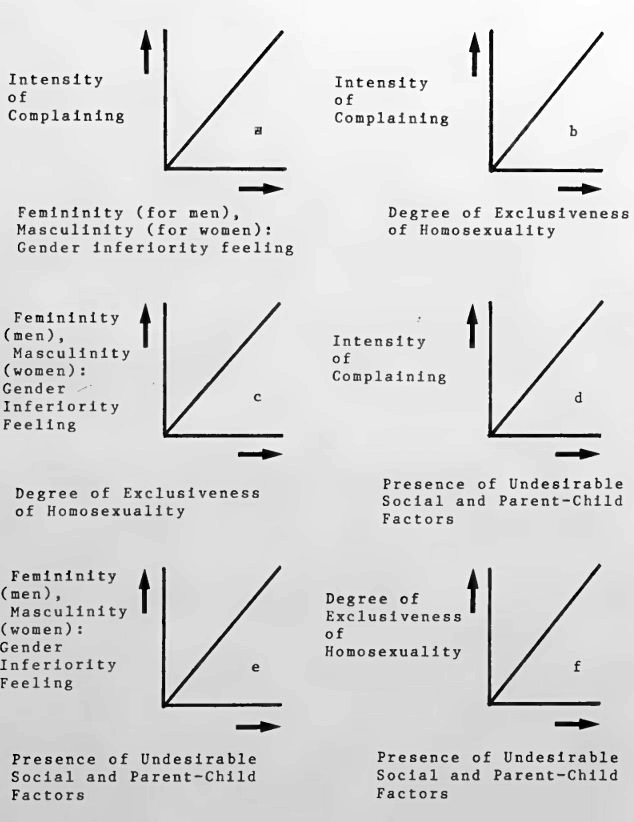
Part IV: Anticomplaining Therapy of Homosexuality
28. The possibility of a «Cure» of Homosexuality and the Nature of a Cure or Change
Is a complete cure of homosexuality possible? Generally speaking, one cannot hold that there is much optimism concerning the possibilities to radically change a homosexual orientation, at least in those cases in which homosexual interests clearly predominate. Yet the psychological literature of the last years contains scattered reports of cases which apparently have to be regarded as «cured» and this is all the more noteworthy as relatively few systematic attempts are made to deal with this disturbance therapeutically. But let us first examine briefly what would be the criteria for a «real» cure.
Of course, we should expect a «cured» homosexual to have lost his homoerotic interest in the first place. Strictly, that would imply that he would no longer be erotically aroused by same-sex persons, that he does not feel any longer a need to look at them in the street, in company, etc., and that he does not any longer experience spontaneous imaginations of erotically attractive figures of his own sex in his daydreams and nightdreams. We should add that he may be expected to be unable to imagine any longer his longings in the same way he felt them in the past, that he is even adverse to the mere thought of homosexual intercourse. All these signs together represent only one side of the coin: the disappearance of the homosexual motivation. The other is that full heterosexuality should be restored. It has rightly been remarked by Freund (1977) that the studies thus far conducted using the physiological method of phalloplethysmography to measure the direction as well as the strength of the homoand heterosexual response after so-called behavior therapy could indeed demonstrate weakened homosexual reactions, but never a striking increase in heterosexual responsiveness. Surely, the Freund test is as yet far from perfect, but even so this finding seems to indicate that the behaviortherapeutically treated cases did not reach the criterion of restored full heterosexuality. I believe this is quite understandable, because this type of treatment is not highly adequate for homosexuality. It stresses too much a mere repression of homosexual feelings without accompanying responses. The hard core of the homosexual interest — the specific infantile mentality, inferiority complaints, and so on — remains unaltered.
With «restoration of full heterosexuality» we not only mean that the desire for heterosexual contacts is about as strong as in the average person of the same age, but moreover, that heterosexual contacts are felt as more satisfactory, both psychically and physically, than the homosexual ones ever were. Homosexuality is an unripe form of sexuality so that greater satisfaction at heterosexual contacts is the logical effect of a «complete» cure. This greater satisfaction is naturally not an isolated fact, but depends on the man’s enhanced — or newly acquired — feeling of being a man in the intimate relationship with a woman, and on the exlesbian woman’s newly acquired self-confidence as to her being a woman in the intimate contact with a man. As a result, we must expand our criteria for a real cure beyond erotic feelings. The changed male homosexual must feel like any other man as to manliness and in his attitudes to the opposite sex, he is not to merely achieve orgasm with a woman, but must also feel the need to tenderly conquer the beloved woman. Sexual arousal by the opposite sex must be completed by overcoming the passive and awaiting attitude during erotic intimacy that is common in recovering homosexual men. Heterosexual intercourse must be experienced as more than a gratifying game.[67] Quite expectedly, too many homosexuals overconcentrate on the sexual side of their neurosis and tend to think that they have overcome it when having experienced true heterosexual arousal. The student or therapist of homosexuality should not commit this error; a real cure implies necessarily the restoration of normal gender self-confidence through the destruction of the complaint sickness.
We must highlight other aspects that are linked to the restoration of adult self-confidence. Outstanding in the «symptomatology» of the cured homosexual is precisely this enhanced psychological adulthood, and this may show in various ways: In a more optimistic, happy and contented mood, a more balanced judgment of persons, situations, etc.; in greater inner stability and calm, the disappearance of expressions of over-anxiety and inferiority feelings, a more positive approach of people and hence improved social contacts. Further, in enhanced feelings of «belongingness,» greater emotional independence from others, more courage in work and life, greater tolerance for frustration, more persistence. The self-pity compulsion goes down parallelwise with the person’s overall infantilism. For this reason I object to measuring the cure of homosexuality by exclusively sexual criteria. In spite of changes in the realm of sexuality there is mostly still a long way to go before the client is able to maturely love a woman, psychologically as well as physically, meaning that he is capable of maintaining a durable — marriage — relationship. From this it follows that in the majority of the cases the process towards a complete change is long and gradual, taking some years at least. The exact end-point is difficult to locate, because the neurotic emotional source may remain functioning intermittently for a long time after a satisfactory recovery has already been reached. The process is a growth, normally interrupted by relapses, episodes of prevalence of the infantile complaint compulsion with its homoerotic yearnings. It develops differently from case to case. Some, like many bisexuals, start at a more advanced point on the line of progress in comparison with most exclusives; some improve very slowly and almost imperceptibly while others proceed shockwise or stepwise, their change being clearly marked by observable changes in sectors of their emotional life. Certainly many carefully collected and checked observations on the course of the individual process of growing out of a homosexual neurosis are needed before we shall be able to assess more concretely and objectively how far an individual client has come. Even so, we can distinguish a number of growth phases which the majority of the clients seems bound to pass and which I shall sketch below.
By the way, the parameters «time» and «exercise» or «training» involved in a treatment like anticomplaining therapy suggests that the autopsychodrama is a quantifiable force, presumably by its dependence on a neurophysiological substrate in the brain.
No matter how much remains to be learned in this field, it is evident however that people can and do recover from this neurosis. Some to a highly satisfactory extent, though not completely, some completely, by all accounts.
This statement may seem hardly credible for some readers and even undesirable for a group of militant homosexuals who would appreciate it more if their condition would prove irreversible, as «just a variant of sexuality. «To other homosexuals it will sound nearly too beautiful to be true. I do not pretend, in effect, that complete cures, also of exclusives, would occur most frequently and easily. To be more specific: About half of my clients (43 percent) who entered anticomplaining therapy because of their homosexuality left or broke off treatment before having reached a reasonable measure of success. Of the remainder, about two-thirds either achieved good results or could be regarded as «radical» cures according to the standards laid down here.
The radical cures made up for 19 percent of those who did not break off treatment (after 2-8 months); however, calculated as a percentage of all the ones who started treatment, they constitute a mere 11 percent. I shall analyze these percentages in some detail, in order to sharpen our interpretation of them and to arrive at a nuanced evaluation of their significance, but at this point it will already be perceived that, although a complete cure is not beyond reach, it is only accomplished after struggle and with the help of a persistent good will. The fact that even exclusive homosexuality has proved remediable is, on the other hand, in itself reason enough to rejoice. Project this against the background of current public opinion and of the opinion of many professionals as well, that fundamental changes in one’s sexual orientation would be nearly impossible. Then one may welcome the outcome that a certain percentage of fundamental changes has been attained by the systematic application of methods based on self-pity theory at least as a hopeful beginning.[68]
Before further discussion of the results obtained by anticomplaining therapy and of the therapeutic procedures themselves, however, I think it is instructive to draw the attention to some peculiarities of cured cases reported upon in psychological literature. One will notice that most of them show a number of the signs described above as being associated with a real cure.
A not so recent report is the one by Poe (1952) relating the cure of a «40-year old passive homosexual.» This man was persistently stimulated to be more assertive in his behavior, to overcome his fears of company, to fight more for himself, etc., in short, his self-confidence was strongly reinforced whilst his inferiority feelings were undermined. From Poe’s description one perceives, moreover, that the therapist influenced considerably the client’s «positive thinking,» his self-image of being a man like the others, thus neutralizing his pessimistic, complaint-based selfview. The man acquired an apparently normal heterosexual interest and capacity, his homosexual feelings vanishing in the end. There was a follow-up period of about two years, so that the change can be regarded as reasonably stable. In the follow-up interview the client makes an interesting comparison between his former homosexual contacts and his current love affair with a woman: «The former sexual pleasure was like cheap wine, the present like champagne.» When a homosexual is really recovering he will not seldom express similar opinions. It means that the heterosexual encounter is more gratifying, richer, fuller. It means that the sexual instinct is most satisfied when it has found its inborn object, the opposite sex. The one who has discovered this — like this patient of Poe — must certainly have made a good deal of progress to total recovery.
As remarked, current behavior-therapeutic techniques do not seem very effective. The most critical study, using aversion conditioning, was undertaken by Freund (1960, 1963). He found in 16 of 31 homosexuals who had voluntarily entered treatment an increased «heterosexual adaptation» afterwards, but noted that all of them agreed that their homosexual wishes still surpassed their heterosexual in strength. These cases then demonstrate that it is often possible for a homosexual to «learn» the heterosexual performance, at any rate, to some extent, but this is evidently a superficial change, not the kind of change aimed at by a radical therapy. What has to be altered is the consciously felt wish; it is of relative value only to learn a role like an actor. The results of Feldman and MacCulloch (1971), obtained with mixed «behavioral techniques,» are perhaps slightly better, but not convincing of a radical change either. Bancroft (1969) reports the course of the sexual development of ten homosexual men during and after treatment by aversion therapy. First of all, he notices that the changes in strength and frequency of homosexual interests were by no means in accordance with the laws postulated for deconditioning, but seemed to occur nearly at random. Clients could initially improve but fell back after a while, some did not react at all and some improved consistently, though not enough to be considered as real cures. At follow-up only one case appeared to have been cured according to the criteria of vanished homosexual interests, restored interest in women and the capacity to maintain a heterosexual relationship. Curiously, however, this man had not responded to aversion therapy itself, had even grown worse immediately afterwards until he became so depressed that he had to be hospitalized. After this period of severe depression he recovered unexpectedly, but his cure was unrelated to therapeutic interventions. Evidently, he changed as the consequence of an independent psychological process going on within him and not by application of a training method directed at the establishment of aversive reactions to homosexual situations. Liss and Weiner (1973) communicate a similar case history: Some time after the failure of a treatment with aversive conditioning the exclusively homosexual interests of their client gradually dissipated and were replaced by heterosexual ones. The man started dating girls and eventually became engaged to be married. The follow-up period is not long enough (about eight months) to guarantee a complete cure, nor is the information on the exclient’s overall emotional change sufficient for an evaluation of changes in the infantile department of his personality and in the intensity of his complaint drive. Nonetheless, such reports illustrate the occurrence of «spontaneous» changes in exclusive homosexuals that are deeper than just superficial «heterosexual adaptations» learned by some behavioral «tricks.»
Liss and Weiner are probably correct in saying that such spontaneous, i.e., not therapy-induced changes «in homosexual orientation may be more frequent than is apparent.» In other words, we may assume that homosexuals can be deeply influenced in a positive way by either autonomous processes within their own mind or consciousness, or by certain experiences, nontherapeutic interventions or external situations. This reminds us of a factor which is likely to be underestimated by psychotherapists: The curative power of the psyche itself.
As I shall expound in the forthcoming chapters, intrapsychic forces can be held responsible for any cure of homosexuality, regardless of whether or not it was brought about by systematic psychotherapy. In this field it is even more true than in somatic medicine that a treatment procedure is only useful in so far as it exploits the curative powers already existing in the mind. Thus one may safely assume that the same salutary psychic factors can and will operate in tl· erapeutically — as well as nontherapeutically — achieved cures. The soidy of nontherapeutic cures is therefore not only interesting because we can learn from it that some homosexuals — and perhaps more than we might have supposed — find their way to sexual normalcy, but still more because it helps clarify the general issues as to what are the main components in the homosexual’s personality that are affected by a change, what factors provoke or further a change, along what lines or course the change proceeds. Examination of nontherapeutically cured cases makes us better discern what is going on in our therapies and what will probably be the most helpful elements in them.
Fortunately, we have a few well-documented case reports of nontherapeutic cures at our disposal. I shall comment on one of them more extensively and refer to two others as an introduction to the discussion of anticomplaining therapy.
29. Nontherapeutically Cured Cases of Homosexuality
Under the pseudonym Aaron, an American musician described his homosexual life and his change to normal sexuality, years after it could be regarded as well-rooted and stable (Aaron, 1972). The process of change took him several years. Summarizing the factors which appear to have exerted a positive influence on his recovering, the following ones must be noted: First of all, the man’s own will. Obviously, this Aaron was determined to succeed and therefore fought with the hope of a good outcome. Narrowly connected to this resolution of the will, which is stressed very much throughout the book, is a persistent trying to be «positive» in feelings, thoughts, and more especially in the anticipation of success: «I do not refer to anything simple or cut-and-dried, like some half-baked misunderstanding of positive thinking. Rather, I suggest that people have inner strength and resources they may not even be aware of, and that having discovered some of these they can build on them and create a framework of further growth and development.»
By trying hard and unabatedly to overcome his whole negative — complaining — outlook on life, to fight his dependency on smoking, drinking, his depressions and apathy, he discovered new and positive emotions. He had lived fatalistically, emotionally passive, following his impulses like a weakling. Aaron puts his sexual change in the proper framework: It was an overall change from negative to positive. To elucidate this basic point we might point to his insight in and decision to stop blaming his parents for his misery, disillusions, etc. In our words, he stopped complaining about being the poor victim of them.
By the way, he mentions the classic pattern of childhood family circumstances: A rather weak and distant father, a domineering, binding mother whose admired and special son he was, being molded by her into a nice, elegant boy; then his frustration among other boys, «I was usually on the sidelines while traditionally masculine activities were taking place.»
His change from negative to positive emotionality, from dependent to independent («Once I had articulated the determination to be ‘my own man’ … I felt as if a great weight had been lifted from my shoulders»), was very difficult to keep up. He was supported however by some idealistic (Christian) friends who talked him out of his depressions, encouraged another way of looking at things, more gratefully, stressing the sense of life against his neurotic feelings of senselessness. Translated in psychological terms, this means they worked as supportive, anticomplaining agents. This support was one of the decisive factors in his cure. It is probably an indispensable healing influence in the majority of the cases: What the will of the person can at some moments not produce by itself is completed by other, supportive people.
Then he cut off his infantile dependence on his mother, who was very much alive in his thoughts. As to the strictly sexual, he avoided homosexual contacts to which he had been compulsively attached and stopped fantasizing homosexually, a behavior he felt as disturbing his newly acquired emotional happiness. This implies that his homosexual imagery was emotionally negative in if elf— a complaint, actually. He had never been very much troubled by the drought of being a homosexual («I never held society responsible for my problems or dilemmas, for I never felt I was discriminated against»).
After some time, he met a woman for whom he had once had tender, though chiefly dormant, feelings. They had an intimate contact and in spite of his not being sexually aroused, he did not feel aversion to the female body either, as always before. They decided to cool off the relationship, however, in view of his turbulent past and in the meantime he engaged in a transitory relationship with a divorced woman. It was with her that he had his first complete sexual contact, which strongly reinforced his feeling a man. «It surpassed anything I had previously experienced: Longer, stronger, more focused, and more intense.» The details are worth mentioning because they confirm his inner change. The normal adult heterosexual contact where tenderness for the beloved person is combined with erotic stimulation is the most gratifying form of sexuality, also for the reconvalescent homosexual because he therein actualizes his masculinity to a high degree.
After the experiences with this woman, he knew he had in principle moved over from homosexuality to heterosexuality: Having lived the full heterosexual experience signifies that one cannot be any longer deeply fascinated by what is essentially an «ersatz.»[69] In this stage of his growth, the homosexual fantasies and interests gradually faded away. The change in sexual orientation having been consolidated for a couple of years, Aaron compared his former homosexuality to his present heterosexuality not only as to the difference in experienced psychophysical satisfaction, but also as to obsessiveness. The homosexual impulses were a constant preoccupation, he says, while heterosexuality made him less sex-ridden: «It no longer rules me. And that, too, is a relief.» Nearly all these observations need our attention, as they do not stand alone and can as well be heard from the mouth of clients who follow the route to heterosexuality in anti-complaining therapy. At first, homosexual feelings harass them; after some time, their compulsiveness decreases, an indication that the autonomous self-pity has weakened. A third point of hetero-homo comparison touched upon by Aaron concerns the infantilism of homosexual behavior. Talking with his wife over his former sex exploits in saunas and other meeting places, they view it as the behavior of «a bunch of overgrown Boy Scouts» and in a way laugh about it. It is a clear sign of recovery from any neurosis when someone can envisage his former emotional and behavioral life as that of a «little boy» or «childish adolescent» and can smile at the thought of it. It is the recognition of the childish ego within.
The curve of a change is one of slow but steady consolidation. The client goes through a period that he knows he would be able to relapse if the circumstances were adverse, then he reaches a stage he feels that also in bad circumstances a relapse would be highly unlikely. Aaron was in the latter stage when he wrote down his recollections.
The description of the process of change of a lesbian woman by the Dutch psychiatrist Sengers (1969) contains about the same characteristics. With a follow-up period of seven years and completely restored heterosexuality (she would have scored exclusively homosexual before her change), this woman related that she had to fight her way through a network of infantile views and behaviors before reaching adult womanhood. The main cure-eliciting factor had been her coming aware of her having remained a teenager emotionally, while her determined will and the support from an understanding priest had been necessary ingredients. (For a more elaborate analysis of this beautiful case story and of some other cases, see van den Aardweg, 1985.)
What should we think of the various case reports of religion-induced change of homosexuality in publications of the so-called exgay movement of the last 10-15 years? I have interviewed quite a few exgays myself and came to the conclusion that such changes do indeed take place. But then, every individual case must be thoroughly examined and checked against the criteria for a change as given previously. It is a fact that some of these exgays play an unconscious role of being the — important — «cured one.» Or they exaggerate what actually is but the beginning of a fundamental change, liable to regress. A sufficiently long follow-up period of the change is moreover required. According to a trustworthy member of an exgay organization, some of the cases described as cured in a publication like that of Pattison and Pattison (1980) would not deserve much credit. Yet we can err in two directions here. I know of several substantially improved and even of radically changed (former exclusive) homosexuals within the broad spectrum of exgay groups.
The change of John V., whom I have personally known for many years, is a good example of the latter category (Bos, 1969; van den Aardweg & Bonda, 1981). The curative powers operating in religionguided change, to my mind, seem to largely coincide with the psychological factors that are at work in formal therapy: A deep motivation, sincerity to oneself, de-egocentrization, changing from negative to positive emotionality, perseverance. On the other hand, a balanced religious life may be a positive prognostic sign in, for instance, anticomplaining therapy.
30. The Procedures of Anticomplaining Therapy: Self-Observation and Self-Analysis
Orientation Interviews; Explanations
The client who wants to get rid of his homosexual propensity is to learn the basic rules or laws of the complaining sickness in general, as they have been advanced in the first part of this book. The idea of the «inner complaining child» must be explained to him until he understands how this mechanism works and what its chief manifestations are. Of foremost importance to the homosexual client is, however, that he understands his homosexual feelings as flowing from a feeling of pitifulness, as essentially complaining. It is necessary to repeatedly emphasize that at the very moment of complaining the person does experience his complaint as a reality. In discussing examples of other people with various complexes, the therapist illustrates the functioning of the autonomous complaining drive. He gives examples of complaining with somatic justifications, of complaining in the form of self-criticism («Poor me, I am worthless»), and in the form of hypercriticism («He is no good,» «Everything is worthless — Poor me, who has to suffer from it all»). He must finally explain why this infantile complaining remains active as an addiction, interrupting the normal stream of consciousness and normal emotionality. As a result, there is a «search» for objects to complain about. The therapy will be a systematic attempt to stop the complaint impulses to deploy themselves, a process of starvation. Resistances will arise, as in any process of «kicking off»; it is a lot easier to give in to infantile self-pity impulses than to cut them off. Therefore, anticomplaining therapy is felt as a «hard» approach, one is to fight oneself.
During the initial interviews, the client’s psychological anamnesis is taken; his childhood and adolescent views of himself, his parents, siblings and playmates are investigated, and his homosexual history is carefully studied — What was the age of the first homosexual erotic longing? How did it develop? What are his masturbation fantasies and erotic daydreams? To what types of same-sex persons he feels attracted, of what age, and what are their physical or behavioral characteristics? What are his erotic and other feelings for the opposite sex? These interviews provide the therapist with a global idea of the client’s neurosis and nearly always give a series of clues as to his childhood grief and specific inferiority feelings. Hereafter, the explanation of the «self-pitying child» follows, in one or two lessons. Of course, the therapist must tune his language and examples to the intellectual level of the client before him and this is quite possible because the crucial ideas lend themselves well to be communicated in simple, straightforward words.
The client with a homosexual neurosis is mostly eager to talk over the sexual side of his feelings and the prospects of a change: «Can I really be cured of my homosexuality,» and «If cured, will it last?» We must place the sexual aspect, however important it may be for the client’s social life, in its proper perspective, pointing out that it is one central symptom of a general emotional infantilism and that he had better focus his attention on the negativistic complaining urge itself for the time being. He will not have to work especially on the heterosexual part, our method solely aims at the destruction of the infantile complaining and as a consequence the heterosexual instinct will be set free, growing according to its own rules. It is better that it awakes spontaneously and that will occur after the client’s having overthrown his infantile personality. Forced attempts at heterosexual behavior are discouraged, because they generally will not be genuine. As for the therapeutic process as a whole, the therapist announces that it is both a struggle and a growth process, that incidental relapses are mostly a part of it, and that the cure of neurosis is gradual, on an average taking several years.
Many clients however experience emotional improvement after some months and they will continue because they feel they are helped by the method. In the majority of cases we make weekly appointments of one hour, changing the schedule to once a fortnight when the client is on his way, and applies systematically the anticomplaining devices — in his own, personal way, in fact — in everyday life. In very serious cases it would be better to meet a client almost daily, because his disturbance has too much of a grip on him than he can fight; it is however seldom that we make as many as two appointments a week. This is because the client needs some time to think things over and to acquire experience with the application of the methods we use. We make it anyhow clear that he must do the essential work himself and that the role of the therapist is one of providing guidance, like the coach in sportstraining or like the role of any teacher. We advise, furthermore, that the client tries to suppress his desires for homosexual practices, and breaks off homosexual relationships.
Some are inclined to seek a compromise in that matter, they want to change, but to continue their exciting and momentarily rewarding sex contacts at the same time, and to them we try to explain that in doing so they are feeding their «inner child’s» wishes, and oppose the process of starvation. Sometimes such hard advice may be postponed for tactical reasons, but it is often preferable to show that being radical is the shortest route to change. On the other side, the therapist must take pains to dedramatize the complaint of many clients: «I am a homosexual, so a misfit; I have to change, I cannot live any more that way, I have to be married like others,» etc. We say that the «inner child» exploits the awareness, which is naturally sad in itself, of feeling not normally in sexual aspect and makes a drama out of it to afford himself a good measure of self-pity. Likewise, we must interpret a possible obsession with the question of whether or not the client’s homosexuality will be cured — or be cured perfectly — as an expression of complaint-mindedness. Actually, he inwardly views himself as the poor one, doomed to failure, so he simply cannot be hopeful, let alone take on the realistic attitude that any, even a minor change for the better is already a reason for joy. Needless to add that we are compelled to frequently repeat these observations, since the «complaining child» returns with the same complaint, also after the conscious ego of the client has been persuaded of the reasonableness of having some confidence: «Yes, but…» Being realistically hopeful is difficult for neurotic persons who think of their future. We do best to encourage a quiet optimism, not the childish euphoria of those who believe to have found the stone of wisdom, the unique way to salvation. (Do not many books on new methods of psychotherapy promise a drastic improvement of the world’s fate if everybody would apply them?) Realistic optimism takes into account the often difficult road to be covered, the patience to be exercised — impatience is an attribute of children! — the persistence and willpower to be raised, but it trusts the future. Often some hope or faith is stirred in the client during the initial interviews and explanations, he feels a certain trust in the situation or the therapist and maybe recognizes a number of things about himself. This hope may even flood his neurotic emotionality for a while, although such a change is bound to be temporary. Hope counteracts self-pity and is therefore an important healing agent, but only rarely can it be raised in sufficient quantity to definitively neutralize the self-pity addiction. Normally, low moods return after not too long a period. The client is warned that the welcome effect of his hope will easily be shaken, that complaintive moods are likely to reappear, and that he will have to quietly fight them for a longer time before he can attain a more durable state of carefreeness.
The first phase of anticomplaining therapy consists of a thorough self-analysis following the principles of the complaint-compulsion model. The client starts observing himself, screening his thoughts, feelings and behavior for expressions of infantile complaining or for related infantile emotions, wishes, and conducts. Self-observation is a conditio sine qua non for progress with this kind of treatment. The capacity for it varies from person to person, but almost anyone can learn enough of it to perform successfully. It is a special kind of self-observation, though; its purpose is to recognize complaining as such. This recognition is otherwise not a question of all-or-nothing. Many times the client initially recognizes something of his need for complaining, but only in the course of more time will he be able to fully «see,» visualize all of it: That and how much he complained of himself Uke a child. Paradoxically, this self-recognition is at its highest point when the complaining compulsion has about withered. Before, the client always had the idea that his complaining was justified, albeit partly. Full conscious recognition of the existence of selfpity means capitulating to a somewhat humiliating thought, swallowing one’s pride — this is the overcoming of «resistance» against recognition of infantile self-pity. Only the one who is prepared to consider himself in any light whatsoever to enhance his self-knowledge is able to recognize his inner complaining. Also, if he does not perceive it immediately, he gradually becomes alive to it when he tries it.
This self-observation procedure starts when the client notices that something is wrong or disturbing in a thought or feeling or reaction. He concentrates on it, tries to put it in words. For instance: «I generally am too violent in defending my opinion in a discussion with colleagues. Thinking about it I see that I have the feeling of not being recognized by them. I feel they do not appreciate my opinions. This drives me to behave so childishly, emotionally, and at the same time I have to complain: ‘They do not esteem my opinions, they despise me — poor me!»‘ Our objective is that the client learns to see his «child» almost visually before him, bearing the emotions and thus the way of complaining he just verbalized, and as concretely as possible, with his facial expressions, behavioral expressions. He is trained to discern his «complaining child» in his daily emotions and reactions, and the therapist coaches him in analyzing a number of instances of disturbing impulses which the client has brought to the consulting room. One might write a little book on this subject of selfanalysis and intrapsychic observation of the «self-pitying child.» Let us restrict ourselves here to the highlights.
The client usually starts with feelings of displeasure. «I feel anxious to leave my room,» «I feel inferior,» «I feel irritated,» «I feel oppressed,» «I feel worthless,» «I feel uneasy,» etc. This is a good and advisable startingpoint, as complaining is always recognizable for its inherent displeasure. That does not imply that the content of the infantile complaint would be so easy to formulate for the client in all instances. Besides, the complaints may flash through his brain with great velocity, one complaint dragging along another, so that it looks a chaotic mess at first glance. The disentanglement of knots of complaints require both time and skill, and some knowledge on one’s lead themes of complaining, because most of the time these play a central role in them. Often a client becomes only aware of the content of some complaints and can see through his «child’s» behavior at a particular moment, after some days. For instance, a man noticed that he had reacted to an invitation of a colleague in a rather disgruntled way. «I felt very much irritated,» he observed, «and my answer was obviously insulting, cool, and rejecting. This came over me, without my being able to control myself, and I felt ashamed and depressed afterwards. But I did not realize what thought crossed my mind at the time.» In such cases, the client must ask himself questions. «How did I feel about this colleague?» «What did I feel when I met him?» «What did I think he thought of me at the time?» etc. Being confronted with some of these questions, this man remembered that he felt inferiorized by the somewhat condescending manner with which his colleague had approached him. He had felt depreciated, and this had made him lose his self-composure. He felt worthless and protested with vehemence. His reaction had been an impulse of revenge, and an autonomous one, coming from his «child.» A similar sequence of emotions and thoughts and views (of his colleague, of himself) is then concretely represented as the activity of his «child,» who felt sorry for himself for being rejected and who reacted with his not uncommon feelings and actions of stubbornness and anger. The client who has seen such a concrete scene before his mind’s eyes will frequently discover similar, near-identical «scenes» that may be typical of his specific «child,» because they enact or repeat his youth drama with its associated wishes, fantasies, and reactions.
Self-analysis of the present neurotic emotions uncovers the specific «self-pitying child» in every neurotic. The other method which leads to its assessment is analysis of youth recollections (see below). Once having been acquainted with the main characteristics of his «child,» the client’s ability to see through many initially rather incomprehensible thoughts and impulses is considerably improved.
Another example: A female client said she regularly had a day when she could not start any activity, spending her time reading and neglecting her duties. How could she see this as a manifestation of her «child?» She added, upon being questioned, that she felt annoyed, listless, in a mood of «I don’t care.» It was a fit of complaining without a demonstrable cause or occasion to it; the complaints could be verbalized as: «What kind of life is this? I, lame duck, have nothing in my life to enjoy.» Actually, she had often had such spells since childhood when she had felt neglected and at a loss. Still another example: A homosexual client accused his partner, who had talked a lot with other guys in a bar, of «unfaithfulness.» Our first question must always be: «How did you feel at that moment, in that situation?» Feelings guide our self-analysis. «I was afraid he had lost interest in me,» the answer is likely to be in such a case. This may be formulated as a complaint of his «inner child»: «Poor me, he left me alone!» A like verbalization is in itself no guarantee that the client really recognized his feelings as, basically, childish whining, but it is the first step to it. Full complaintawareness increases but slowly.
Some more examples. A homosexual client commented on his habit of purposely wearing too tight trousers: «I feel there is something to it. I think I feel more attractive, elegant, and interesting when dressed that way.» He meant: Interesting to other men. This is a childish wish, consequently a wishful fantasy of his «inner boy» who appears to be preoccupied with his image with the other men: «Now, with these trousers I am beautiful, look at me, don’t you think I am great?» etc. With a smile — sometimes it may be a smile with the wrong side of the mouth — the client perceived his wishful self-image as infantile, but our analysis does not stop there. How is an infantile wish related to complaining? The answer in this case was: «I feel insecure, I have doubts about my charms»; thus the complaint behind the wish, generating it, sounds: «Poor me, I am not interesting enough.» An inferiority complaint.
«Often I watch myself talking in an overfriendly way to people, which is not genuine at all, but sheer comedy,» a client observed. Scrutinizing his feelings at such occasions, he soon concluded that this was infantile begging for sympathy, the wish to be found a nice guy, rooted in inferiority complaints («It would be so painful for me if the other one would not like me,» or something like that).
31. Observation of the «Complaining Child» (Continuation)
The «inner child» can be suspected to operate when the person experiences a strong emotion which he feels he cannot master well. He may feel too anxious, angry, irritated, overexcited, insulted, but also overelated by a success, by approval. For the larger part, however, these emotions are unpleasant. As to strong unpleasant emotions: The emotionally mature person who is, for instance, unjustly treated according to objective standards, or who has adequate reasons for a complaint about whatever misfortune or obstruction, will naturally also feel discomfort or sorrow, but nonetheless keeps a certain distance to it. The child — and the «inner child» — by contrast is totally upset, or more personally wounded, and sees his adversity as more absolute. Furthermore, emotionally adult persons can accept things which objectively give them reasons to complain, children as a rule cannot. As to strong positive emotions: Here as well, the mature person preserves some objectivity in the perception of his good fortune, success, etc. For him too, it is wonderful to meet with acceptance, recognition, friendship, but he preserves a sense of relativity and is not taken away by his joy unless by extraordinary happenings. The «inner child» is overly pleased by compliments, social recognition, and the like. His euphoric reactions are in disproportion to the pleasantness of a situation, as measured with adult standards.[70]
Infantile impulses tend to dominate the person, are overwhelming, whereas adult feelings, wishes, enthusiasm, and disappointments obey the command of the ego. This feature of course flows from the intensity of children’s emotions and of the child’s lack of capacity to relativize his own position. His own fate is all-important. The person who observes and analyzes his feelings will act wisely if he examines all impulses which contain an intrinsic «must,» which he has difficulty in channeling according to his insight and reason. «Irresistible» impulses often spring from an «inner child.»
A further sign of the functioning of the «complaining child» is a strong I-relatedness of one’s perceptions and feelings. The man in a conversation who catches himself taking the words of another person who disagrees with him as a personal affront, the one who quickly thinks the others laugh at his expense, talk about him disapprovingly, who believes the rain is precisely falling on his day off, who is too eager to express his opinion, who notices that he is almost constantly aware of the impression he makes on others, etc. — these people are probably at such moments troubled by some manifestation of their «child.» He is unable to look at things and persons in a more objective and impersonal way, and immediately relates everything to himself.
Negativism
Negativism in feelings and thoughts is the most universal sign that some complaining of an infantile nature is going on. In using this criterion, one must be very strict because it is very easy to wave away with whatever justification the idea that a certain feeling or thought would in fact be a complaint. For instance, an expression of criticism often seems appropriate at first glance, but may nevertheless contain an admixture of infantile complaining. Feelings of frustration, disappointment, etc., may look justified, but on closer inspection prove to be expressions of the need for complaining. The anticomplaining therapist and client know how difficult it can be to recognize neurotic negativism as such. Many times the observer (the therapist in our case) perceives it sooner and this is the reason I think it not very probable that a neurotic reaches a sufficient degree of complaint-awareness without the eye-opening observations of others. The neurotic is too attached to his habit of complaining and justifying his complaints to be able to discover this emotion in its many forms and disguises in his thinking and talking. ‘ .
Since we deal primarily with the homosexual neurosis, some words must be spoken on the recognition of the homoerotic wish as pathetic yearning, i.e., aspecific way of complaining. «How can a sexual feeling be a complaint?» is the recurrent question of many clients. Some see and understand it quickly, others not until after months of self-scrutinizing. It raises doubts when one does not recognize this wish as rooted in a complaint: «Will it be correct that my homosexual feelings are neurotic complaints? Aren’t they the product of an instinctual urge?» The doubts are understandable as the homosexual impulse as such is lustful at the same time by its sexual nature. We must explain that this pleasantness is superficial psychologically and that it resembles the pleasure of wishful fantasies of being rich and mighty by one who feels worthless and an underdog. The client must wonder: «Am I happy, relaxed, cheerful whenever I have this wish? How would I look, what would my facial expression be at such moments? Do I really make a happy impression on others then?» We therefore insist that he tries and observes his behavior, the tone of his voice, his way of approaching a partner, of looking at him, etc., with the question in mind: Is my attitude adult, that of a composed person? At long last it wih penetrate that he is at those moments in fact begging like a child, that he compares himself unfavorably with the other(s), in short, that he is complaining about his inferiority.[71] As Medard Boss (1952) put it, many feelings that seem purely sexual at first impression, are motivated and accompanied by nonsexual impulses that are far more important, like the wish for contact and liberation from psychological isolation. This is true for neurotic sexuality in general and certainly for homosexuality.
Analysis of their homoerotic feelings teaches many homosexual neurotics, furthermore, that these were triggered by pre-existing complaints and thus function as a sort of self-comfort in compensation for the experienced «misery.» For instance, a man realized that his homoerotic fantasies often followed after a feeling of discontentment or annoyance, another that his too intent looking at other men in the street was most of the time contingent upon a complaint of loneliness and inferiority with respect to his colleagues, a third discovered that he was troubled most by homosexual inclinations when under strain at his work (escapism), etc. At other times, however, the homoerotic wish is aroused not by displeasure but by pleasure: When the person feels comfortable, or precisely the moment he feels united with others, when he feels togetherness. Herein we recognize the destructiveness of neurotic impulses; a complaint must rise whenever the neurotically afflicted person is about to enjoy something.
Self-observation and self-analysis for the detection of infantile complaints is progressive. Every individual client discovers his own clues that signify to him: «At this moment, in this feeling or thought, your complaint drive is at work.» «Most of the time when it is active I feel as if a wet mop is put on my head,» a client observed. And another: «It feels like a quilt enveloping me,» and so on.
Self-observation helps the client conclude that his problems are not located in the outside world but in his own need to create problems. For example, he will verify that indeed, after one sort of rumination disappears, others quickly replace it. A woman complained intensely that people around her would constantly talk of her in terms of «that disgusting lesbian.» After some months of this suffering — how many times did she not ascertain that she would have preferred any other misfortune if she would have the choice to change her plight with that of other persons suffering from a different obsession? — she could verify that, if there had been any gossip at all, it had been highly innocent. Her first (adult) reaction was one of relief. This lasted, however, not longer than half an hour. Suddenly it crossed her mind that she had recently told her employer something about a former boyfriend and that this conversation had probably been overheard and so would constitute new material for gossip. Seeing this change in the object of her complaining, she could convince herself for the time being that she had a need for misery and woe within herself, while she formerly had blamed the outward circumstances for her misfortune. «I seem unable to live without something to complain about,» will be the conclusion of the self-observer and this can facilitate the detection of a great number of other and new manifestations of complaining in the future.
The recognition becomes more acute when the person notes that something unpleasant will almost predictably crop up in his mind under prosperous circumstances that might give reasons for contentment. He becomes annoyed, anxious, irritated and does not know why. Or he feels unable to enjoy a beautiful day, a day off, pleasant company. He learns to become skeptical at many negative feelings he formerly would have considered as well-founded in reality.
32. Procedures of Anticomplaining Therapy: Analysis of the Individual «Child»; the Therapist’s Observations
After some time, the client will find out that many of his complaints center around a special theme, that it is possible to describe the main traits of the personality of his «child» in relatively few terms. For instance: «The poor boy who is always a loser» (this person may indeed look and behave like a beaten-up dog, walking slightly bowed, gloomy face). Or: «The’ poor girl who cannot face life and the outer world alone, without protection» (She may suffer from abrupt panic, her face may look dramatically frightened, she clings to others to protect her, all these expressions bearing strong resemblance to a frightened child’s behavior). Or: «The poor boy who is weak and in need of care»; «The poor fatherless boy who wants protection»; «The poor ugly girl with whom nobody wants to play»; «The poor slighted girl for whom nobody has any interest», and so on. For each «complaining child» in the individual neurotic a psychological portrait can be depicted. To arrive at such a sketch, we can make use of three methods: (1) Analysis of the client’s childhood, (2) observation of his behavior, and (3) his own observation and analysis of the recurrent themes in his complaints. The result of these approaches must merge, each method supporting and enriching the outcome of the other ones. As we have already summarily dealt with the latter method, we shall now take up the former two.
After the initial interviews and explanatory sessions on self-pity theory, the client is encouraged to observe and analyze in his daily life what strikes him as unpleasant or coming from his neurotic side. His experiences and doubts are discussed in the following sessions. About this time, the therapist explores more profoundly the client’s childhood relationships with his parents, siblings, his childhood behavior and emotional life with the purpose of reconstructing the former child’s self-view. We concentrate on his grief and frustrations, paying special attention to those childhood recollections that seem to comprise the typical elements of his feelings and thoughts, as it were, in a condensed form. A female client told us that whenever her mother had charged her with some task in the household she used to execute it with meticulous precision and perfection, taking much time for details. Usually, her older sister was the one to do those jobs, and to harvest the appreciation of her mother. It was only exceptionally that she was done the honor. The woman remembered that she was tense and nervous when doing this duty, and that, in effect, she tried very hard to prove herself, to win mother’s approval («Do you see? I am capable, tool»). But also, she wanted to outperform her sister of whom she was deeply jealous. In this memory of herself as a child who meticulously laid the table, arranged the plates, cups, knives, and forks so neatly that it would make an excellent impression, who worried a long time in finding the best arrangement of the flowers in the vase, etc., her characteristic feelings of childhood frustration as well as reactions to it were all present: namely, not feeling appreciated by her mother, doubting her value, feeling inferior to her sister — and thus reactively jealous — feeling slighted; and her worrying, tense, perfectionis tic attempts at overcompensation. By the way, such «key memories» which reveal the dominant psychological traits of the former child, and thereby, of the actual «inner child,» are much akin to the childhood memories used in Alderian analysis to detect the individual’s «life style» or typical way of regarding himself and his world. Implicit in these memories we see, however, a child’s sorrow and self-pity.
A homosexual client remembered as a key memory of his childhood grief that he was considered a sissy by the boys and that they did not like to play with him. On free afternoons he watched them playing together, planning some adventure in the surroundings of his village, and when they set out for the field or the woods, he followed them at a safe distance, crying that he could not find company. Another recalled how he was sitting behind the window in his home, while the boys of the neighborhood were romping with each other. His mother had said something like «It is too cold now for you to go out,» and he felt lonely and envied his comrades. Passive envy of other men, feeling excluded and pathetically undergoing his fate was indeed characteristic of his neurotic emotional life.
It is useful to keep these especially expressive youth remembrances in mind, because they help shape the visual image of the «self-pitying child» in the individual client and vivid, concrete imaginations are needed in treatment later when we shall apply the hyperdramatization technique.
The slogan or formula indicating the main drama of the «complaining child» may often be approximated by the observations by the therapist of the client’s demeanor and verbal and emotional expressions. Many clients demonstrate their «child» in the way they look, speak, and behave. For instance, one homosexual man’s behavior fully made visible a «little boy» who desperately tried to be honest, a virtuous, nice guy, who nevertheless was teased by everybody. Another expressed in his way of looking the dependent, submissive, protection-needing «little boy»; a third, the arrogant, deeply insulted «little boy» who was nearly furious when he did not get what he wanted — one could see the tyrannizing «boy» in his eyes, so to speak. The art of observing is not only interesting in itself, but good observations may be enormously helpful in diagnosing and understanding the specific «child.» A popular song of some years ago went: «I see the child in your eyes»; this child must indeed be seen by the therapist and he uses the descriptions of what he sees to clarify the «child» to the client himself. Throughout the treatment he uses his tool of communicating his observations to the client in order to enhance his awareness of his infantile mentations, but also as a means of estimating the client’s change. Improvements are as well reflected in the eyes, which then show more tranquility and clearness, and less pitifulness and chagrin. Imitations by the therapist of characteristic «child-of-the-past» facial expressions can be valuable; the client sees before him what lives within him.
Observations by others are often rather difficult to accept, but exactly because of that can they be of importance. The neurotic (his «child-ego») may flatly refuse even to consider some of these observations, no matter how adequate they are. For instance: «You act like a spoiled little boy,» «You are lying a great deal,» «Your feelings are artificial, not genuine, you are role-playing,» «You live almost completely for yourself» (on occasion of a client’s talking in a certain way about his dealings with others), «You look like a submissive boy who exaggeratedly tries to be nice to others,» etc. Statements or descriptive observations like these can be good starting-points for the client to analyze himself, but they will be principally effective with clients who try to be sincere to themselves, whose will is intent on finding true self-knowledge.
33. The Will to Change
The faculty of the will is not overly popular in modern personality theory, although it is hardly possible to study the mental processes going on in psychotherapy without running up against its fundamental role. As I see it, it is an irreducible, autonomous and essential part of the «I» (Ego) and even its most essential and authentic part. The will has to decide for a fundamental change, in any psychotherapy whatsoever. It has to decide to open the doors of self-perception to less flattering facts, it must recognize and admit as negative what is negative and fight it. Neurotic impulses can be considered to have been programmed (in the autonomous structure we call the «complaining child»). Nevertheless, it is the person’s will which in part, and with more or less clear awareness, let the neurotic impulses develop themselves as they by their nature do. From childhood or adolescence on, the Ego or will has given in to infantile, egocentric selfpity and its correlates, just as a smoker is constantly and without clear awareness giving in to impulses to smoke. The margin of freedom with respect to infantile self-pity and all its negative concomitants may perhaps not be great, it cannot be denied that it exists, except for cases of psychosis. «Irresistible» impulses, if existing at all, are the end-products of a series of non-irresistible impulses to which the will did not oppose itself. A state of mind may ensue in which the will is undermined to the extent of seeming totally absent, but even then the neurotic usually keeps enough willpower to oppose at least a part of his neurotic impulses.
It may seem, if one reads accounts of different modern schools of psychotherapy, that positive changes came about without the intervention of a will, but I believe such a description would be inadequate for what really happened. In reality, «being motivated» is not only a necessary precondition for any positive change to occur, but it would even be tenable that positive changes are largely the work of the will, irrespective of the methods used. A will that profoundly sets itself to change will always be rewarded with some measure of success. Insights such as given here in the laws of the autonomous self-pity are instrumental, serve as a guide, a route map, but the resolute will has to do the cumbersome job of covering the road. Psychologists cherish the term «motivation» but it is perhaps too weak a word to indicate the powerful resources of the will. Most clients who visit a therapist are «motivated,» meaning that they wish a change, but it is quite a different thing to mobilize the will completely, to have decided to change.
How is it that some persons arrive at a «totally committed will» to change and relatively many others do not? I cannot give a fully satisfactory answer to this,[72] but agree with Hatterer (1970) that the will to change can be strengthened by insight in the undesirability of a condition (like homosexuality), by insight in the processes of neurosis, and, perhaps principally, by the awaking of hope and the prospect of more inner happiness, in combination with a natural aversion of all that is negativistic, egocentric, narcissistic. The latter is akin to experiences like «I feel contempt of (certain behaviors of) myself,» «I deplore my behavior,» «I fee) ashamed of it.» Of course, the person’s will must be open to similar selfperceptions as to the «undesirability» of part of his emotions and motives, so that we come back to the statement that a positive change cannot even begin without the will’s consent. Anyhow, the will of most homosexuals who have a wish (some motivation) to change is unstable, variable, oscillating, and badly in need of reinforcement. The therapist is one of those who must provide this; he must be alive to the datum that for most of these people the bond with their erotic fantasies and rewards is so compelling that they feel it as harsh to themselves to cut it off. Their situation is not very divergent from that of the alcoholic or the delinquent who, both of them, are addicted to their gratifications in their particular way. Every homosexual inclines to soothe himself with all kinds of reasonings and arguments to accept his feelings, albeit partly. In this, he subtly deceives himself and it is only sincerity to himself that can make him see through his rationalizations. Apart from the factor «commitment of the will,» then, honesty to oneself is a necessary condition to change. Pushing this reflection a little further, this implies that most homosexuals — or neurotics, for that matter — somehow perceive that there is something wrong in their impulses, or unnatural, «not good.» They may argue this perception away, for instance, clinging to the idea that it is solely an effect of stamped-in cultural prejudices, but that does not really silence it. Somewhere deep within, it is still there.
As has been said before, the efforts of the conscious will probably constitute the decisive nonspecific factor common to all forms or schools of psychotherapy. Application of special techniques can have the desired effects in so far as they are stimulated and accepted by the person’s will to profit from them. A change-oriented client will make use of any logically appealing means that presents itself. Hence, we should not attribute exclusive salutary value to whatever techniques in themselves. During the course of treatment it is therefore equally important to maintain a client’s will in a state of mobilization and to have him apply the concrete methods, in our case, of self-observation and humor techniques. After all, it has to be the will of the client which says «No» to some impulses and «Yes» to others and our methods and techniques are merely the way of saying «No» or «Yes.» Thus the process of recovery from neurosis is not purely mechanical, its course and fate are greatly dependent on how the will exerts its leadership.
After these introductory remarks we shall study the specific techniques employed in anticomplaining therapy.
34. Procedures of Anticomplaining Therapy: Techniques of Humor, Hyperdramatization
Screening oneself for expressions of self-pity and other infantilisms continues throughout the therapy process, its findings and problems are discussed in the therapeutic sessions. At this juncture, it is useful to draw the reader’s attention to the difference between a discussion between client and therapist in which the former takes an active and objective attitude to his complaints and to his observations on them, and a type of conversation in which the client passively ventilates his complaints from the period he went through before the session, explaining what sufferings he experienced, how difficult his life has been, and the like. The latter type of conversation is to be avoided, though it is often very difficult to be very strict in it. For therapeutic purposes it has little or no significance and for all the relief it may temporarily give to the complaining client, it will not help him, unless of course, he will come to recognize his communications as indulging in infantile complaining.
However, attempts on the part of the client to objectively describe his complaint-impulses in front of another person, the therapist, have some salutary effect: They make the communicator aware of his infantile mentations and his plain admittance of them in itself already implies some willful effort to distantiate himself from them. A similar effect may be obtained by writing down neurotic feelings and thoughts as they crop up in the mind, or after some internal happenings. Many times the client who re-reads his emotional effusions afterwards recognizes how infantile and complaint-ridden he was. An ordinary reaction of a client who is during some weeks actively engaged in observing his feelings and thoughts from the viewpoint of the «complaining child» is astonishment about how many complaints apparently live in him and how much his behavior and mental life is contaminated, if sometimes not fully motivated, by them.
After some weeks of self-observation, when the client has a reasonable idea of the functioning of his «inner child» as well as of its formation in youth (many actual infantile strivings will be matched with those of his childhood or adolescence), it will be time to introduce our formal techniques to counter infantile complaints that have been observed and verbalized. Mere intellectual recognition of infantile complaining, however helpful and alleviating it sometimes can be, is not sufficient to overcome the powerful self-pity drive. As Arndt has stated, positive emotions should be opposed to the negative neurotic ones.
Complaints of mild intensity may be handled by the technique of merely stopping them after conscious recognition. This is adequate for a great many instances when the person is aware of a negative, whining or sentimental, inner attitude. He does not will to give in to it, and may direct his attention to other, more positive thoughts, or he consciously restructures his complainer’s view of something into a more positive one. He can, for instance, seek the positive aspects of the situation about which he complains, place a frustrating experience in a positive context by recalling possible profit that can come from it, etc.
We must also stimulate the client to use other willful means to counter a number of negative consequences of the complaining drive, such as bringing more order and discipline in his life, refraining from too much self-indulgence in drinking, eating, getting up too late, etc. As part of anticomplaining therapy, though, it is essential that such efforts are carried and accompanied by the client’s clear insight in the infantile and self-pitying aspects of the habits of impulsive eating, drinking, etc. For example, lying too long in bed may be the consequence of the «child’s» whining: «It is so hard for me to come out,» or «What a terrible day I have to face.» One must likewise recognize that it is complaining that causes a habit of postponing certain small duties as writing a letter, cleaning something up. In sum, the person who does something he would not have done if he had let himself be dragged away by his impulses of complaining, uses a «technique» of counteracting his complaints, doing exactly the opposite. This technique is especially useful in case of complaints about the unpleasant character of some work that ought to be done. However, in our therapy those efforts must go together with awareness of the infantilism and of the complaining against which they are directed.
«To stop complaining» and «counteracting the complaining» can be effective aids. We advise frequently to use the first method during a conversation, viz., to watch one’s verbal expressions and notice the tendency to complain or to use the subject of the conversation as a justification for complaining. Counteracting the complaints is effective on other occasions, notably when complaining keeps the complainer from desirable action such as fulfilling normal duties or taking responsibility. Both methods enhance the subject’s feeling of satisfaction; yet often neither recognition of the complaints as infantile complaining nor the application of such methods can annihilate them. Specifically, obsessional complaints — recurring over and again — and neurotic feelings of great intensity may be refractory to these approaches. The client is quite convinced that he is bothered by infantile self-pity, yet does not know how to eliminate it. In many of these instances, techniques of humor can produce effects that are hardly within reach by more conventional, intellectual or mere volitional methods. I think the introduction of the systematic use of humor against infantile complaining, following Arndt, is a therapeutic innovation of the first order. Humor, principally in the form of the hyperdramatization technique has become, next to self-observation and selfanalysis, the most outstanding tool of anticomplaining therapy. Many variations are possible, others can be developed in the future; at any rate, with what we have now, we can often accomplish much more than before.[73]
Hyperdramatization
First, a client must acquire sufficient skill in isolating and verbalizing the complaint(s) inherent in his infantile impulses. When he is aware of such a complaint, he must verbalize it as simply as possible. Then he summons up in his imagination his individual «child of the past.» To this end, he can use some vivid memory of frustration, a key memory, which he had recalled during the exploration of his youth grief. He now imagines that the complaint he just put into words is an expression of that particular pathetic child. «This feeling of poor me’ stems from him (her),» he (she) must think, or «Now I felt exactly like that child.» Having realized this, he starts talking to that «child.» He talks like an adult talks to a real child who unduly complains or whines about something, consequently, this is to be a dialogue between «adult» and «poor me-child.» «The adult» begins lamenting and deploring the «child’s» fate, saying how right he is to feel so sorry for himself. Then he mentions many reasons why the «child» has indeed to complain as he does. This enumeration is a gradual buildup of all kinds of reasons from realistic to ever more unrealistic, until it reaches the grotesque and absurd, i.e., even in the eyes of the «child.» One should notice that for the complaining child an already greatly exaggerated reason for his pitifulness still appears as fully justified in reality, whereas the adult himself, or any other person, would see it as absurd and ridiculous. In other words, the «child» can by no means laugh at it, while any other person does. As a result, one has to exaggerate to a higher degree than the adult himself would think it necessary in order to reach the goal: To make the «inner child» smile or laugh. We name this method «exaggeration» — of the «child’s» self-pity. When the «child» is about to perceive the absurdity of the reasons offered to him he will react with a smile, however faint it may be. If the person talking to him pursues his enumeration of increasingly absurd reasons for his complaints maybe the reaction will be plain laughing, which is an even better result. In this method, then, the reason for the complaint is exaggerated in front of the «complaining child»; the progressive enlargement of the complaint-reasons stirs some response of humor in the client. Humor responses as laughing, smiling, and grinning destroy neurotic impulses to complain. The following are examples of this process.
A homosexual man talked about his anxieties when alone at home at night. «I know it is childish, but I believe in those horror tales of ghosts who may attack you and the like.» Some reflection made him understand that as a boy, overprotected and warned many times against all kinds of danger by his mother, he was very naive in his beliefs, promptly attaching credit to frightening stories told by other boys or read in books. The infantile complaint in this symptom was: «I shall be the victim of evil spirits!». The client had to stay a couple of nights alone in the house of a parent and this was good opportunity to talk to his «little boy.» He imagined him as standing before him in the flesh, namely, the poor weak boy of his childhood, often harassed by his age-mates and teased by his brothers because of his stuttering, who saw dangers where they did not exist. He addressed the boy this way: «Oh, poor little man, I know very well how worried you are, and for what a good reason! You certainly have heard about the gruesome things that happened to the poor girl in ‘The Exorcist.’ Well, this house, too, harbors a family of ghosts, for years ago someone was murdered here without anyone knowing it. The ghosts know very well whom they can catch and they already have prepared for tonight. A whole bunch of them will come in, but will be invisible to you. They hide behind the curtains, three of them climb the lamp above you — a nice strategic position for the attack on you — some creep under the carpet on the floor and will try to pull your legs, and then a very big one will come in, his head as big as an elephant’s head, blood dripping from it and running from his ears and mouth like a torrent. He pulls one of his cupsize eyes (bloody, with a terrible look) out of its socket, keeps it in his claws and tries to smear it in your face! A sister of his enters, a screaming witch having teeth of half a meter long, very sharp of course, still chewing the innocent flesh of her previous prey, also a poor lonely boy from another lonely house, but bloodthirsty as she is, she craves for more . . . And then, when you are near-dying from terror, your teeth chattering so that the windows tremble in the silence of the night, when you are crying in vain for your mommy who cannot hear you . . . then you look through the window and there you discover an army of skeletons slowly approaching, quietly marching, eyes deep in their sockets, etc.»
The client said he started grinning the moment he imagined the poor helpless boy in front of the bloody ghost monster and the rest of his fantasies only strengthened this effect. We must emphasize that the exaggerated dramas told to the «child» have to be exaggerations for this particular «child.» Someone who does not suffer from the symptom of this client will probably smile about the symptom in itself before any hyperdramatization took place, but to this «boy» the first part of the imagined scene still was very real, so that, would the man have stopped there, he probably might have increased instead of decreased his infantile worry. Secondly, the client who applies this method must exaggerate the tragic or pathetic nature of the situation in which the «poor child» finds himself. This may be done, e.g., by multiplying the number of evil spirits that haunted the defenseless child; or by imagining how the child cried for his mother and father, but in spite of that was killed in a superdramatic way, alone, imploring the spirits on his knees not to cut him into pieces; or, if that could not be avoided, to send at least some slices or his little trembling hand to his poor grieving mother as a last souvenir, etc. In short, the purpose is to hyper-dramatize the infantile complaint. All absurd and laugh-provoking distortions which our fantasy can think of are welcome, provided they help create an imaginary scene of such exaggerated tragedy, with the «little child» in its center, that it is reversed into a comedy. These hyperdramatizations are supertearful, superpathetic, supersentimental.
The client is instructed on how to hyperdramatize. The procedure is at first demonstrated by the therapist with some complaint brought by the client. After some trials, the latter is encouraged to use the method himself, in his normal daily circumstances after he will have observed and verbalized an infantile manifestation of complaining. The best manner to hyperdramatize is to speak aloud, as a result, the client will often have to isolate himself from a company, a situation, in order to enable himself to quietly concentrate on the nature of his complaint(s) and to invent hyperdramatizations .
Many complaints require more than one hyperdramatization before they give in, and sometimes this struggle can last for more than a quarter of an hour; in general, it is not advisable to continue the procedure beyond that limit. The ideal final moment of hyperdramatization is the laugh or smile. Sometimes it comes quickly, sometimes only with great difficulty and at other times not at all. Then the client stops his attempts, for instance, saying to the «child»: «Oh, you’re right. Continue whining if you want to. I will not resist any more!» or something like that.
Hyperdramatization can be applied with almost every neurotic complaint. Loneliness complaints, e.g., may be responded to by a kind of hyperdramatization like: «You are softly crying, big, warm tears dripping down on your hands, your sensitive, big eyes staring through the window, longing for some human attention, which never comes … In your hands the picture of your beloved friend, wet with tears. He has left you alone, although you are so ill and suffering from a high fever (etc.) Now you hear a touching song on the radio, the man singing: ‘Daddy, daddy, why don’t you come back to us? We need you so!’ and you sob even more. Before you lies a pile of sheets, soaked with your tears, and you have no more fresh sheets in the cupboard, so you have to use the curtains now, etc.» As can be deduced from this hyperdramatization, it must be a supertragic «little boy» or «girl» who is depicted in the stories.
Another example — a complaint about failing. «/ shall make a mistake (in performing something).» Hyperdramatization: «Poor boy, you shall be guilty of ruining your boss with your fatal blunders. He will have to close down his shop after your work and he and you will become beggars. They will stitch a big label on your ragged shirt, so that everybody can read: «He has ruined everything!’ Your old mother will have a heart attack, and lying on her death bed she will cry: Oh, that my dearest little boy could do that to me!'».
The stories must make use of the concrete situation in which the cornplainer finds himself. A complaint concerning an anticipated failure in making a speech to a certain group can be answered by imagining the «boy» or «girl» before the audience, and witnessing the reactions of certain persons who in reality will be present, etc. A complaint of failure that implies the fear of being criticized or ridiculed must be answered by focusing on the poor «child’s» position of being exaggeratedly criticized, haunted, thrown in a dungeon, being ridiculed in the papers and on television. In order to «hit» the infantile self-pity it is advisable that the client imagines his supersuffering «child» as vividly as possible. He therefore must often resort to the image of a child who is totally crippled, without legs, arms, with only one crying eye left; physically or mentally handicapped in an absurd way, etc. Always add a touch of absurdity, because with many «complaining children» you will have to go to some length before reaching the point that they experience the images as smile-provoking.
Still another example: A neurotic head-ache. Hyperdramatization: «What a terrible thing I see! Your delicate, although morbidly big head, so pale, the veins swollen so that your purple blood is nearly bursting from them, yes, I already hear them cracking, the first thick drops sliding over your cheek. . . . Then you faint, slowly gliding into the pool of your own blood, while your cries are so blood-curdling and wild that people run out of their houses and soon a multitude of bystanders will watch you with horror in their eyes and lament with compassion, while you are twisting on the ground, and your and their upset cries fill the air,» etc.
When the client smiles or laughs he stops his superlamentations. Often, though, he will not really succeed. He may then try a variant of hyperdramatization (see Chapter 37); if that is not effective either, he had better leave the matter alone for a while. The overall effect, a general improvement of mood, often comes gradually, after a period of regular hyperdramatizations. Also, the effect of hyperdramatizing may be delayed: A client hyperdramatizes without much noticeable result, but some hours afterwards, perhaps the following day, he feels better. On the other hand, in many instances it may already be sufficient to summon up just the image of the «poor child» with his pathetic facial expression and posture and the client has an immediate reaction of «seeing it again» and can dismiss the neurotic feeling without much effort.
35. The Rationale of Humor Therapy
«Learning to laugh at oneself is often a major achievement for the person in therapy» (Fay, 1976)
Self-knowledge is indispensable for change, but one of the sure signs that someone is being cured from neurotic emotionality is a smile about former infantile feelings and attitudes. G.W. Allport had the same thing in mind when he wrote: «The neurotic who learns to laugh at himself may be on the way to self-management, perhaps to a cure» (Allport, 1956). The expression «at himself» in this statement is tantamount to «at his neurotic feelings, etc.,» thus «at his childish ego.» A child takes his «I» highly seriously, while a psychologically mature person can see his «I» at a distance, so that he is able to see its relative importance or unimportance; in other words, he is able to treat his «I» as an object of humor. Laughing and smiling are very interesting behaviors in themselves, but smiling about oneself deserves most of our attention, because it is an act of liberation by which the person overcomes the bonds with his primitive «I-ness» or egocenteredness. Throughout this work I have described neurosis as a compulsion to complain infantilely about oneself, but with as much right one might call it «the incapacity to smile or laugh about one’s infantile self.» The more neurotic a person is, the less able is he to laugh about himself, even if he be a humorist by profession. This is to say: Really laugh, not the sarcastic laugh of the neurotic who complains about his worthlessness and who is, underneath his sour laughter, very serious about himself. This healthy smiling or laughing about oneself kills any infantile feeling of ego-importance, in particular that of being an «important poor me.» In this sense it is true that genuine «humility» is contrary to and incompatible with neurotic self-pity. The humble person can smile at himself and a technique of superlamentation — «poor, poor dear little me» — might be interpreted as a technique of humility. Stated another way, emotional maturity, the ability to smile about oneself, genuine humility and happiness are different aspects of the same basic mental attitude.
The connections betweeri complaining and laughing and between crying and laughing are wonderful, though not well understood. Physiologically, the nerve systems which conduct the impulses that provoke crying and laughing partly overlap (Stearns, 1972). Psychologically, we know that laughing and crying can be very near one another in certain mental states, although one of these reactions excluded the other. We might speculate that, physiologically, smiling and laughing suppress the centers or structures which are responsible for the complaining or crying reactions, and vice versa. Both reactions have also a compulsive element in common: They are involuntarily released by certain perceptions or thoughts. In our therapy we make use of this compulsiveness of laughing about exaggerated imaginations. Laughing is forced upon the psyche, as it were. The person may feel a resistance or aversion to laughing about himself — his «childish self» — which is logical because he is firmly attached to self-pity, but at the same time he cannot resist an impulse to smile. Humor techniques, therefore, seem to be near mechanical «tricks» to bring the infantile self-pitying attitude out of balance. Arndt once quoted the French expression «C’est le ridicule qui tue» («It is the ridiculous that kills»).
The effect of smiling, grinning, or laughing at one’s «inner poor-me child» may sometimes be drastic. All of a sudden, one’s perspectives have changed; one judges his own position, his life and future in a different light, the world has become more attractive and inviting to action, new possibilities are discovered, the dynamism in thinking, deciding, planning, and acting has returned. «I feel quite another person», a client may discover after having laughed heartily about some hyperdramatizations. This is not to say that a smile or laugh are always provoked easily. It will often cost a lot of energy to hyperdrama ize the right way so that the effect of smiling or laughing is obtained, but once obtained, it is a real antidote, working on the spot, making neurotic complaints and ruminations «evaporate.»
The use of humor in psychotherapy is not new. One can find references to it in the work of Adler (Ansbacher & Ansbacher, 1958), Frankl (see Weiskopf-Joelson, 1958), Jackson and Watzlawik (1968). A psychoanalytic therapist (Rosenheim, 1974) as well as a Gestalt therapist (Close, 1973) recognized its therapeutic value. Interesting observations on the psychological functions of humor for the maintenance of mental stability have been made by authors as Schindler (1954) and Banks (1962). The satirical booklet by Greenburg and Jacobs (1966), «How to Make Yourself Miserable,» resembles our hyperdramatization. The strategy advocated by the authors can be summarized as: «Always seek and imagine the worst possibilities and invent even more of them than come to your mind spontaneously.» As a consequence, the worry-prone person makes a supervictim of himself. Hyperdramatization, however, differs from these kind of techniques in that it primarily focuses on the «inner child’s» pitifulness. Like other devices, it contains the enlargement of certain features of the neurotic worry in relation to the «child’s» position of a «poor me.» Further, hyperdramatization is used after conscious recognition of infantile self-pity or complaining, not as a «blind» technique. The step of self-observation and self-analysis is crucial, for the neurotic must understand what is going on within him at a particular moment and why he should react with superlamentation. Finally, without recognition of the «inner child» and its complaint-drive the client would never discover a great many of the complaints and related infantilisms which are more subtle than manifest worries and anxieties. (Think, for example, of neurotic hypercriticism, of many kinds of feeling hurt and insulted, of homosexual desires, etc.). Since most neurotic expressions are seen here as springing from infantile self-pity, the reader may infer that hyperdramatization and its variants are applicable to many more symptoms than fear and anxiety, the preferred targets of a number of current therapeutic techniques.
36. Hyperdramatization: Examples
The hyperdramatization technique is preferably applied «on the spot,» at the very moment and in the very place the client recognizes some manifestation of infantile self-pity. Naturally, this is often not feasible, for instance, when one is in company. Then one may retreat from the situation, going to the lavatory, going out for a little walk, and when this is not possible either, one may just try to retreat for a little while into one’s imagination, concentrating on the complaint and imagining the «poor child» to whom one merely says one or two words of compassion. For example, «Poor boy, now you have to cry many warm tears because «Poor boy, how cruelly did they hit you on your frail head . . .», and the like, depending on the nature of the complaint. Mostly such short addresses to the «child» do not penetrate deeply enough, though they can give some relief. In general, hyperdramatization should be practiced when the client finds himself in quiet circumstances where he can concentrate. He is often plagued by a compound of various complaints that rise simultaneously and then it will take some time to disentangle them and verbalize them. Thus, he will often hyperdramatize extensively after the situation in which the complaints arose has passed by, but he may also do so before he enters a situation which he knows will surely stimulate certain infantile complaints in him.
Hyperdramatization must become a routine procedure in everyday life. Here we can see that a firm motivation is necessary, because more often than not the client must fight inner resistances against it. Over and over, he must oppose the impulse to give in to complaining, for that costs less energy than actively hyperdramatizing.
Full recognition of infantile self-pity generally comes slowly, with many ups and downs, until the image of the «inner poor child» becomes at last very real and concrete and easy to summon up. But even then the client can lose contact with his «poor child» who was so real and perceptible to him some time before. Before discussing several phenomena and problems encountered in anticomplaining therapy it may be useful to give more illustrations of hyperdramatizations. Certainly, the kind of humor which makes one person smile maybe quite different from the one that is effective in others. Besides, examples of hyperdramatization are always somewhat artificial because the reader does not know the person who harbored the «child» to whom the story was addressed, his specific ways of thinking and reacting. Hyperdramatization, like any form of joking, borrows its humorous effect in part from the concrete moment and situation to which it was a reaction. The following examples are given, therefore, for didactic reasons.
A Homosexual Longing
Hyper dramatization: «There you are, lonely soul, with your pale, sensitive face and two big tears in your big, sad eyes, your whole figure expressing a painful, deep, and unanswered longing: ‘Please love me! Please, take me in your arms, or at least stroke my poor head once, or, if that is not allowed to me either, let me touch yov just once!’ So you are looking at that beautiful fellow from a grievous distance, he is so handsome, so strong, so beaming with health, a God, etc. While your whole appearance is such a striking contrast with him: you — the destitute, unattractive, weak and rejected little creature with a heart which literally bleeds because of your not belonging to guys like him. I see the blood appearing through your shirt, so everybody can see your wounded heart. One glance only in the mirror convinces you of your complete inferiority and makes you understand why you will never be like that fellow there. Oh! How I can understand your desolate craving for just one minute of romping with a man like him! What an ocean of sorrow flows underneath that divine wish!…»
If analysis of the longing revealed an admiration for another man’s masculinity, it is this aspect that must be hyperdramatized, i.e., the «poor boy’s» pitiful lack of masculinity and his heartbreaking longing for a little warmth from one who has all the things he has not. If the emphasis is on other aspects such as seeking a protector, a fatherly man or a friend («Nobody wants to be my friend!»), the hyperdramatizer should of course react with supertragedies adapted to them. Lachrymose loneliness and seeking of comfort, however, are mostly the chief elements to be hyperdramatized, next to inferiority complaints in relation to young men or women. Some clients are much helped by a type of hyperdramatization centered on their «boy’s» being superprotected, his being sickly, or anxiously guarded by mother. Others imagine the «poor boy» as dying from loneliness and unfulfilled longing, alone in a lonely room, buried somewhere apart from the other boys in the graveyard, where he can continue his complaining about being so lonely. In some cases it is useful to exaggerate the sentimentality of the «eternal happiness» it presumedly would bring if an idealized same-sex person would respond to the «deep, pure, even holy love» of this «poor boy.» Then, for instance, «tearful violins would weep with emotion, church bells would ring, the ‘poor boy’ lying in his well-beloved’s arms, being caressed… streams of rosy tears would run over his cheek, also over his lover’s cheek, both of them being deeply moved as well as completely wet by the love they found after so much time of silent, lonely torment…» etc.
The client is advised to tell hyperdramatization stories, too, when he is seized by the wish to masturbate with homosexual fantasies. Asa variant, he can treat the «boy» on this occasion like a stem teacher talks to a rebellious boy: «No, little man, today you are not permitted to play with your little penis. I want you to behave!» and the like. When he feels aroused by a man in the street he mostly does not have the opportunity to hyperdramatize the impulse in detail, so he may use abbreviated hyperdramatizations, e.g., by immediately imagining his «poor boy» as pathetically begging for attention from the other: «Please, love me a little bit!» It is otherwise essential that the client splits the «child» from himself and «sees» the hyperdramatization scene as if it took place before him (in the street, in this example).
In case the homosexual longing is a comfort-reaction to some preceding frustration or frustrating thought which had engendered infantile self-pity, it is necessary to hyperdramatize the «triggering complaint» in the first place. Thereupon, the pathetic comfort-seeking, the erotic fantasy, will be handled.
Fear of manifesting, presenting, affirming oneself; fear of ridicule: «Poor child, when you enter the room everybody will burst into laughter. They will point at you, your ridiculous face and figure, your head, ears, arms, nose, every member of your body, piece by piece, renewing their sardonic laughter every time the attention shifts to another part of your body. One of them will pour a bucket of cold water over your head, another makes pictures of you in color while you stand sobbing, crying for sympathy. At last, they will become angry and throw all kinds of things at you: ashtrays, vases, shoes, rotten tomatoes … and you will be kicked out onto the pavement,» etc.
Complaint of not being equal to others, of being the loser: «What a pity for you that you must always be the loser. It has always been that way. When only a child, all the other kids knocked you down easily, even infants who could barely stand on their feet. When they distributed a delicious cake at a party, it was already consumed by the others before it was your turn to get your share. After shooting marbles, you always went home without possessing even a single one, while your friends’ pockets were swollen with yours. . . . When you try to say something to defend yourself, you immediately receive a blow. No one ever protects you or helps you, no day passes that you are not beaten up at least one time by someone who is stronger than you,» etc.
Complaint of being criticized: «They never pay attention to your feelings but kick you in the stomach whenever their sadistic lust awakes. They do not notice your silent look which to me is so expressive, which asks for sympathy and compassion instead of scolding and humiliation. They do not know how badly you need an appreciative word, some understanding, a warm smile. They do not know what they do to a child’s sensitive soul. Why cannot they take you, just once, in their arms and fondle you?» etc.
Aversion to work; «It is so much, so difficult»: «You are really an exploited slave, and they say that child labor is a thing of the past century! Forget it! Neither can I refrain from bitter tears when I see your concentration camp efforts. No more time to sleep for you, your eyes burn with fever, hollow eyes with dark edges, a pathetically bowed head, bowed shoulders; heavy sighs and groans escape from your mouth. . . . Oh, the moment is near that you will collapse, and then they will erect a big cross on the very spot where you finished y ,ur life, with the inscription: «Too heavy a burden it was, for his tender shoulders.»
«They have a better fortune, are luckier, possess more»: «You are right again, poor child. They have to work only for a couple of hours and receive lots of money, while you slave whole weeks for only a piece of dry bread and a cup of water. They have wonderful houses, with luxurious Persian carpets, eat from golden plates with golden spoons, have satin bed-clothes, well-kept parks and three swimming pools, but in your windows you do not even have glass, a heap of old papers are your protection from the cold. There are holes in your shoes because of your endless walking in the rain while they surpass you, comfortably resting in leather cushions, in their Rolls. They are flooded by success and easily become a President or a Minister, they give one important television interview after another, are applauded as soon as they appear in public, while you, miserable one, may watch their happy faces,» etc.
Complaint of jealousy. The reader may imagine how hyperdramatization stories can be invented as an answer to the complaint: «He (she, they) have got something which I, poor me, have not!» or «He (she) is loved, I am not; poor me!»
To the «child’s» angry complaining — grumbling, inveighing, accusing, blaming — the client can react with exaggerated indignation, showing his agreement with him like somebody might do who supports a grouser: «You are right! It is mean what they do to you, it is cruel, barbarian! Why should you take it any longer? They always spit on you, never a word of compassion, they crucify you! Come on, throw a stone through his (their)
window, take a can of gasoline, pour it on them and set fire to it, seize an enormous axe and slice them! Then they will know once and for all how they have made you suffer all the time!» etc.
37. Hyperdramatization: Variants
Although the majority of neurotic feelings can be reduced to complaints, some are not complaints in themselves and not unpleasant at all for the «inner child,» for example, infantile self-congratulations, boasting, enjoying the admiration from other people, and the like. These infantilisms are nevertheless complaint-linked (i.e., originating in complaints or connected to them); mostly they are compensations for inferiority complaints, so the client can hyperdramatize the latter, which are as it were the sources from which they arise. However, he can also ironically exaggerate the «child’s» ego-importance, e.g.: «Now everybody is deeply impressed. Surely they will erect a statue of you, build a big monument. I can already see the worshipping masses, who will buy your photograph,» etc. A man who frequently examined his appearance in the mirror with infantile self-complacency said to his «little boy»: «How admirable you look today! As soon as you appear in public, the boys will cheer you, your picture will be in the evening papers, your poster in every teenager’s room,» etc.
Because the «inner child» takes himself very seriously, a person intent on his elimination may cultivate a habit of mild, i.e., nondestructive, self-irony. He treats his infantile «I» humorously, making little jokes about himself, his position, achievements, fate, and so forth. In doing so, he implicitly jokes at his poor-me attitude. Instead of earnestly complaining about some misfortune to somebody else, he may be openly ironic, saying something like: «You see, that’s the way they always treat me»; «For some, life is not easy at all,» and the like. Many neurotics experience rather strong resistances in thus relativizing their complaints. It is a sign of improvement when a client can report on his feelings in a noncomplaining way, adding with a smile: «I am sure I am the worst neurotic in your practice.» Similarly, he may develop the habit of addressing his «child» with «quick remarks» like: «Life is a burden for you, boy»; or «That can only happen to you!» or «This really is pitiful.» These are instant reactions to relatively small frustrations which caused some slight self-pity.
«Poor you»-talking in the mirror can be remarkably effective. The client imagines that he is looking at his «inner child» in the mirror and either hyperdramatizes or simply sighs exaggeratedly or says «Poor boy,» What a lot of tears I see again,» and so on. Many clients fearfully avoid this method as too aggressive, too inconsiderate, but precisely for this directness can it hit the mark.
Imitating
Imitating in an exaggerated manner the yelping and whining of the «inner child,» his complaining demeanor, tone, facial expression and dramatic «poor me» expressions in general, can be considered a variant of hyperdramatization. This caricaturization of the complaining behavior can be applied by others as well — in our case, by the therapist — but it should be done humorously in order to minimize undesired feelings of hurt on the part of the client.
As to hyperdramatization proper, every original idea or fresh variation is welcomed because jokes are most effective when they contain an element of surprise or novelty. To stimulate variation we can advise the client to alternate the method of hyperdramatizing loudly with written hyperdramatizations, e.g., in the form of «letters of commiseration to my poor child.» Also the tape recorder has proved an efficient tool. The client can record his hyperdramatizations and listen to them afterwards, a procedure with sometimes clearly humorous possibilities. He may invent and record superlamentations about certain of his stereotyped complaints at a time that he is not acutely troubled by them, reciting them with pathos and acted commiseration, and listen to his tapes at the moment such complaints actually arise. In this manner he can bypass the difficulty of being unable to awaken his imagination for the invention of some hyperdramatization at the moment that the actual complaints overwhelm him. For instance, a client who suffered from morning-sickness — a mood of complaining about the day to come, about the worries of the work, about nothing at all — switched on his tape recorder and was greeted stereophonically by a jeremiad on these complaints from two corners of the room. Tape-recorded hyperdramatizations have the advantage that they can be examined by the therapist. Many times the latter may, upon hearing such a tape, suggest perfections or changes of the client’s technique. This method can be instructive, too, in that the therapist can more than once show the client that he did not really hyperdramatize, but stopped short of the point that the stories would become ridiculous and absurd in the eyes of a child (symptom of resistance).
Concerning variations of hyperdramatization we might further point to the method of dramatically increasing the pitiful contrast between the «poor child’s» being a worthless, underprivileged, etc. creature, and the value, successes and good fortune of «the others.» For example, hyperdramatizing a loneliness complaint, the client might address the «child» as follows: «You are so lonely; looking through the window you can see your friends who are not interested in you, happily united in a warm room, embracing each other from time to time; they wear stickers which read: We are so happy that although it may be severely cold outside we do not need a stove, for we have the warmth of our eternal friendship/ etc.»
The «Aggressive» Approach
Infantile self-pity is frequently akin to yelping, whining, puling, harping, and nagging. This is true for a real child but also for the «inner child.» That not every impulse of infantile self-pity in an adult is immediately identifiable as puling or whining flows from its being inhibited, channeled as it were, by the adult side of the personality. If it would be expressed freely it would very often indeed show as real childish whining and yelping. Such emotional behaviors of a child stir irritation in daily life; whining, crying, and puling are as any complaining — aversive to the perceiver. Therefore, too, it leads to repressive actions: «Shut up! Stop it!» and the like. However, the neurotic himself very often experiences the same annoyance when he distinctly recognizes his self-pity as childish whining or nagging. We take this natural aversion to complaining as the point of departure for the following approach: Imagine the «child» as usual, but with emphasis on his whining behaviors. The image is made more vivid by enumerating the expressions of whining. «Oh! Horrible whiner! With your mouth half-opened, yelping all the time, your eye-lids sunk over your slimy eyes! Standing there before me, bent, cringing, yellow, servile little yelper! I never saw such a weakling, without any courage!» The address can then be pursued along two lines: Bawling out and beating up the «child,» respectively; the latter guided by the idea: «I shall give you something real to complain about!» An example of bawling out: «You snot-nosed little bastard! Bah! I despise your face, I nearly vomit when I hear your voice again, that terrible whi-i-i-ne! Get your nursingbottle and put it in your mouth! Go to your nurse, fill the bath-tube with your slimy, sticky tears and be drowned, please!» In case of a homosexual longing it may go: «Creep towards that God, you baby! Press your slimy face against his, your slobbering whiner’s mouth dripping with saliva, while you squall and bleat with your thick tongue: ‘Love me! Lo-o-o-ve me!» The resembling beating-up approach may go, for instance: «Oh! Whiner, fetch a plate with glass splinters and devour it as fast as you can!
Drink a bottle of cyanide and please fall twisting on the floor, then you will have something to howl about!» Or «I want to throw you straight through the window in those thorn-bushes outside and I’ll do it, too! Here, a blow with a leaden pipe on your head, here a kick with my shoe so that you break into pieces, and not enough? Here, I pour out a can of gasoline over you and light it,» etc. One may object that this is sadism in fantasy, but that is not quite correct. The hyperdramatizer does not guzzle in the imaginary suffering of the «child» but merely tries to kick the whining out of him and as this power is compelling, the «beating scenes» must be sufficiently strong if they are to have any impact at all. These fantasies must contain absurd facets so that they cannot be taken 100 percent seriously in spite of their violence; then, they may be very helpful. Perhaps we may compare their effect with the sometimes observed salutary influence of an angry remark made by a parent to a nagging child. There are occasions that a psychological — and, not so rarely, also a physical — «sound drubbing» breaks through a child’s negativistic complaining and whining. «Bread and beatings make beautiful boys,» as the saying has it.
A client remarked that he needed an occasional verbal «sound drubbing» and felt very refreshed afterwards: «Then I see it again.» It seems to be the emotional power of the other person’s justified anger which is able to temporarily penetrate, by the fierceful impression it makes, the complaining of a child (and an «inner child»). If the reader feels a bit shocked by this way of looking at neurotic feelings, he may possibly realize that, by our overlooking the self-pity drive, we have too much stressed in our attitudes towards neurotic attitudes the element of understanding, compassion, etc., out of the conviction that only a like approach would be therapeutic.
38. Hyperdramatization: Difficulties and Resistances
Anticomplaining therapy with hyperdramatization and similar techniques does not work miracles, but it helps many neurotics — and homosexuals — to master their infantile emotionality and to live considerably happier than before. One who wants to profit from this self-therapy, however, must overcome his infantile impatience and accept that he will undoubtedly continue being bothered for a relatively long period by the very neurotic feelings and inclinations he wants to get rid of. In the majority of cases the client will be aware that some improvement, in some problem areas, is made provided he succeeds in regularly applying the techniques in response to his complaining, during at least several weeks. To persist is not as easy as it looks, however. Some apply hyperdramatization frequently for the first two or three days after a therapeutic session but abandon it afterwards, falling back on an attitude of passivity and even forgetting all about it, so that they must be put on the track again in the next interview. It generally requires some time before a client becomes self-supporting and applies the methods with sufficient self-discipline. Others sustain their efforts during one or two weeks and then lose their motivation or postpone their exercises. Nearly every client needs a regular fresh-up and the gentle coercion of regular appointments in order not to slacken in his determination to work at himself. This flows from the resistance to change built-in in neurotic complaining, for it is easier to abandon oneself to these impulses than to resist them.
Something within many clients stirs them to want to expound their neurotic feelings in detail, which is complaining about their complaints, seeking comfort. Some let themselves go in «interesting» theories on their traumatic youth, their complicated unconscious soul, and the like. The idea that he would suffer from «only infantile self-pity» often looks too simple to the mind of the neurotic, too «simplistic.» He may partly accept it while he nonetheless continues looking for new or alternative explanations and therapeutic solutions. By preference, the latter must for some clients be comfortable, meaning that they can stay passive («Can’t you hypnotize me and then .. . ?» «Isn’t there a short-cut method to overcome your ‘child?'» «Wouldn’t it help if I changed my life circumstances, my job, etc.?»).
There is a category of people whose «normal» neurotic resistances to actively fighting their self-pity are strengthened by a certain weakness of character or a lack of fighting spirit, and we are likely to find many homosexuals among them. They have not much willpower in many fields of life, as a result of upbringing factors, lack of discipline, or out of complaints such as «I shall never be any good,» «I always lose» and so forth. Whatever means that may help them to stay active in their therapeutic work must be used, such as keeping a diary with respect to observed complaints, writing down hyperdramatizations, retreating every day at a fixed hour to reflect on possible ongoing inner complaints and to hyperdramatize them, and other tricks and methods that may suggest themselves in the individual case. As we have seen, the complaint about being a weakling, of lacking strength in psychological as well as physical respect, is a frequent homosexuality-associated complaint. The weakling attitude may spread over the whole personality: Some of them have no courage, allow themselves to be easily discouraged, easily panic, avoid efforts, are overindulgent to themselves. This lack of vigor is naturally a serious obstacle because our therapy cannot succeed without persistence. To remedy this handicap we need a strong motivation on the part of the client and an active, exhorting, and stimulating attitude on the part of the therapist.
Despair is often a neurotic self-pity reaction. It is also — in some form or another — a common phenomenon in homosexuals, whether or not they try to resist their neurosis. Psychobiographical studies of the emotional life of homosexuals demonstrate the universality of the periodicity of their dramatic, depressive emotional crises. Therefore, one should not expect this despair-proneness to disappear right from the onset of treatment. On the contrary, dejectedness will emerge from time to time, leading to classic complaints as «I shall never succeed,» «I was seized by strong homosexual feelings again: You see, my case is hopeless,»[74] or «Maybe it works with other people, but I am unchangeable.» This may remind us of the necessity for both client and therapist to stick to a quiet, constructive, and determined attitude towards the therapy process. We shall advance, step by step, despite moments or episodes of despair and relapses, and we must not dramatize these adversities.
The gloomy list of difficulties and resistances contains other important items. Many, if not all, clients do not dare initially to really hyperdramatize, they just repeat their complaints to the «inner child.» Others toughly resist putting a humorous element in their hyperdramatizations and remain too intellectual — fun is not the way we should approach my holy ego! Many times a client protests that he cannot joke about childhood happenings that were really hurting and painful, but we have to make an important distinction to this effect. Undeniably, neurotic persons very often (not always, however!) did have reasons for feeling unhappy and lost and some went through a good deal of childhood suffering (rejection, terrible situations of parental discord, real physical handicaps, and the like). Indeed, many were pitiful objectively while they did not meet with real love and affection. We must fully recognize and be sympathetic to their childhood suffering, but at the same time be fully aware that this may have become now a justification for continuing the self-pity attitude. We must therefore explain several times perhaps that the present emotional problems did not originate in the traumas as such, but in the self-pitying reactions that had to follow them. Thus we strictly adhere to the rule not to blame outward circumstances, not even traumatic treatments in youth, but only something within the person himself, i.e., his addiction to once aroused self-pity. As a correlate of this, we explain that we do not hyperdramatize objective and real sufferings of the past, solely the self-pity that was contingent upon it.
Then there is the not infrequent distracting maneuver of occupying oneself with the alleged neurosis of other persons in the client’s environment or family, instead of with his own problems. This mostly covers a failure to work consistently at himself.
When the emotional condition improves, the client is often tempted to drastically diminish his efforts to fight the remainder of his complex. He tends to play down remaining complaints, believing that he has already sufficiently overcome his infantilisms, but the real motive is a resistance to completely give up his egocentered self-pity attachment. Hence it is not surprising that many treatments are broken off too soon, or that a positive change in a very visible and striking symptom (such as, sometimes, homosexual interests) is falsely considered as proof of a «cure,» whereas in reality there is at best partial improvement as to the overall infantile mentality.
Many clients complain that hyperdramatization fantasies worked initially, but have lost their effect after some time of use. Without denying the importance of innovating the repertory of hyperdramatizations from time to time with fresh material, one should not take these complaints at face value, because they frequently cover a weakened will to counteract the self-pity sickness. Some childishly blame the «ineffectiveness» of their
fantasies, whilst they actually should say: «I am giving in too much to my complaining lately,» or «I only apply the techniques occasionally, and when they do not work immediately, I give up.»
39. The Change
A homosexual client who tries to follow the anticomplaining regime typically goes through periods of alternating good and bad moods. When he informs you one week that he feels he is on the good road, that he has discovered or mastered part of his complaints, he is likely to report difficulties in the next session. Consequently, one cannot read the progress made from momentary reports. Real changes come about slowly, even more so than most clients themselves believe. Yet the majority of those who abide by our rules perceive changes for the better in some or another area of their emotional life after some weeks or a few months. For instance, they feel less depressed or already can handle certain troubling complaints or moods better by the newly gained insight. The insight in the complaining mechanism and the «inner child» may already in itself be a support, because it enables the client to locate his problems.
The first results are often superficial. Some «spectacular» complaints may weaken — anxieties, fears, low moods, irritations. The hard core of the infantile ego, however, has by then not really been affected. Gradually the impact of self-observation and regular hyperdramatizing becomes deeper and this goes along with the client’s growing recognition of more and more infantile complaints and complaint-based behaviors: «I never thought this ‘child’ dominated me to that extent.» In spite of moments and whole periods of «new feeling,» almost every client falls back occasionally on his old emotions and then has the impression that nothing has changed at all. Yet his crises are increasingly easier to overcome and finally, e.g., after several — and in more serious cases after many months, he will be aware that a basic change in his emotions is taking place so that the former unpleasant or vexed moods are experienced and passed by. Liberation comes step-wise; like the peeling of an onion the
client strips layer after layer of his «complaining child» until the chief complaints remain as the most resistant bastion. In homosexuals, this is the self-pity-based craving for attention from admired persons of the same sex and inferiority complaints about their manly (in the case of women: feminine) qualities and one must expect these specific complaints to crop up after certain intervals for a long time after everyday emotional life has become reasonably happy and mature, with the addition, however, that such temporary «intrusions» of the nuclear emotions of the complex are increasingly felt as something «ego-alien,» i.e., coming from without one’s own personality. For a relatively long time the client must remain alert, intent on immediately discovering manifestations of his former personality, for weak neurotic impulses, if not responded to adequately, tend to grow. Put otherwise, the «child» tries to reconquer what he has lost. After a longer period without perceptible neurotic moods, anyhow, without the client’s awareness of infantile complaints, the still dormant complex may reappear despite the client’s conviction that such a thing would henceforth be impossible because he feels much changed already. Unexpected re-appearance of the «complaining child» seems to occur especially in three circumstances: real frustrations and stresses of a certain magnitude; physical illness and fatigue; and a prolonged period of emotional happiness. As to the first two circumstances, one may understand that real adversity and misfortune cause some selfpity in the nonneurotic persons as well. This normal self-pity in its turn can trigger the near-overcome childish self-pity. Often then, we hear a client declare, that he at first experienced some frustrative situation rather normally, with adequate emotions of annoyance, etc., but that «on second thought,» sometimes one full day later, he began feeling really depressed and hurt (reaction of his «child»). The third circumstance, a happy period, is probably less conspicuous. That it can also trigger the vanishing complaint drive has different causes. It may be that the client’s attention grew away from observing or watching his infantilisms and complaint behavior, which gave the latter the opportunity to imperceptibly come in again through the backdoor, increasing in strength until they were again powerful enough to overwhelm the person. Relapses after a longer happiness period often come without this neglect on the part of the client, though. This spontaneous reappearance can be explained with the addiction model. The sensitized brain structure which formerly had been active for so long sends out its impulses after a period of dormancy by internal processes similar to those occurring during de-habituation of addictions like smoking and drinking. Anyway, the client passes through a phase of increasing consolidation of a happier emotionality and decreasing neurotic relapses.
Common Phenomena in the Process of Change
As we deal here with homosexual clients in particular, we may divide the phenomena of change during therapy into changes in general emotionality and changes in sexual emotions.
The client experiences his «complaining child» more and more as a real personality and not just as an artificial concept as it looks initially. Along with this, he experiences an increasing psychological distance to his «child,» meaning that his adult ego is becoming the dominating power. Not only does the infantile ego become a growing reality for the recovering neurotic (homosexual neurotic), but also the ugly emotion of complaining upon which so many of his reactions were based. He increasingly regards his complaining as something concrete and observable, and experiences it as a weak attitude, a lack of firmness, and his aversion to it increases accordingly. He uses more derogatory words for the «child’s» complaining, like «whining,» «yelping,» etc.
Hatterer (1970) described a series of emotional signs he thinks characteristic for homosexual men who approach a final stage of therapy. In my practice with anticomplaining therapy I have made very similar observations, which constitute an argument for the generality of the rules of change. I do not repeat the formulations of Hatterer here but instead will point to some observations on changing homosexuals which are more especially relevant from the view of self-pity theory. In male homosexuals, then, the typical weak-will is gradually substituted by more daring and firmness. The former weak-will manifested itself in emotional and social dependency, leaning on other persons, even in some clients in a sort of parasitism, servility, submissiveness, overfriendliness and lack of courage. Most articulate male homosexuals are not really independent or stand on their own feet. However, as they overcome their infantile selfpity, they grow more self-confident and experience an inner firmness they perhaps never knew before. They no longer behave as the eternal coward who agrees with everything and everyone but acquire normal self-defensive behavior and display normal aggressiveness when this is called for to defend or to achieve something. The move toward greater firmness gives joy. This is the natural joy of functioning as a man.[75] The logical effects of this fundamental change are an increase in self-respect and strength of character (sometimes this means: Greater moral character-strength). Formerly, the person often did not have too much reason for self-respect and as to strength of character, there is no power so devastating to it as a lack of courage. The various aspects mentioned so far are of course interdependent. In the same way, growing feelings of responsibility and actual acceptance of responsibility in life go along with this grow: ing inner independence and firmness. On the other hand, the awaking experience of being-a-man[76] leads to a charged attitude towards other n°f feeling oneself any more the poor inferior one as compared with them as well as to women. The instinctual manly role pattern of conquering, dominating,» etc., so long dormant through its repression by the «self-pitying child» at last awakes and from the source of this specific feeling «to be a man» the typically manly approach towards women arises, inclusive of the sexual element. The statement on the manly role pattern may sound heretical to those indoctrinated with the doctrine of gender equality between man and woman, yet it is an empirical fact observable in many recovering homosexual men which has its implications for the general theory of human sexual development (Appendix D.).
In lesbians, the change is in the direction of a break-through of feelings of «being feminine» and diminishing cramped efforts to be «strong,» «independent,» in short of weakening inferiority feelings as to the innate feminine role. This, in its turn, engenders a more relaxed attitude towards men and eventually results in awaking heteroerotic feelings.
We saw that the sexual change must be regarded as part of the total emotional reorientation. Homosexuals who want to be «cured» understandably not seldom have a too narrow view of what has to be changed and tend to pay almost exclusive attention to the development of their sexual interests. It is true that a real and deep sexual change irradiates in other mental fields, but the effects of a therapy or self-therapy — which our procedure is in large part — should not be primarily measured in strictly sexual terms. Changes in sexual feelings are more or less by-products and will certainly appear when the client’s «child» has been starved. Therefore it is not advisable for the client and the therapist to be sexualityoriented in their attempts and discussions, but by the same token it would not be correct for the research worker to measure effects of therapy with homosexuals and other sexual neurotics merely in terms of sexual interests. Our principal yardsticks of change are the level of complaining and of general emotional infantilism. Bearing this in mind, I shall describe some signs of progress in the strictly sexual sphere.
Initially, the client reports a decrease in the obsessiveness of his homosexual desires. They become less feverish, less frequent and are more restricted to specific circumstances and places instead of coloring the emotional life almost continuously. Some clients notice that their homosexual taste has narrowed, now being directed to a more circumscribed type of person. Others say they pass through periods during which they forget their homosexual interests almost completely. There is a decrease in the wish to masturbate as a consequence of recognition of its infantile, self-comforting character and reinforced by the perception of greater well-being when this habit has remained in abeyance for some time. Masturbation fantasies tend to change, moreover. Often, the first heterosexual imaginations emerge in the fantasy, although the person is not yet capable of sustaining his heterosexual impulses in reality. A recovering client may report that homosexual imagery spontaneously changes into heterosexual at the moment of orgasm (in most homosexuals, it is rather the other way around). By the way, we should not encourage this too self-centered masturbatory activity as an «exercise in heterosexual feeling» and emphasize that the best attitude for the client to assume is to quietly await things to develop in their own way and at their own time.
As homosexual infatuations decrease, homoerotic interests can take the form of a purely physical attraction and is increasingly experienced as a periodical compulsion for sex — though of an unnatural kind — without henceforward being mixed with romantic elements. Along with this the male homosexual frequently notices that his behavior toward a sex partner becomes more active, more dominating. The female homosexual will inform about her growing acceptance of typically feminine patterns of behavior and the accompanying wish to «be» courted and «to be» desired as a woman instead of possible former active tendencies to dominate other women she admired.
More often than not the client passes through a period of sexual indifference. Persons of the same sex no longer arouse him, neither has the interest in the opposite sex yet awaked. This in-between situation indicates the transitional stage in which he finds himself also in other areas of his emotional life. From this it appears that is only half the job to outgrow infantile inferiority complaints and that it takes more time to let the mind evolve from this situation to a new orientation. Mostly, the first heterosexual interests come rather unexpectedly, e.g., in the imagination, or upon seeing someone in the street. The first heterosexual infatuations may bear the marks of adolescence, as if the normal psychological growth process is rapidly being replicated: The client may fall in love with several persons of the opposite sex at the same time, it seems, or chooses someone who is much younger than he is himself and who, in fact, does not yet possess the full characteristics of sexual maturity. The client anyhow discovers the existence of a sex divergent from his own, a fact he scarcely noticed before. The male client eventually feels the enchantment of the female creature, her tender bodily forms and grace stir him erotically and he becomes aroused by the sight of her breasts. The improving lesbian woman discovers excitement at the idea of being «possessed» and desired by the active strength of the man, which is expressed in her arousal by the perception of a man’s typical male approach to her, as is apparent from his behavior, his genital erection. But again, a purely sexual description of the ongoing change can create a lot of misunderstanding. Hence, it is more important to describe the emotional experience of feeling a man in front of a woman — feeling a woman in front of a man — than to try to dissect the separate erotic and sexual feelings which accompany such central experiences. Before, the neurotic person felt inferior as to his sexual identity in front of a person of the opposite sex, stated in another way: felt as an inferior child. The client is not to stay of course in the stage of adolescence in which the physical side of heterosexual love prevails, but must reach a more mature form of love. Tenderness for the beloved one is an essential part of mature love and without it one would not have achieved much more than at best a partial recovery. Infantile egocentricity inherent in poor-me feelings seriously hamper the development of tenderness towards and interests in another person; the goal of homosexuality therapy must be to enable the establishment of a lasting love relationship with a partner of the opposite sex rather than restore heterosexual enjoyment alone, or even in the first place. This is why I believe the kind of approach practiced by Masters and Johnson (1979), to acquire skills in heterosexual techniques, runs the risk of stimulating puerile attitudes towards sex instead of resolving the essence of sexual neurosis.
The first heterosexual love affairs or infatuations of changing homosexuals are generally transitory experiences. Often the client has not yet progressed enough to completely «trust» such affairs and his situation is comparable to that of a young man or woman who passes through their first love affair. Various infantilisms may reappear in these first heterosexual love affairs of exhomosexuals. The man may choose a too dominating woman or a too submissive one, since he has not fully mastered his inferiority view as a man. Whether he then relies too much on her stronger personality, or he only feels at ease with a woman who in his eyes is less threatening or exigent as to his manly assertiveness. Not that these imperfections should necessarily ruin a relationship. Many marriages contain similar infantile elements without heading for disaster, but it is useful to recognize them and to warn the client not to run too fast in his first enthusiasms and to wait some time before definitively deciding on marriage. Many more things might be said about these questions, but let it suffice here with the warning that occasional relapses in infantile complaints are the rule, also when the person has developed full-fledged heterosexuality and has fallen in love with someone of the opposite sex. For example, after a disappointment in the partner relationship, after external frustrations.
How long can these infantilisms return? When is it justified to consider a case as «completely cured or changed?» To answer these questions conclusively is beyond my knowledge. To begin with the latter one: Some homosexuals who certainly must be considered profoundly changed in their whole personality nevertheless can experience occasional short bursts of former self-pity feelings, whether or not connected with homosexual longings. Others inform after several years that they have stayed completely free from homosexual longings but not of occasional inroads of other infantilisms. Among the communications of those who do not experience homosexual impulses any longer, some interesting qualitative differences exist as well. Some say they loath the idea of two persons of the same sex having sexual intercourse, others do not find the idea so repulsive. Some say they cannot imagine precisely what enjoyment homosexuality could give, others do not go so far. In my opinion, a «real» change theoretically must imply what I see as a natural aversion to homosexual imagery, but in practice it is not very feasible to objectively establish how deep the change in this sexual aspect has gone.
We must rely on practical criteria to decide the termination of regular contacts with a client. As for the sexual side of the homosexual neurosis, I regard our task fulfilled when it appears that normal heterosexual interests, wishes, and strivings exist for at least two years, and that homosexual interests and fantasies have been absent during the same period of time, except for exceptional transient thoughts or associations that did not more than superficially affect the client’s emotions and could easily be handled at the root. One might properly object that the addition to the second criterion does not guarantee a perfect or complete cure, but it will often require several years after the conclusion of formal therapeutic contacts until this situation is reached and, provided the client remains sufficiently vigilant as to the slightest reappearances of former homoerotic interests, we may be confident that the process of his psychological maturation will continue on its own and without the regular support of therapeutic conversations. The nonsexual part of the neurosis is even more difficult to assess. Again, we must rely on a thorough examination of the whole of the client’s relationships, views and behaviors in order to conclude if the change can be called «radical.»
To complete our above remarks, some other change-accompanying phenomena must be mentioned. One is an increase in work-pleasure and energy. Linked up with this is an increase in interests in general. Relationships with the parents can change profoundly. For example, feelings of revenge disappear as well as dependency feelings. In other cases, the image of an exaggeratedly admired or hated parent is reduced to more realistic proportions. The client tends to feel more like an adult person in relation to his parents, more independent. The relationship with his parents may be restructured into one of more friendship and mutual benevolence. There are instances that a benevolent attitude on the part of the client seems the best that is attainable due to personality characteristics of the parents, who may remain too dominant and meddling, hysterical, hypercritical, or unable to show real interest and affection for their child. Even so, most parent-child relationships with recovering neurotic persons tend to normalize to a degree.
The sense of «belonging to other people» is considerably enhanced. The typical neurotic feels a poor loner; to his mind, it is «they» — whom he often views as hostile — on the one side and «me» on the other. Feeling «one of the others» reflects the person’s decreasing egocenteredness, his increasing ability to like others and his increasingly feeling equal to them. The capacity to love begins to grow, whereas the former prevalent selfcenteredness is gradually discovered and weakened («Did I really love in my past? Weren’t my interests and sympathies basically all self-centered?» many changing neurotic and homosexual people will wonder at some moment). The surrounding world, people and things, is no longer blamed for all misfortune in life and the person is awaking to his own responsibility for the course of his life in many essential respects. Life is increasingly regarded in positive terms, the good and positive aspects of things and people become predominant in the emotional evaluation, in contrast to his former complaint-based inner, or openly expressed, negativism.
40. Results with Anticomplaining Therapy
In the preceding chapter I explained why a strictly sexuality-oriented evaluation of the effects of neurosis therapy with homosexuals misjudges what really happens when these clients find themselves on the way to change. It also became clear how difficult it is to accurately assess the degree of perfection of a change, in sexual and other areas, and to be sure that the final goal has been reached. In spite of these limitations I nevertheless will try to give a somewhat more concrete impression of what results have been obtained by anticomplaining therapy.
Table 40.6 does not give a flattering picture of the results. It has been composed after critical interviewing of the 101 clients or exclients about whom I could receive sufficient information. To deepen the insight in what is conveyed by these statistics I shall comment on the different categories of results one by one.
Ad «radical» change (category 1): Nineteen percent of IV = 58, or 11 persons, three of them female, can be regarded as having been drastically changed with respect to their sexual orientation for at least two years. For most of them, the follow-up period is considerably longer, for two of them up to eight years. As is clear from the description of the «radical» change category, some of these persons observed very short-lived and easily surmountable homosexual impulses even while their change could be considered as near complete. Others, however, did not remember such short experiences at all and thought that their occurrence would be highly unlikely. As a result, a relative minority of those who persisted in their self-therapy reached a point where one might speak of a real or fundamental «cure.» Admittedly, this is no reason for overenthusiasm, especially when we take into account that this group consists only of 11 percent of all those who were treated at least for several months. Surely, the skeptical homosexual who either does not want to change or cannot believe in a change may interpret these results negatively, even as a justification for a complaint: «You see, it is hardly possible to change!» In addition, he might point to the fact that also in this group slight homosexual impulses occasionally occurred. Such an attitude is not justified, though. First of all, some of the «radically changed» persons did not experience any homosexual interest whatsoever during at least two years. This fact is rather promising and underscores the position that homosexuality is not irremediable in itself. Second, also the «satisfactorily changed» persons of the second category cannot be considered unsuccessful and if one combines the percentages of the first and second categories of those who did not stop treatment after several months, there was a positive outcome in 65 percent of the cases. Third, it is likely that a certain percentage of the second category7 will eventually move toward the first as time progresses. The process of change is often slow and not very predictable. For instance, some clients remain rather stationary at some stage of change for several years and then develop further. We need more detailed studies of cases observed during many years in order to be better informed about the various factors influencing the growth process. Furthermore, the very factor of persistence or will to change tremendously affects the whole picture. Already the high percentage of those who broke off treatment prematurely (43 percent) is an indication of the weak and unstable motivation of many homosexuals. Hence, if the results obtained would seem a bit disappointing, one would not be right in explaining this by the alleged «incurability» of the homosexual condition itself, because in part the lack of persistence and determination of the will must be held responsible. At last, the skeptic may be reminded that a lot more than only sexuality may have been reoriented. Also the category-2 client whom we have called «satisfactorily changed» in his erotic interests cannot be dismissed as merely «unconvincing» on the grounds of his having occasional homosexual spells of some intensity. The majority of them have in fact undergone profound changes in their emotionality in the direction of greater maturity, contentment and enjoyment of life. Otherwise, the correlation between the change in sexual interests and changes in emotional maturity or level of infantile complaining is far from perfect; the client may eliminate one area of complaining more easily than another.
Can specific features be identified to discriminate the personality of the «radically changed» homosexual from the remainder? The answer to this question cannot be conclusive either, although some trends present themselves. The firm determination to work at oneself ranks high among them; more especially, the person who is prepared to be «tough» on himself and who wants to take pains to give up whatever attachments to habits or things he discovers to be wrong or negative is likely to make good progress. Honesty to oneself, a trait which is of course not independent from the former one, as it requires courage, also relates positively to a result of the first category. Not surprisingly, the more complaint-ridden and infantile the homosexual is (the more neurotic), the greater will be his difficulty to overcome his neurosis. Length of self-therapy also seems to vary along with the depth of the obtained change — in other words, it is improbable that someone changes radically within two years.
On the basis of my evidence I could not confirm the sometimes expressed opinion that bisexuals would have less trouble in changing. The radically changed group contains bisexuals and exclusive homosexuals in. about the proportions encountered in the total group (fifty-fifty). Nor was a clear relationship with age at onset of treatment apparent. Some completely changed individuals were young, some well in their thirties. Because of the small number of persons involved, these findings cannot be generalized, though.
Ad «satisfactory change» (category 2): This category is further divided into two subcategories: Those who already feel predominantly heterosexual but still suffer from periodic homosexual upsurges and those whose interests have disappeared at least for one year but who still do not feel very much interested in the opposite sex. The term «satisfactory» has been chosen because the balance seems to have tipped away from the homosexual side. According to my experience, this stage may in many homosexuals last for a long time, even for many years, so that it would look as if it is the farthest point they can reach. It is a situation of a certain equilibrium: The adult personality is generally in control of the mind, though not without an occasional neurotic infiltration. Married homosexuals, for instance, can live with this internal condition without too many problems — in case they belong to the first subcategory, to be sure. It may take considerable self-therapy to get at this inner state. The inherent danger here is that the client loses his alertness and weakens his anti-self-pity efforts. He remains vulnerable; if he ignores the periodic upsurges of the «child» it may lead to its gradual revitalization and after more time possibly to a serious relapse. The «satisfactorily changed» homosexual, then, cannot be considered as having definitively passed the danger zone, although he himself will often subjectively think so. By contrast, relapses from stage «1,» radical change, are most unlikely.
The change which has taken place in «satisfactorily changed» homosexuals slowly expands in the course of the years. Some ultimately break through toward stage «1,» but my follow-up evidence does not comprise a sufficient number of years to conclude whether or not this is exceptional. One exclient, for example, visited me after a year or two, declaring that as far as he was concerned, the end-stage had been reached and this was a form of bisexuality, the heterosexual component however clearly predominating. In support of himself he cited a psychoanalytic author whose view it was that bisexuality was the fullest unfolding of the sexual instinct. I disagreed and explained that on closer inspection every feeling of homoeroticism, however slight, is neurotic, self-pity-motivated. Still some years later the man contacted me and communicated that his opinion had changed by now, for he indeed had gradually recognized every homosexual interest as infantile, etc., without having to fight very much for it. It had developed almost automatically that way. In the meantime, I have heard several comparable experiences, so that I believe this is not so rare as it seemed to me years ago. I have the impression that many homosexuals have to go through a good many life-experiences to mature, as it were, which they have to integrate into their newly gained adult feelings and views before their mind can finally take leave of its infantile attachments.
My distinction between «stage 2» and «stage 1» is a bit artificial, but it makes sense to intellectually structure what is going on.[77] A stage-2 change may not be a perfect result but it is still much worth the trouble. The stage-2 client typically feels happy and reasonably stable for most of the time, inwardly complains a good deal less than before, is considerably less self-centered in his feelings and less childish. On the other hand, he is firmer and quieter. Though he still runs the risk of a relapse into the old infantilisms, he has good reasons for an optimistic outlook on his future, because he usually does not want to give up this better state of emotionality and may therefore be expected to renew his efforts in case of an emotional set-back in order to regain what he temporarily lost.
To the often heard objection that these partially or radically changed homosexuals «only have repressed» their homosexuality, I would reply that this depends on what we understand by «repression.» Indeed one might consider the process of extinction or starvation of infantile urges as a kind of repression or suppression but with the addition that the repressed or starved tendencies gradually lose strength. I can see no logical objection to thus consciously «repressing» any infantilism or addiction (compare the situation with the unlearning of smoking). On the other side, let us not lose sight of the fact that it actually is the neurotic condition that continuously represses normal emotions and reactions, blocking the psychic growth at the same time! The slogan or moralistic proclamation «You shall not repress» is widely misused as a justification for indulgence in many kinds of character-weaknesses and for the avoidance of the struggle with oneself. Such a superficial application of the notion of repression is to be rejected.
About the «improved» (category 3) clients there is not very much to report. Our greatest concern goes to the clients of category 4, «unimproved,» who, in spite of years of treatment, do not appear to have been noticeably changed in their homosexual orientation. To this group some clients belong who after a long time and many attempts at self-therapy did not improve in sexual respect beyond some temporary decreases in homosexual interests. Two factors seem primarily causative in this lack of progress: the exceptionally high level of complaining or strength of neurosis, and in other cases, a weakness of the will or a lack of fighting spirit which makes them irregularly apply the self-treatment methods of self-observation and self-humorization. Consciously they may be of strong will — but how far is this will utilized, or how strong can it be in the first place? As for the strength of neurosis factor, some of these people may be diagnosed borderline psychotics. In this book I did not pay attention to homosexual psychotics, but statistics argue for a subgroup of these neurotics. These are the excessively withdrawn or contact-disturbed persons, who are so firmly in the grip of their near-autistic mentations that it is highly difficult to bring them to some normal self-knowledge. Some highly resistent homosexuals, to continue this rubric, have impaired willpower by their addiction to alcohol. And yet even these really sick persons may and often do profit somehow from more or regular contacts with a therapist. Notwithstanding the datum that they do not succeed in getting rid of their homosexual interests and, what is more important in their cases, of their general emotional disturbance, they may at least be kept from abandoning themselves to a completely chaotic homosexual life, which they often do not wish as much as they are pushed to it. The therapist, by giving them realistic insights in small doses, can help strengthen the adult and normal parts in their emotionality; moreover, in the long run these patients seem nearly always to be able to improve to some extent, in some respects. They become a bit more optimistic and may grow slowly to greater acceptance of their life as it is, with all its objective dissatisfactions and real shortcomings. This group needs regular guidance, encouragement, and support given from a realistic and balanced view on the homosexual neurosis. Of course, this group is a reminder to modem psychotherapy to improve its insights and methods.
In summary, it is not true that a homosexual neurosis is irremediable, but on the other hand it would be thoughtless to state that a complete cure would be within reach after a few years of (self-) treatment for the majority of people who suffer from this problem. What the great majority can achieve, however, is a very substantial improvement in their emotional stability, inclusive of its sexual aspects, while a minority even comes to a full cure. This fact contradicts the pessimistic and fatalistic ideas often divulged relative to the changeability of homosexuality.
Looked at from another angle, it is questionable if the effects of a therapy like anticomplaining therapy with homosexuals are worse than those obtained with other neuroses such as phobias, obsessive-compulsive neuroses and the like. In these cases as well, psychotherapy «radically» changes only a minority and brings about «satisfactory» changes in the majority, but no one would argue that because of the less than perfect chance of a complete recovery in these cases a (self-) therapy would be meaningless. Neither would it be acceptable to stop treatment of many physical diseases — think of rheumatoid arthritis or cancer — because a perfect cure is not possible unless in a restricted group of patients. The situation of the homosexual, as a matter of fact, does not leave him much choice: He may either abandon himself to a life determined by infantile and disturbing urges or try to oppose them in one way or another. Who chooses the second option and makes a full decision to resist what is infantile, neurotic, or wrong, will welcome every bit of improvement no matter how modest it may seem in comparison with a truly complete change.
Table 40.6. Changes in Sexual Interests in 101 Homosexuals after Anti-Complaining Therapy*
|
Categories of Result |
Percent of Total Group (N=101) |
Percent of Those Who Continued Treatment (N = 58) |
|
Stopped treatment after 2-8 months |
43 |
|
|
1. Radical change |
11 |
19 |
|
2. Satisfactory Changeb |
26 |
46 |
|
3. Improvedb |
11 |
19 |
|
4. No change |
9 |
16 |
Description of categories
1. Radical change. No homosexual interests except for occasional and weak homosexual «flashes» at most; normal heterosexual interests. Follow-up: minimally two years.
2. Satisfactory change, (a) Heterosexual interests prevail, but still periodic homosexual upsurges in fantasy which, although temporary, may nevertheless be fierce (b) No more homosexual interests but still weak or rudimentary heterosexuality. Follow-up for both (a) and (b): Minimally one year
3. Improved. Considerably fewer homosexual interests, with or without accompanying increase in heterosexual interests
4. No change. At best temporary decrease of homosexual interests, but not lasting. After at least three years of treatment
aOf my total group of homosexual clients of about 230 persons (male and female) only those are included in the table who entered treatment between 1968 and 1975 and about whom I could obtain sufficient information.
bAfter at least two years of treatment; some continued therapy afterwards.
Table D.7. Number of Sexual Partners of Male and Female Homosexuals During the Last Two Years (from Sbardelini and Sbardelini, 1977)
|
Number of Partners |
Male Homosexuals |
Female Homosexuals |
|
0 |
0 |
0 |
|
|
4 |
6 |
|
2,3,4 |
8 |
16 |
|
5,6,7 |
1 |
4 |
|
8,9,10 |
13 |
6 |
|
11 and more . |
11 |
3 |
|
|
N=37 . |
N= 35 |
Combination of the first and last categories yields the following picture:
|
Number of Partners |
Male Homosexuals |
Female Homosexuals |
|
1-4 |
12 |
22 |
|
8 and more |
24 |
9 |
chi2 = 7.993
p< .01
Appendix D. Notes on the Psychophysiology of Human Sexual Development
From our observations in cases of radically changed homosexual men and women who formerly were either exclusively or predominantly homosexual in their orientation some tenative conclusions can be deduced concerning the psychophysiological mechanisms controlling man’s sexual development. We have said that the awaking of heterosexual interests goes along with the awaking of sex-linked behavioral patterns: The man discovers a tendency to actively approach and court the woman and she discovers enjoyment in «submitting» herself, in being desired. These sex-linked patterns of sexual behavior are certainly not merely isolated behavioral reflexes to specific stimulus situations but part of a larger structure of instinctual patterns. For instance, the active or «dominating» approach to things we customarily call «manly,» refers to many more situations than the sexual one, and though it would not be tenable to state that a woman could not display great courage and activity, the role of leading and mastering the world is nevertheless not as congenial to her as to the man. In contrast with the masculine, the innate feminine approach to the world is more in the direction of caring for, devoting herself to, thus more person-directed. The sexual approach, therefore, is hierarchically imbedded in the sex-linked approach of numerous life situations. In the typical manly or womanly sexual behavior, however, the sex-linked specific approach to the world finds one of its most articulate expressions.
Naturally, the above description is not in favor of purely «culturalist» theories which deny any innate basis for sexual role patterns. These theories seem the products of an exaggerated reaction to too rigid, oldfashioned stereotypes of what would be «typical» of masculinity and femininity. By contrast, they proclaimed the absence of natural, i.e., inborn, psychological sex differences. The empirical evidence for the culturalist conviction has always been frail, however. One of the often heard arguments goes that it would be old-fashioned to depict the woman as inherently feminine and the mind of the man as inherently masculine. This argument has no logical value whatsoever. The question is not if some concept is old-fashioned or superprogressive, but if it corresponds to reality. It is merely a sign of overestimation of our own intelligence and sophistication when we believe that the fact that we have better ideas than countless generations before us is in itself an argument for our theories. In fact, we cannot do without the assumption of an inherited basis for both the preference for a heterosexual object and male or female behavioral and emotional patterns. For one thing, we encounter these tendencies in all nonneurotic, happy, and emotionally mature people. Apparently, man’s sexual instinct can be prevented from finding its normal goal during the first phases of its development but this causes it to remain underdeveloped, incomplete. Similarly, nonsexual behaviors related to adult manhood and womanhood may remain at level of immaturity due to inferiority complexes which tend to fixate emotions and ways of behaving at childhood age
Even in a sexual neurosis like homosexuality, though, normal sexlinked behavioral and emotional tendencies are not repressed to the full. For instance, Gundlach and Riess (1968) observed that lesbians tend to be more faithful to their partners than male homosexuals, having relationships of a longer standing and becoming more depressed after separation from their partner. In other words, as compared with male homosexuals, they cling more to their friends and thus demonstrate their greater person-directedness, just like girls and women in general. If such a personality trait were a product of modeling the girl in conformity with cultural ideals of femininity, how to explain that many lesbians did not reverse this feminine devotion to one person like they have reversed other attitudes and habits which are traditionally considered marks of femininity, such as wearing dresses or refraining from certain activities — playing rough games, assuming «masculine» behavior patterns? On the other hand, would it not have been likely that male homosexuals would have reversed the supposedly «culturally determined» role pattern of the more exploring, «aggressive,» and «hunting» approach of men in things sexual, as many of them did reverse the traditional masculine patterns of interest and activities? This is, however, not what happpns. Thus it appears that homosexuals, male and female, display some of the characteristics linked with the normal sexual behavior pattern in men and women: Lesbians tend to be more person-directed and male homosexuals are more the hunters. Table D.l, taking data from Sbardelini and Sbardelini (1977), is an illustration.
One can point to still other phenomena that plead for the existence of innate sex-linked behavioral tendencies. Consider the recent anthropological analysis of Goldberg (1977) of patriarchy and matriarchy in different cultures, and his rejection of the myth of former matriarchal societies. Eysenck (1978) rightly commented on Goldberg’s logical expositions: «He surveys the anthropological and historical evidence on the existence of patriarchy, i.e., the predominance of men in the top hierarchical positions of the society examined, in all those societies which have been adequately studied. He concludes, and there is no doubt that he is right in doing so, that all societies that have ever existed or now exist have been under male domination; the alleged exceptions are shown to be myths, or else the anthropological record does not bear out the claims to matriarchy made for them. He concludes, and his argument is a strong one, that male dominance is a universal fact, and that its emergence in hundreds of separate and independent societies is unthinkable unless there is a powerful biological cause for its universality. «78
This does not mean that women would be incapable of leadership, nor does it deny the fact that certain women are more capable of leadership that certain men, but it does suggest that the leading role is not the natural preference and the natural talent in women. Psychological observation and analysis of articulately «domineering» or «leadership-prone» women sharpens this point: Not so seldom do these women appear to suffer from neurotic inhibitions which impair their capacity to abandon themselves to their underlying feminine tendencies, or do they give the impression of forcedly trying to prove themselves, or to imitate the manly role at the expense of their femininity. Similarly the man who lacks «dominating» power frequently suffers from an inferiority complex. As a correlate of this, the recovering neurotic — for instance, the homosexual neurotic — may experience, along with increasing feelings of self-confidence, a new and adult sense of manliness (womanliness) and discovers that many of the traditional male and female behavioral tendencies are quite congenial and natural to him. Their emergence within him (her) in fact produces a feeling of liberation.
Recent research has emphasized the importance of biologically rooted behavioral sex differences. The dimension of «assertiveness» or «aggressiveness» is associated with the male sex, in humans and in higher apes (E.g., young male Rhesus monkeys play more roughly than young females, irrespective of «socializing» influences after birth. For a broad study on the biologically based behavior divergencies between the sexes, see May, 1980). The dimension of «emotional expressivity» and «caring for» or «person-directedness» is associated with the female sex. These differences may be accounted for, perhaps, by differences between the sexes in brain-hemispherical attributes (Blakeslee, 1980); other indications of differences in brain anatomy come from animal research (Goy & McEwen, 1980).
If there is enough evidence to accept the existence of certain innate behavioral differences between men and women, even more probable is the idea that the approach of the partner in heterosexual contact is heavily determined by the genetic factor. In the man who is sexually aroused by a woman, a behavior pattern of dominance is elicited: He wants to tenderly «conquer» the female body, which eventually leads to the woman’s being subdued in the act of intromission of the penis. On her part, the woman wants to be desired and subdued by the tender strength of a man. In this way the innate sexual reflexes of men and women alike are most completely unfolded. On the psychological level, the sexual emotion and the feelings ot pleasure inherent in it become most fully deployed simultaneously, making this experience fuller and richer than any other sexual or erotic experience. In order for a sexual experience to be complete it does not suffice that mere orgasm has been reached; man and woman must deploy their sex-linked innate roles in relation to the beloved sexual object. The sexual tension is always reduced by the orgastic reflex, but if the above condition is not met the experience is bound to be rather empty and shallow. In effect, the sexual drive causes the uninhibited person to automatically seek those stimuli that enable the most complete experience.So some day in early adolescence the boy discovers that his sexual reflexes — including his «conquering» or «dominant» behavior towards the partner — are activated by the female body more than by anything else.
From then onward he starts exploring the possibilities of erotic contact with a girl even more, in any case, in his imagination, leaving behind him as childish» and uninteresting his possible former sexual experiences, games, explorations, or practices. Given a certain sexual drive level, caused by the sexual hormones, the sexual hunger thus spontaneously seeks the natural object of its satisfaction as well as the natural behavior leading to it.
The normal development of the sexual instinct follows this route. The sexual neurotic (e.g., the homosexual) has failed to take these steps. Not being able to abandon himself to the reflexes of manly (or womanly) sexual behavior because of his obsession by inferiority complaints as to his maleness and the puerile craving for contact with a man (for a woman, in case of lesbianism), the manly (womanly) behavior tendencies remain dormant, suppressed. His inborn disposition to full sexual behavior is as much blocked as the aggressive or hunting instinct of an overdomesticated lion who, set free after many years, seems to have lost his innate capacities to defend himself and to attack a prey.
On the basis of these considerations we can form a rough idea about some basic mechanisms involved in human sexuality. We must assume, then, the existence of inborn connections between certain perceptual centers which are aroused by a circumscribed category of (primarily visual and tactile) stimuli on the one hand, and emotional and behavioral sex centers on the other. Activation of these specific inborn perceptual centers deblocks the sexual emotions, reactions and actions. This is a scheme similar to the one developed by Lorenz and Tinbergen, the so-called Innate Releasing Mechanism for the explanation of instinctual functioning in general; it proves quite appropriate for the clarification of human sexuality (see Ruwet, 1972). As is true for other instincts, the sexual emotional centers — we may also speak of drive centers — can function autonomously, i.e., independently from external perceptual stimulation, under the impact of hormonal activation. Under the influence of hormonal stimulation the sexual drive centers activate the efferent, motor and behavioral reflexes, but also facilitate their connection to specific sensory centers, which leads to heightened attention for the kind of perceptual stimuli that «fit» into these centers and make them work. In other words, the sexual drive normally stirs the activity of seeking the best-fitting perceptual stimuli that can «switch on» the perceptual centers and the latter have an innate capacity to maximally deblock the motor sexual reflexes.
Once having discovered these optimal stimuli — the boy having discovered the sexual stimuli coming from the girl and vice versa — the individual is not likely to ever resort to other types of stimuli, unless in the absence of the optimal stimuli. As a matter of fact, only the inborn categories of stimuli, which are of a heterosexual nature, can fully release the whole scale of sexual behaviors, thus affording maximal sexual satisfaction. For this reason, any sexual situation except the heterosexual body contact is experienced as inferior (masturbation with only imaginary partners, pseudohomosexuality as in prisons where the most feminine-looking man is used as a woman substitute,[78] and so on). It appears, in consequence of this analysis, that man’s erotic drive is essentially heterosexual and not bisexual.
The above scheme presumes the existence of inherited sex-linked sensory brain units containing the «images» of the sexual behavior-deblocking perceptions. In the man these centers must contain, in one way or another, the «image» of the female body as a whole as well as of its specific parts, such as breasts, buttocks, etc. In addition, general physiognomic qualities such as roundness and softness must have been engraved by nature in some part of the visual and tactile sensory brain in linkage with the sexual emotion centers. And further, the brain must innately contain the «forms» or «molds» with which certain specific perceptions of movements and body postures of members of the opposite sex, and certain (auditory) perceptions of their voice to which they correspond. In short, a whole series of perceptual categories, some of which of a very circumscribed nature like the form of the female breasts, must have an innate neurophysiological substrate which has direct connections with the emotional and behavioral sexual centers. Possibly there exist, to speak the language of the Gestaltpsychologists (see more especially Metzger, 1975, Chapter 8), «constellations of arousal» («Erregungskonstellationen») in the perceptual brain for the general perceptual qualities («Gestaltqualitäten») we designate «feminine» and «masculine,» respectively. In the man then, the structure containing the «gestaltquality» of «femaleness» has an innate connection with the structures underlying sexual emotions and behaviors. In the woman something similar is true for the «gestaltquality» of «maleness.» In the same way we must assume the existence of sex-linked behavioral centers: The sexual behavior of men is more active and conquering than that of the women.
We will not go into the question of how these sex-linked perceptual brain structures and their connections with the sexual emotional and behavioral centers in man develop, during a critical phase in early infancy or in the embryonic stage, under the influence of sex-specific hormones, as has been demonstrated with rats (Harris, 1964; cf. Money & Ehrhardt, 1972). However it seems that the sex differentiation of these brain substrates is far from superficially engraved because in no race or people are there more than small minorities whose sexual emotions are not primarily and chiefly provoked by stimuli from the opposite sex.
Sexual emotions and reactions may be elicited by a variety of stimuli, but not all of them have the same potential of arousal. The sight of the nude female body, especially of female breasts, elicits the sexual emotions and actions in the man to a higher degree than the woman’s eyes or face, although perceptions of these features may also contribute to the sexual response. As has been expounded by ethologists, one may distinguish a hierarchy in the stimuli that provoke inborn reactions. Second, each perceptual configuration or isolated stimulus is composed of characteristic part-stimuli or features that contribute to the reaction. These features may be present to different degrees of markedness, therefore, there are more or less «ideal» stimuli as measured from the magnitude of the response(s) they elicit. For example, nude female breasts provoke sexual reactions in the man, but despite the influence of learning factors it is evident that not all female breasts have the same stimulus value because of differences in features as contour, largeness, etc. It seems possible to delimit in a more precise way the qualities of the optimal stimulus configurations leading to maximal sexual responses in about the same way ethologists experimented with models for testing the innate reactions of birds to birds of prey.[79] Third, the full release of sexual emotions and behaviors is seldom the consequence of the impact of only one type of stimulus. Adult heterosexual contact implies the operation of a wide variety of different stimuli which work cumulatively in provoking the sexual response. Here, too, we can point to the experimentation of ethologists on the additive releasing effect of separate stimuli (Ruwet, 1972).
The concept of stimulus gradient may explain why it is biologically possible for an adolescent or preadolescent to become sexually aroused by members of their own sex. Innately, the perception of the nude body of a person of the opposite sex releases the sexual responses most fully. However, it takes some time for the young individual to discover the «best fitting» or maximally response-eliciting perceptual situation. This is the developmental stage of perceptual experimentation, ending up with the inevitable discovery of the optimum possibilities of the opposite sex. In this stage the young person stepwise discovers the innately optimally stimulating object, so that it is possible that his attention is temporarily drawn by objects which possess characteristics similar to or resembling those of the heterosexual body; for instance, his own body, or the bodies of children, or of same-sex persons. The awaking sexual interest thus may be somewhat aroused by the common features of all human nudes, so that some kind of autoeroticism, homoeroticism, or pedophilic eroticism may ensue, especially in the absence of stimulation by the adequate heterosexual object. Normally, these nonheterosexual interests completely discontinue after the «Aha-experience» («Aha Eriebnis») caused by the heterosexual stimulus object. The question is, however, why some adolescents do not leavp the preheterosexual developmental stage and remain fixated to these immature sexual interests.
The answer does not lie in the field of biological or physiological sexual mechanisms proper. As it is, the adolescent or preadolescent may become infatuated psychically, in a «hysterical» way with persons of the same sex because of his feeling inferior in comparison with them. However, the perceptual stimulation coming from them is not the chief drive in their striving for sexual intimacy with them, but the psychological motivation underlying it. As is well known, infatuation — in this case, adoration, etc. — can tremendously heighten the erotic stimulus value of the desired object and these preheterosexual infatuations can be most intense. On the other side, a very intense infatuation with respect to someone of the same sex should generally be considered a sign of emotional imbalance on the psychological level. A normally happy and self-trusting adolescent will not be the prey of such emotional upheavals and therefore, if he feels homoerotic or other pr^heterosexual interests, these will not grow intense. As has been made clear throughout this book, homosexuality is not primarily a sexual phenomenon. The fixation to the compelling neurotic emotionality — complaining and other manifestations connected with infantile self-pity — has cut off the natural development towards heterosexuality.
For understandable reasons one may sometimes discern rudimentary, or better said, beginning, heterosexual elements in homosexuality and other deviant sexual behaviors. For instance, some homosexuals and pedophiliacs are sensitive to certain feminine characteristics in their homosexual partner. Deviant sexual behavior in general can bear similarity to normal male-female relationships (cf. homosexual anal intercourse). Perhaps it is true that the more feminine qualities a homosexual desires in his partner, the less serious his inferiority feelings as to his maleness are (and for lesbians, vice versa). This however awaits further exploration. What is meant with these last observations is that even in sexual deviations something of the attractions of the natural sex object may transpire.[80]
Part V: Prevention of Homosexuality
41. How To Avoid Homosexual Development in a Young Child
Those who see homosexuality as a «normal variant of sexuality» will not be very much interested in thinking about its prevention. The great majority of parents, however, would not like it if their children would become homosexuals and for them, as for all other educators who want to contribute to the formation of happy and stable people, this subject has great relevance. From our study of homosexuality as a «disease» of selfpity and the factors favoring its coming into being we are able to deduce some directives that can help orient the practice of child-rearing.
The fundamental condition for the prevention of any neurosis, inclusive of the sexual one, is the parents’ serious and real interest in their children, their appreciation of them, and respect for their individual personalities, interests, and needs. This means that they create a family whose members can have a sense of belonging to each other and can feel contented. Homosexuality is mostly the consequence of unpurposively committed but still grave pedagogical errors that led to serious disturbances in the family relationships, more especially in parent-child relationships. Its prevention, therefore, must begin with the education of the parents themselves, or with the parents’ self-education. One may rightly object that exactly here lies the greatest difficulty, because how would such a thing be possible, the more because many parents of homosexual have neurotic personality problems themselves? Still fatalism is not the correct attitude. For instance, why would it not be feasible to discuss these things as early as the secondary school level with young people who are not yet married, in order to make them conscious of sound child-rearing principles, so that they are not altogether ignorant once they are confronted with the task of child-rearing? It is obvious that instruction alone is insufficient to neutralize emotional habits and habits of character already formed, even in young people, but it may help a great deal to open the eyes to one’s personality weaknesses so that one can try to avoid at least the more serious mistakes. Instruction on sound principles concerning a happy marriage, child-rearing, and on the importance of acquiring some basic self-insight is far more crucial for later happiness in marriage and family than instruction in sexual matters, the pet-child of modern pedagogy. It should comprise information and advice on the prevention of the most common neurotic malformations such as homosexuality and surely some concrete things can be said on this subject as I will try to demonstrate below.
The «education of the parents,» or of the parents-of-the-future, must be guided by the idea of forming the right attitudes for a stable marital relationship. The basic decision of both marriage partners and parents must be that they accept as their primary goal in life the happiness and wellbeing of the others in the family and are prepared to subordinate all other, more personal goals, to this. «Happiness and well-being» is not to be seen as solely something hedonistic, for a person’s happiness depends on such factors as being appreciated, but also on his having learned sufficient selfdiscipline, his being able to take responsibilities, in one word, to have outgrown his inborn egocenteredness to a reasonable degree. Making children happy and giving them a sense of well-being is therefore not tantamount to pampering, but has much to do with the effort to make «good characters» of them. This is an idealistic attitude which must be continuously reinforced in the marriage partner and parent because it runs counter, for some part, to inborn egocentric wishes and needs and thus makes it necessary to make some sacrifices in the strictly personal sphere. A marriage partner or parent who does not try to live up to this ideal is almost certainly lacking in genuine interest in and affection for his partner and/or children, and prepares the ground for marital discontentment as well as for unhappiness in his children. To put it differently, the egocentricity and immaturity of the parents are the prime causes of childrens’ neurotic maldevelopments, for these properties or attitudes inhibit the parents’ instinct of loving and giving personal attention to their offspring. It is certain that many half-boiled and so-called progressive ideas on marriage relationships that are propagated by now in fact reinforce infantile self-centeredness in the parents. For instance, we proclaim the right to «actualize yourself,» but in practice this too often amounts to little more than egoism and prepares a situation in marriage and within the family from which human warmth and enjoyment of life together have nearly vanished. «How difficult it is to rear children,» many parents say. In fact, the greatest difficulty is to rear oneself in the direction of a loving parent (husband, wife) who is really interested in the others around. Very often parents wrap their egoism in justifications such as «It is for the children that I do this or that,» when they in fact want to lead their own lives at the expense of the happiness and warmth in the family. Generally speaking, the decline of the ideal of a happy and healthy family life in our civilization is at the root of a variety of modem social evils, but the most important result is that life becomes harder and colder, and children are the first to suffer from this. Stated in a more positive way, it is not very likely that a family where both parents are reasonably mature and try to give affection and try to make good persons of the children instead of seeking affection and comfort for themselves in the first place would produce children with serious emotional problems, for instance, with homosexual problems.
We have seen that neurosis starts with self-pity of large quantities. A child from a happy family is less inclined to develop this emotion chronically because he feels more contented, satisfied and appreciated and this gives him a special immunity to frustrative life experiences. Moreover, if a child from such a family happens to suffer from some psychological hurt he has better chances to find appropriate forms of consolation and support at home so that he need not bear his misery alone. By contrast, many neurotics were alone with their grief in childhood.
The majority of homosexuals, male as well as female, suffered from loneliness, not only among playmates, but also at home. This is also valid for the pampered, overprotected boy with the strong mother-bond; such a child is lonely in spite of his mother’s affection because in one way or another he must perceive that her interest in him is too selfish. Hence, parents must ask themselves if their love is really child-centered: Do I treat the child according to what is the best for him? A mother may be fond of the long, beautiful curls of a boy but does she do him a favor if she dresses his hair according to what she likes to see in him? Or the father who urges his daughter to be «strong» and a leader type because he wants a socially successful daughter or a companion for himself with whom he can share his interests. Does he pay attention to the needs and interests of the girl? Sheer emotional neglect by one of the parents is a not uncommon circumstance in the childhood of homosexuals, but apart from this many more forms of lack of personal interest in a child exist, some of which under the semblance of love. This is not said to accuse,[81] but to stir recognition of the causes of maldevelopment in order to reflect on how they might be prevented. Not that we should believe that engraved egocentric patterns in adults (the parents) could easily be reversed, but sometimes recognition of them can lead to the avoidance of some concrete behavioral mistakes.
Negative criticism is a powerful neurosis-causing factor. Homosexuals suffer from inferiority complexes; the surest way to avoid them is to provide the child with approval and encouragement. He must feel accepted and wanted and this is impossible if he does not perceive the love of his parents. The youth histories of many homosexuals contain too many memories of having been disapproved of, criticized, and too few of having heard something encouraging. Sometimes, the criticisms coming from a parent are very much concerned with the child’s gender role: «You are not a real boy,» «You are almost a boy» (in case of a girl who is somewhat tomboyish); «You should have been a girl» (in case of a boy); «You should have been a boy» (in the case of a girl). One can understand that parents are tempted to criticize their children that way when a child shows a behavior pattern which indeed is less in conformity with what we normally expect from a boy or a girl, but even then negative criticisms, if repeated many times, do not resolve anything, on the contrary, may deepen the child’s growing inferiority feelings. Schoolteachers not seldom commit this error, too. A homosexual man remembered that he was placed in the classroom in the row of the girls because «he was almost like a girl.» This was surely a contribution to the boy’s self-view of being defective as a boy. A father whose son indeed had been brought up too femininely by his wife — he did not pay much attention to him himself — used to sharply criticize him, ventilating his irritation: «You are a sissy, you behave like a homo.» However, a father with too unboyish a son can contribute much to his son’s improvement when he takes on an encouraging attitude, trying to make a man of him implicitly, for instance, by doing things together with him, giving him an appropriate compliment or appropriate help or an appropriate correction, so that the boy feels respected and recognized.
Boys and girls must be appreciated as boys and girls by mother as well as father. For example, when the girl does not receive much attention from her mother, the father can greatly compensate for it (although not completely, in all likelihood) by showing her that he likes her and considers her to be a real girl. In the absence of the father, the mother can still greatly compensate for the lack of fatherly approval of her son, by treating him and appreciating him as a real boy. This is probably why the factor of father absence in itself does not necessarily lead to homosexuality in the son, whilst it may do so if the mother fails to give him sufficient self-confidence as a boy. To prevent homosexuality in their children, then, parents must rear and educate them in the sexual role which belongs to their biological sex and give them self-confidence in this role. Naturally, the traditional division between activities which would be appropriate only for men and those which would be only for women need not be taken too strictly, but on the other hand we must accept that boys and girls, men and women, are not equal in their behavioral, emotional, and interest preferences. We must dare to accentuate somewhat the points of difference in the gender roles of our boys and girls. A totally egalitarian education of boys and girls would do wrong to both sexes, leaving too little room for developing their natural interests and preferences. Some jobs or tasks in the household must be given by preference to boys, others to girls, so that children also learn to identify with their gender. In addition, this works well in the relationship between girls and boys within a family since both learn to respect each others’ personality, role and, as it were, preferred territory. Otherwise, it is not probable that a time will come that women will not prefer any more a «manly» man as a partner and that men would prefer a «feminine» woman. Nor does it seem likely that a totally egalitarian upbringing would stamp out the characteristics of the male and female nature which are already so evident when one observes groups of boys and girls from early childhood on. The disadvantages of the artificial sex-neutral upbringing will chiefly hit the somewhat unstable and insecure child, as we can sometimes observe around us. In the individual case the danger of rearing a boy too much as a girl and a girl too much as a boy predisposes the child to become an outsider in his or her life-group of playmates of the same sex, as most other children will continue to behave according to the innate tendencies of their gender. Outsiders feel «different,» «inferior» and thereby are prone to developing the kind of feelings that might lead to homosexuality.
Hence, rearing should follow the natural disposition of the sexes. A girl should be encouraged in her feminine interests and ways and a boy in his boyishness. However, this should be done quietly and without compulsion. Some lesbian women already as a girl revolted to a too compelling manner of enforcing the lady role on them; they liked to play a bit wildly from time to time but felt obliged to be «girlish» all the time; there was no room for variation, for even the occasional wearing of trousers was criticized as not feminine. So we see that the old wisdom is true that every «too» is contra productive. Such girls may develop a childish aversion to the female role, as well as the feeling that they are not good at that. The overconcern of the parent (mostly mother, in these cases) with their feminine behavior was translated by the child into «I am not really feminine and I hate to be it.» More girls who wished to shake off their femininity rebelliously imitated boys, even tried to emulate them in being daring and boyish, sought for these reasons chiefly the company of boys and felt uneasy in that of girls. A similar rejection of the feminine role sometimes occurs when a girl perceives too great an emphasis on the masculine position and on masculine achievements as the only things that count. The only girl among a number of brothers, for example, may learn to view her girlish interests with the same contempt her brothers display towards them and thus tries to live up to the masculine ideal in order to catch up with the brothers.
In most of these instances, though, the role of the same-sex parent is of still greater importance. The fact that only a very small percentage of homosexuals felt psychologically united to the same-sex parent should not go unnoticed when we study the possibilities of prevention. On the other hand, participation in activities with the same-sex parent reinforces a child’s healthy self-view as to his sexual identity. The father who lets his son help him fix a job, takes him to a sports game, talks with him about «men’s interests,» about cars, about work, etc., communicates to the boy the idea: «We belong to the same unit, to the world of boys and men.» Likewise, the mother establishes in her daughter a feeling of self-confidence as to her belonging to the female world when she lets the child participate in her activities and interests. Parents should do this not only with their first son and their first daughter but try to do it with all of them. Children by nature imitate their parents, but more especially the parent with whom they feel togetherness. Hence, the parents must not only give the «good example» of manliness and womanliness, they must also provide the child with the psychological condition for learning masculine or feminine behaviors and for developing their masculine and feminine interests through the mechanism of imitation. This condition is the feeling of belonging to the world of the same-sex parent.
It is not unimportant that the parent himself (herself), in order to give the good example of manliness (womanliness) and to be able to share his (her) interests with their same-sex children, feels at ease with and fully accepts his (her) own sex role. How can a father who himself avoids what is «manly» transmit manly interests to his sons? Nonetheless, even in these cases the personal interest of the father in his sons, leading to a friendship relationship of a kind, largely compensates for his lack of masculinity. The boy will still see his father as the representative of the world of men and thereby develop the conviction that this world is not alien to him.
A special case is the parent who is not only marked by a lack of masculinity or femininity in behavior, but inwardly rejects his sexual role as an effect of a specific inferiority complex. Not infrequently may one hear a married homosexual man express his hope that he will not have sons, or when he has them, say that he cannot get along with them. And a woman who inwardly despises her feminine identity may exclaim that «All that girlish stuff is nothing for her, that fiddling with babies, etc.» Precisely by this aversion or clumsiness with regard to the things the psychologically normal man and woman would like to do or are interested in, these persons are inclined to keep themselves at a distance from their children of the same sex, not knowing how to handle them. As a result, the child lacks the opportunity to feel part of the world of his own sex and otherwise, insofar as he actually feels an emotional bond with his parent, he is likely to imitate his parent’s rejection of the gender role.[82]
Games. Although little boys play with dolls from time to time and girls with cars and soldiers it is not right to think that it would not make any difference with what kind of toys children usually play or in what games they usually engage. Boys should be allowed and encouraged to play the kind of games boys normally like, and in comparison with girls their preference tilts more to activities as fighting, driving and the like — war games, cowboy and Indian games, etc. Girls tilt to games with dolls, babying, dressing, decorating, etc. Again, there must be an inherited component in this sex-linked preference for certain types of activities and our child-rearing methods should be in tune with it. Playing can be instrumental for the child’s identification with his sexual identity. It is not dramatic when a boy plays with dolls and likes it, but if he chronically prefers dolls and teddy bears to the more usual toys of boyhood it is a sign that something is going wrong with his self-image of being a boy; maybe he wants to fly from his gender role, or feels inadequate in it, or he is just too much of a happy baby and this in itself may prepare for later troubles when he has to adapt to the boyhood community. The same applies to the girl who chronically avoids doll-playing in favor of typical boys’ games: How does she feel in comparison with other girls? How does she think about being a mother eventually? As I have remarked, for most boys and girls, as for most parents, the egalitarian propaganda — encouraging boys to do the things traditionally considered girlish and vice versa — will probably not have too harmful consequences on their self-image of being boyish and girlish. (It may, however, be noxious in other respects. For instance, the girl may learn to reject those tasks of her role that require some sacrifice, the boy equally those tasks requiring persistence or responsibility.) However, those children who already labor with their adaptation to the behavioral and interest pattern of their sex will be harmed most. They (and sometimes their parents, too) will feel reinforced in their preference for activities of the opposite sex instead of for those of their own. There is no problem in occasionally crossing the borders of gender activities as long as children can enjoy the activities of their own sex in the first place.
Modem parents, who are used to being taught that all things traditional in child-rearing and education should change, must not be afraid to make «men» of their boys: Firm, with courage and a sense for enterprise and responsibilities in life. Neither must they be afraid to develop their daughters’ womanly qualities and dispositions: To be full of care, to be able to devote themselves to other people, to like creating a good atmosphere in the home, paying attention to insignificant details, to take care of their physical appearance, and the like. Encouragement and personal attention are the preferred means to this end, not criticism or compulsion. These means are especially called for when the parents or teachers at school notice that a child runs away from activities with his same-sex playmates. That child needs personal accompaniment to overcome his aversion or fear of participation. For example, a sports teacher can enormously help a too fearful, overprotected boy by his personal appreciation and encouraging his achievements — and there is written nowhere that encouragement must absolutely be soft or overfriendly. What counts is that the child feels the interest in him; the way it is given is less important. In general, schoolteachers can minimize the effects of a wrong home-upbringing. This requires much energy because merely talking to children in the outsider position in the group of their same-sex playmates is not effective; it is necessary to share activities with them if one wants them to cross the barriers formed by their emotional inhibitions. Schoolteachers are also advised to prevent teasing and name-calling of children who feel not up to their age-mates. Teasing stamps a negative self-view more than most other frustrations in a child’s social life.
The subject of prevention of homosexuality has many facets. We cannot pretend here to treat it more than sketchily. Some further point must be made, however. First, there is our special emphasis on the prevention of the habit of self-pity and self-dramatization. Some children are more liable to this habit than others. These are the children who receive too little personal affection and appreciation on the one hand and those reared overindulgently and made weak and pampered on the other. The latter category is sometimes overlooked; children must not only receive affection, but simultaneously encouragement to look positively at life and accept misfortune and frustration or hardship of an average kind with courage. Crying, complaining, feeling sorry for himself is tolerable and to a certain extent even desirable on many occasions of childrens’ grief, yet gradually the child must learn to refrain from those reactions. Here we have in mind not only the outward reactions of crying and complaining, whining, puling, etc., but the inward reaction of indulging in a dramatic self-story. Sometimes there really are reasons for self-pity, but the child must learn to dry his tears after a while and accept what is inevitable or cannot be changed any more. With the help of comfort from the parent or other realistically — not oversentimentally — understanding adults a child is capable of taking this view and position toward disappointments. This is all the more true as the child grows older. For instance, it can be made clear to the preadolescent and to the adolescent why they should not abandon themselves excessively to self-dramatization and why they should stop this emotion before they become too much attached to it. The parents are the first to give the good example, showing their own contentment with life, even in case of adverse circumstances. However, they must also teach the child the ideal of contentment in other ways, not pampering him (pampered children are prone to complaining), reinforcing his courage when he is confronted with difficulties of any kind, and the like.
Our data on the childhood of homosexuals (Chapter 18) show the importance of the factor of self-comparison with same-sex siblings. In families with more boys one of them might consider himself as the weakest, or the inferior to his brothers; in families with a number of girls one of them may come to think she is the least «girlish.» Parents should see to it that all their sons be reared and appreciated equally as real boys and all their daughters as real girls, especially when they have only children of one sex. Also, they must not permit that one of the children be constantly teased or ridiculed by the others (of the same sex in particular); for instance, a younger boy by his older brothers, or that one of the children would come into an isolated position among the same-sex siblings.
Finally, children, especially adolescents, can be helped to avoid gushing. Idolization of other children or adolescents of the same sex or of young adults is to be discouraged by relativizing remarks, and, above all, chiefly by emphasizing to the child that he possesses sufficient reasons to be proud of himself (herself), to accept himself (herself) with contentment, as a boy or a girl.
Bibliography
Aaron, W. Straight: A Heterosexual Talks about His Homosexual Past. New York: Doubleday, 1972.
Aaronson, B.S., &Grumpelt, H.R. «Homosexuality and Some MMPI Measures of Masculinity-Femininity.» Journal of Clinical Psychology, 1961, 17, 245-47.
Abe, Κ., & Moran, P.A.P. «Parental Age of Homosexuals.» British Journal of Psychiatry, 1969, 115,113-17.
Adler, A. Das Problem der Homosexualität (The Problem of Homosexuality). Munic: Ernst Reinhardt, 1917.
Allport, G.W. The Individual and His Religion. New York: The Macmillan Company, 1956.
Allport, G.W. Becoming. New Haven: Yale University Press, 1960.
Ansbacher, H.L., & Ansbacher, R.R. The Individual Psychology of Alfred Adler. New York: Allen & Unwin, 1958.
Apperson, L.B., & McAdoo, W.G. «Parental Factors in the Childhood of Homosexuals.» Journal of Abnormal Psychology, 1968, 73, 201-6.
Arieti, S. Interpretation of Schizofrenia. New York: Basic Books, 1974.
Arndt, J.L. Zelfdramatisering (Self-Dramatizing). Leiden: Stenfert Kroese, 1950.
Arndt, J.L. Over neurosen (On Neuroses). The Hague: Boucher, 1955.
Arndt, J.L. «De betekenis van het autopsychodrama in het neurotisch-hypochondrisch syndroom (The Significance of the Autopsychodrama in the Neurotic-Hypochondriac Syndrome).» Nederlands Tijdschrift voor Geneeskunde, 1956,100, 3431-34.
Arndt, J.L. Genese en psychotherapie der neurose, Vol. I (Genesis and Psychotherapy of Neurosis, I). The Hague: Boucher, 1958.
Arndt, J.L. Genese en psychotherapie der neurose, Vol. II (Genesis and Psychotherapy of Neurosis, II). The Hague: Boucher, 1962.
Arndt, J.L. «En bijdrage tot het inzicht in de homoseksualiteit (A Contribution to the Understanding of Homosexuality).» Geneeskundige Bladen, 1961, 3, 65-105.
Arndt, J.L. Onnodig Lijden (Unnecessary Suffering). The Hague: Boucher, 1967.
Averill, J.R. «Grief: Its Nature and Significance.» Psychological Bulletin, 1968, 70, 721-48.
Bailey, D.S. Homosexuality and the Western Chnstian Tradition, London: Longmans, Green & Co., 1955.
Bancroft, J. «Aversion Therapy of Homosexuality.» British Journal of Psychiatry, 1969, 115, 1417-31.
Banks, M. How to Live with Yourself. London: W.H. Allen, 1962.
Bell, A.P., Weinberg, M.S., & Hammersmith, S.K. Sexual Preference: Its Development in Men and Women. With Statistical Appendix. Bloomington: Indiana University Press, 1981.
Bendig, A.W. «Factor Analyses of ‘Anxiety’ and ‘Neuroticism’ Inventories.» Journal of Consulting Psychology, 1960, 24,161-68.
Bene, E. «On the Genesis of Female Homosexuality.» British Journal of Psychiatry, 1965, 111, 815-21.
Benjamin, H. «Transsexualism and Transvestitism as Psychosomatic and Somatopsychic Syndromes.» American Journal of Psychotherapy, 1954, 8, 219-30.
Bergler, E. «The Myth of a New National Disease: Homosexuality and the Kinsey Report.» Psychiatric Quarterly, 1948, 22, 68-88.
Bergler, E. Homosexuality: Disease or Way of Life? New York: Hill & Wang, 1957.
Bergler, E. Counterfeit Sex. New York: Grime & Stratton, 1958.
Bergler, E. One Thousand Homosexuals. New York: Pageant Books, 1959.
Bieber, I. «A Discussion of ‘Homosexuality: The Ethical Challenge.'» Journal of Consulting and Clinical Psychology, 1976, 44, 163-66.
Bieber, I., & Bieber, T.B. «Male Homosexuality.» Canadian Journal of Psychiatry, 1979, 24, 409-21.
Bieber, I., Dain, H.J., Dince, P.R., Drellich, M.G., Grand, H.G., Gundlach, R.II., Kremer, M.W., Rifkin, A.H., Wilbur, C.B. & Bieber, T.B. Homosexuality: A Psychoanalytic Study. New York: Basic Books, 1962.
Blakeslee, T.R. The Right Brain. Garden City: Anchor/Doubleday, 1980.
Bos, J.Th. Ik ben nietmeer «zo» (I’m no longer That «Way»). Hoornaar: Gideon, 1969.
Boss, M. Sinn und Gehalt der sexuellen Perversionen (The Meaning and Quality of Sexual Perversions). Bern: Huber, 1952.
Boss, M. Der Traum und seine Auslegung (The Dream and Its Interpretation). Bern: Huber, 1953.
Braaten, L.J., & Darling, C.D. «Overt and Covert Homosexual Problems among Male College Students.» Genetic Psychology Monographs, 1965, 71, 269310.
Breuer, J., & Freud, S. Studien über Hysterie (Studies on Hysteria). Vienna: Deuticke, 1895.
Brodman, Κ., Erdman, A.J., Lorge, I., Gerhenson, C.P., & Wolff, H.G. «The Cornell Medical Index Health Questionnaire III: The Evaluation of Emotional Disturbance.» Journal of Clinical Psychology, 1952, 8, 119-24.
Cattell, R.B. «Second-Order Personality Factors in the Questionnaire Realm.» Journal of Consulting Psychology, 1956, 20, 411-18.
Cattell, R.B. Personality and Motivation Structure and Measurement. New York: World Book Company, 1957.
Cattell, R.B. «Anxiety and Motivation: Theory and Crucial Experiments.» In Ch. D. Spielberger (Ed.), Anxiety and Behavior. New York: Academic Press, 1966.
Cattell, R.B., & Morony, J.H. «The Use of the 16 PF in Distinguishing Homosexuals, Normals, and General Criminals.» Journal of Consulting Psychology, 1962, 26, 531-40.
Cattell, R.B., &Scheier, I.H. The Meaning and Measurement of Neuroticism and Anxiety. New York: Ronald Press, 1961.
Cattell, R.B., & Stice, G.F. Handbook for the Sixteen Personality Factor Questionnaire. Champaign, IL.: Institute for Personality and Ability Testing, 1957.
Chang, J., & Block, J. «A Study of Identification in Male Homosexuals.» Journal of Consulting Psychology, 1960, 24, 307-310.
Claridge, G. «The Excitation-Inhibition Balance in Neurotics.» In H.J. Eysenck (Ed.), Experiments in Personality, Vol. II. London: Routledge & Kegan Paul, 1960.
Close, H.T. «Massive Exaggeration with a Schizofrenic Patient.» In J. Fagan & I.L. Shepherd (Eds.), Gestalt Therapy, Brazilian Edition. Petropolis: Zahar, 1973.
Cook, E.B. & Wherry, R.J. «A Factor Analysis of the MMPI and Aptitude Test Data. Journal of Applied Psychology, 1950, 34, 260-66.
Cremerius, J. Die Beurteilung des Behandlungserfolges in der Psychotherapie (The Evaluation of Success of Treatment in Psychotherapy). Berlin: Springer, 1962.
Curran, D., & Parr, D. «Homosexuality: An Analysis of 100 Male Cases Seen in Private Practice.» British Medical Journal, 1957, 4, 797-801.
Dahlstrom, W.G., & Welsh, G.S. An MMPI Handbook. St. Paul: North Publishing Company, 1960.
Dannecker, M. Der Homosexuelle und die Homosexualität (The Homosexual and Homosexuality). Frankfurt: Syndikat, 1978.
Darke, R.A., & Geil, G. A. «Homosexual Activity: Relation of Degree and Role to the Goudenough Test and the Cornell Selectee Index.» Journal of Nervous and Mental Disease, 1948, 108, 217-40.
Declaration of the Holy Congregation for the Doctrine of Faith About Some Problems of Sexual Ethic («Persona Humana»). Rome, 29.12.1975.
Dean, R.B. «Some MMPI and Biographical Questionnaire Correlates of Noninstitutionalized Male Homosexuals.» Master’s thesis, San Jose College. Ann Arbor, Mich.: University Microfilms no. M-1384, 1967.
Dean, R.B., & Richardson, H. «Analysis of MMPI Profiles of Forty College-Educated Overt Male Homosexuals.» Journal of Consulting Psychology, 1964, 28, 483-86.
Dickey, B.A. «Attitudes Towards Sex Roles and Feelings of Adequacy in Homosexual Males.» Journal of Consulting Psychology, 1961, 25,116-22.
Doidge, W.T., & Holtzman, W.H. «Implications of Homosexuality Among Air Force Trainees.» Journal of Consulting Psychology, 1960, 24, 9-13.
Dollard, J. In: New York Herald Tribune, 13.9.1953.
Dörner, G. Hormones and Brain Differentiation. Amsterdam: Elsevier, 1976.
Dörner, G., Rohde, W., Stahl, F., Krell, L., & Masius, W.G. «A Neuroendocrine Predisposition for Homosexuality in Men.» Archives of Sexual Behavior, 1975, 4, 1-8.
Douma, J. Homofilie (Homophilia). Amsterdam: Ton Bolland, 1973.
Eck, M. Sodome. Essai sur l’homosexualité (Sodom. Essay on Homosexuality). Paris: Arthème Fayard, 1966.
Ehrhardt, A.A. «Prenatal Androgenization and Human Psychosexual Behavior.» In: Handbook of Sexology, 1977, Eds.: J. Money and H. Musaph. Amsterdam: Excerpta Medica, 245-57.
Eibl Eibesfeldt, I. Liebe und Hass (Love and Hate). Munich: Piper and Co., 1970.
Evans, R.B. «Childhood Parental Relationships of Homosexual Men.» Journal of Consulting and Clinical Psychology, 1969, 33, 129-35.
Evans, R.B. «Sixteen Personality Factor Questionnaire Scores of Homosexual Men.» Journal of Consulting and Clinical Psychology, 1970, 34, 212-15.
Evans. R.B. «Physical and Biochemical Characteristics of Homosexual Men.» Journal of Consulting and Clinical Psychology, 1972, 39, 140-47.
Eysenck, H.J. Dimensions in Personality. London: Routledge&KeganPaul, 1947.
Eysenck, H.J. The Scientific Study of Personality. London: Routledge & Kegan Paul, 1952.
Eysenck, H.J. The Dynamics of Anxiety and Hysteria. London: Routledge & Kegan Paul, 1957.
Eysenck, H.J. Manual of the Maudsley Personality Inventory. London: University of London Press, 1959.
Eysenck, H.J. Experiments in Personality. Vol. I and II. London: Routledge & Kegan Paul, 1960.
Eysenck, H.J. «The Learning Theory Model of Neurosis: A New Approach.» Behaviour Research and Therapy, 1976,14, 251-67.
Eysenck, H.J. «Development and Anticipation in Psychology: The Role of the Psychologist in Society.» De Psycholoog, 1978,13, 531-47.
Eysenck, H.J., & Eysenck, S.B.G. Manual of the Eysenck Personality Inventory. London: University of London Press, 1965.
Eysenck, H.J., & Eysenck, S.B.G. Personality Structure and Measurement. London: Routledge & Kegan Paul, 1969.
Eysenck, H.J., Granger, G.W., & Brengelmann, J.C. Perceptual Processes and Mental Illness. London: Chapman & Hall, 1957.
Farber, S.L. Identical Twins Reared Apart: A Re-Analysis. New York: Basic Books, 1981.
Fay, A. «Clinical Notes on Paradoxical Therapy.» In A.A. Lazarus (Ed.), Multimodal Behavior Therapy. New York: Springer Publishing Company, 1976.
Feldman, M.P., & MacCulloch, M.J. Homosexual Behaviour, Therapy and Assessment. Oxford: Pergamon Press, 1971.
Flacelière, R. Amour en Grèce (Love in Ancient Greece). Paris: Hachette, 1960.
Ford, C.S. «A Brief Description of Human Sexual Behavior in Cross-Cultural Perspective.» In P.H. Hoch & J. Zubin (Eds.), Psychosexual Development in Health and Disease. New York: Grune & Stratton, 1949.
Foulkes, D. The Psychology of Sleep. New York: Charles Scribner’s Sons, 1966.
Frank, J.D. «The Bewildering World of Psychotherapy.» Journal of Social Issues, 1972, 28, 27-43.
Frankl, V. Man’s Search for Meaning. New York: Washington Square Press, 1963.
Freedman, M. «Homosexuality among Women and Psychological Adjustment.» Unpublished Doctoral Dissertation. Western Reserve University, 1967.
Freedman, M. Homosexuality and Psychological Functioning. Belmont: Brooks & Cole Publishing Company, 1971.
Freud, S. «Letter to an American Mother, 1935.» In American Journal of Psychiatry, 1951, 108, 252.
Freud, S. «Analysis Terminable and Interminable, 1937.» In S. Freud, Collected Papers, Vol. V. London: Hogarth, 1950.
Freud, S. «Three Contributions to the Theory of Sex.» In A.A. Brill (Ed.), The Basic Writings of Sigmund Freud. New York: The Modern Library, 1938.
Freund, K. «Some Problems in the Treatment of Homosexuality.» In H.J. Eysenck (Ed.), Behaviour Therapy and the Neuroses. London: Pergamon Press, 1960.
Freund, K. Die Homosexuahtät beim Mann (Homosexuality in the Male). Leipzig: Hirzel Verlag, 1963.
Freund, K. «Psychophysiological Assessment of Change in Erotic Preferences.» Behaviour Research and Therapy, 1977, 15, 297-301.
Freund, Κ., Diamant, J., & Pinkava, V. «On the Validity and Reliability of the Phalloplethysmographic Diagnosis of Some Sexual Deviations.» Review of Czechoslovak Medicine, 1958, 4, 145-51.
Freund, Κ., Langevin, R., Zajac, Y., Steiner, B., & Zajac, A. «Parent-Child Relations in Transsexual and Non-Transsexual Homosexual Males.» Bntish Journal of Psychiatry, 1974 (a), 124, 22-23.
Freund, Κ., Magler, E., Langevin, R., Zajac, A., & Steiner, B. «Measuring Feminine Gender Identity in Homosexual Males.» Archives of Sexual Behavior, 1974 (b), 3, 249-60.
Friberg, R.R. «Measures on Homosexuality: Cross-Validation of Two MMPI Scales and Implications for Usage.» Journal of Consulting Psychology, 1967, 31, 88-91.
Friedman, R.C. et al. «Psychological Development and Blood Levels of Sex Steroids in Male Identical Twins of Divergent Sexual Orientation.» Journal of Nervous and Mental Disease, 1976, 163, 282-88.
Friedman, R.C. et al. «Hormones and Sexual Orientation in Men.» Amencan Journal of Psychiatry, 1977,134, 571-72.
Fromm, E. The Art of Loving. New York: Harper & Row, 1956.
Fuller, J.L., & Thompson, W.R. Foundations of Behavior Genetics. St. Louis: Mosby, 1978.
Gide. A. Les cahiers d’André Walter, 1891 (The Notebooks of André Walter, 1891). In A. Gide, Oeuvres Complètes, 1932-1939. Paris: NRF Gallimard.
Gide, A. «Journal, 1906.» In A. Gide, Journal, Vol. I, 1889-1939. Paris: NRF Gallimard, 1951.
Gide, A. «Journal, 1918.» In A. Gide, Journal, Vol. I, 1889-1939. Paris: NRF Gallimard, 1951.
Gide, A. Corydon. Paris: NRF Gallimard, 1924.
Giese, H. Der Homosexuelle Mann in der Welt (The Homosexual Man in the World). Stuttgart: Enke, 1958.
Gilot, F. Life with Picasso. New York: McGraw-Hill, 1964.
Goldberg, S. The Inevitability of Patriarchy. London: Temple Smith, 1977.
Goy, R.W., & McEwen, B.S. Sexual Differentiation of the Brain. Cambridge, Ma.: ΜΓΓ Press, 1980.
Greenburg, D., & Jacobs, M. How to Make Yourself Miserable. New York: Random House, 1966.
Guilford, J.P. «Factors and Factors of Personality.» Psychological Bulletin, 1975, 82, 802-814.
Gundlach, R.H. «Childhood Parental Relationships and the Establishment of Gender Roles of Homosexuals.» Journal of Consulting and Clinical Psychology, 1969, 33, 136-39.
Gundlach, R.H., &Riess, B.F. «Birth Order and Sex of Siblings in a Sample of Lesbians and Nonlesbians.» Psychological Reports, 1967, 20, 61-62.
Gundlach, R.H., & Riess, B.F. «Self and Sexual Identity in the Female: A Study of Female Homosexuals.» In B.F. Riess (Ed.), New Directions in Mental Health. New York: Grune & Stratton, 1968.
Gundlach, R.H., & Riess, B.F. Characteristics of Middle Class Female Homosexuals. Research Report. New York: Postgraduate Center for Mental Health, 1968.
Hall, C.S. The Meaning of Dreams. New York: Dell, 1959.
Harris, G.W. «Sex Hormones, Brain Development and Brain Function.» Endocrinology, 1964, 75, 627-48.
Harris, T. A. I’m OK, You’re OK. London: Pan Books, 1973.
Hatterer, L.J. Changing Homosexuality in the Male. New York: McGraw-Hill, 1970.
Hauri, P. «Dreams in Patients Remitted from Reactive Depression.» Journal of Abnormal Psychology, 1976, 85, 1-10.
Hemphill, R.E., Leitch, A., & Stuart, J.R. «A Factual Study of Male Homosexuality.» British Medical Journal, 1958, 104,1317-23.
Henry, G.W. All the Sexes. Toronto: Rinehart and Company, 1955.
Hirschfeld, M. Sexual Anomalies and Perversions. London: Encyclopaedic Press, 1953.
Hofstee, W.K.B. «Enkele notities over G.J.S. Wilde’s ‘Neurotische labiliteit, enz/» (Some Annotations to G.J.S. Wilde’s «Neurotic Ins.tabiity, etc.»). Nederlands Tijdschrift voor de Psychologie, 1963, 18, 481-99.
Holemon, R.E., & Winokur, G. «Effeminate Homosexuality: A Disease of Childhood.» American Journal of Orthopsychiatry, 1965, 35, 48-56.
Holmes, D.S. «Investigations of Repression.» Psychological Bulletin, 1974, 81, 632-53.
Hooker, E. «The Adjustment of the Male Overt Homosexual.» Journal of Projective Techniques, 1957,21,1-31.
Hooker, E. «Male Homosexuality in the Rorschach.» Journal of Projective Techniques, 1958,22, 33-54.
Hopkins, J.H. «The Lesbian Personality.» British Journal of Psychiatry, 1969, 115, 1433-36.
Jaspers, K. Allgemeine Psychopathologie (General Psychopathology). Berlin: Springer, 1959.
Jackson, Don D., & Watzlawick, P. «The Acute Psychosis as a Manifestation of Growth Experience.» In D. Jackson (Ed.), Therapy, Communication and Change. Palo Alto: Science of Behavior Books, 1968.
Jelgersma, G. Het hysterisch stigma (The Hysterical Stigma). Amsterdam: Scheltema & Holkema, 1903.
Jonas, C.H. «An Objective Approach to the Personality and Environment in Homosexuality.» Psychiatric Quarterly, 1944, 18, 626-41.
Kallmann, F.J. «Comparative Twin Studies on the Genetic Aspects of Male Homosexuality.» Journal of Nervous and Mental Disease, 1952, 115, 28398.
Kassebaum, C.G., Couch, A.S., & Slater, P. «The Factorial Dimensions of the MMPI.» Journal of Consulting Psychology, 1959, 23, 226-36.
Kaye, H.E., Berl, S., Clare, J., Eleston, M.R., Gershwin, B.S., Gershwin, P., Kogan, L.S., Torda, C., & Wilbur, C.B. «Homosexuality in Women.» Archives of General Psychiatry, 1967, 17, 626-34.
Kenyon, F.E. «Studies in Female Homosexuality: Psychological Test Results.» Journal of Consulting and Clinical Psychology, 1968, 32, 510-13.
Kinsey, A.C., Pomeroy, W.B., & Martin, C.E. Sexual Behavior in the Human Male. Philadelphia: Saunders, 1948.
Kinsey, A.C., Pomeroy, W.B., Martin, C.E., & Gebhard, P.H. Sexual Behavior in the Human Female. Philadelphia: Saunders, 1953.
Klintworth, G.K. «A Pair of Monozygotic Twins Disconcordant for Homosexuality.» Journal of Nervous and Mental Disease, 1962, 135, 113-25.
Kolodny, R.C., Masters, W.H., Hendryx, J., & Toro, G. «Plasma Testosterone and Semen Analysis in Male Homosexuals.» New England Journal of Medicine, 1971, 285, 1170-74.
Kramer, M. (Ed.) Dream Psychology and the New Biology of Dreaming. Springfield, Ш.: Charles C. Thomas, 1969.
Kremer, M.W., & Rifkin, A.H. «The Early Development of Homosexuality: A Study of Adolescent Lesbians.» American Journal of Psychiatry, 1969, 126, 91-96.
Kippner, S. «The Identification of Male Homosexuality with the MMPI.” Journal of Clinical Psychology, 1964, 20,159-61.
LaHaye, T. How to Win Over Depression. Grand Rapid: Zondervan Publishing Company, 1974.
Landauer, K. «Aequivalente der Trauer» (Equivalents of Grief). Internationale Zeitschrift fiir Psychoanalyse, 1925, 11, 194-205.
Liddicoat, R. «Homosexuality.» British Medical Journal, 1957, 9, 1110-11.
Liong A. Kong, H.P. «Neurotische labiliteit en homofilie bij mannen» (Neurotic Instability and Homosexuality in Men). Unpublished Research Report. Amsterdam: Vrije Universiteit, Department of Psychology, 1965.
Liss, J.L., & Weiner, M.D. «Change in Homosexual Orientation.» American Journal of Psychotherapy, 1973,27,102-4.
Loney, J. «Background Factors, Sexual Experiences, and Attitudes towards Treatment in Two ‘Normal’ Homosexual Samples.» Journal of Consulting and Clinical Psychology, 1972, 38, 57-65.
Madison, P. Freud’s Concept of Repression and Defense. Minneapolis: University of Minnesota Press, 1961.
Maltz, M. Psycho-Cybernetics. New York: Prentice-Hall, 1960.
Manosevitz, M. «Early Sexual Behavior in Adult Homosexual and Heterosexual Males.» Journal of Abnormal Psychology, 1970, 76, 396-402.
Manosevitz, M. «Education and MMPI-M/scores in Homosexual and Heterosexual Males.» Journal of Consulting and Clinical Psychology, 1971,36,395-99.
Masters, W.H., & Johnson, V.E. Homosexuality in Perspective. Boston: Little, Brown & Company, 1979.
Maurois, A. The Quest for Proust. London: Penguin Books, 1962.
May, R. Sex and Fantasy: Patterns of Male and Female Development. New York: Norton, 1980.
McAllister, J. «Fould’s ‘Continuum of Personal Illness’ and the 16 PF.» British Journal of Psychiatry, 1968,114, 53-56.
McCleary, R.D. «Patterns of Homosexuality in Boys: Observations from Illinois.» International Journal of Offender Therapy and Comparative Criminology, 1972,16,139-42.
McCord, J., McCord, W., & Thurber, E. «Some Effects of Paternal Absence on Male Children.» Journal of Abnormal and Social Psychology, 1962, 64, 36169.
Meilof-Oonk, S., ‘t Hart, S., van Ravesteijn, T.L.W., & Smolenaars, A.J. Homosexualiteit: Een onderzoek naar beeldvorming en attitude bij de meerderjarige Nederlandse bevolking (Homosexuality: An Investigation into the Image-Forming and Attitudes of the Adult Dutch Population). Amsterdam: Stichting tot Bevordering Sociaal Onderzoek Minderheden, 1969.
Metzger, W. Psychologie. Darmstadt: Steinkopff, 1975.
Miller, P.R. «The Effeminate Passive Obligatory Homosexual.» Archives of Neurology and Psychiatry, 1958, 80, 612-18.
Mishima, Y. Confessions of a Masked One. Dutch Edition. Amsterdam: De Bezige Bij, 1966.
Missildine, W.H. Your Inner Child of the Past. New York: Simon & Schuster, 1963.
Mohr, J.W., Turner, R.E., & Jerry, M.B. Pedophiha and Exhibitionism: A Handbook. Toronto: University of Toronto Press, 1964.
Money, J., & Ehrhardt, A. A. Men & Women, Boy & Girl: The Differentiation and Bimorphism of Gender Identity from Conception to Maturity. Baltimore: The Johns Hopkins University Press, 1972.
Moran, P.A.P. «Maternal Age and Paternal Loss.» British Journal of Psychiatry, 1968, 114, 207-214. ‘
Moran, P. A.P., & Abe, K. «Parental Loss in Homosexuals.» British Journal of Psychiatry, 1969, 115, 319-20.
Myrick, F. «Attitudinal Differences between Heterosexually and Homosexually Oriented Males and between Covert and Overt Male Homosexuals.» Journal of Abnormal Psychology, 1974, 83, 81-86.
Nedoma, K. «Homosexuality in Sexological Practice.» International Journal of Sexology, 1951, 4, 219-24.
Oliver, W.A., & Mosher, D.L. «Psychopathology and Guilt in Heterosexual and Subgroups of Homosexual Reformatory Inmates.» Journal of Abnormal Psychology, 1968, 73, 323-29.
Opler, M.K. «Anthropological and Cross-Cultural Aspects of Homosexuality.» In J. Marmor (Ed.), Sexual Inversion. New York: Basic Books, 1965.
Panton, J.H. «A New MMPI Scale for the Identification of Homosexuality.» Journal of Clinical Psychology, 1960,16,17-21.
Parry-Jones, W.L., Santer-Weststrate, H.C., & Crawley, R.C. «Behaviour Therapy in a Case of Hysterical Blindness.» Behaviour Research and Therapy, 1970, 8, 79-85.
Pattison, E.M., & Pattison, M.L. «Ex-gays: Religiously Mediated Change in Homosexuals.» American Journal of Psychiatry, 1980, 137, 1553-63.
Perloff, W.H. «Hormones and Homosexuality.» In J. Marmor (Ed.), Sexual Inversion, New York: Basic Books, 1965.
Person, E., & Ovesay, L. «The Transsexual Syndrome in Males: I. Primary Transsexualism.» American Journal of Psychotherapy, 1974, 28, 4-20.
Petö, E. «Weeping and Laughing.» International Journal of Psychoanalysis, 1946, 27,129-33.
Philpott, K. The Third Sex? Six Homosexuals Tell Their Stories. Plainfield, N.J.: Logos International, 1975.
Piaget, J. The Child’s Conception of the World. New York: Harcourt & Brace, 1929.
Plessner, H. Lachen und Weinen (Laughing and Weeping). Berlin: Dalp, 1953.
Poe, J.S. «The Successful Treatment of a 40-Year-Old Passive Homosexual Based on an Adaptational View of Sexual Behavior.» Psychoanalytic Review, 1952, 39, 23-33. — ‘ .
Raboch, J., & Nedoma, K. «Sex Chromatin and Sexual Behavior.» Psychosomatic Medicine, 1958, 20, 55-59.
Rachman, H. «Obsessional-Compulsive Checking.» Behaviour Research and Therapy, 1976, 14, 269-77.
Rainer, J.D., Mesnikoff, A., Kolb, L.C., & Carr, A. «Homosexuality and Heterosexuality in Identical Twins.» Psychosomatic Medicine, 1960, 22, 251-59.
Ramsey, G.V. «The Sexual Development of Boys.» American Journal of Psychology, 1943, 56, 217-33.
Rose, R.M., Gordon, T.P., & Bernstein, I.S. «Plasma Testosterone Levels in the Male Rhesus: Influences of Sexual and Social Stimuli.» Science, 1972, 178, 643-45.
Rosenheim, E. «Humor in Psychotherapy.» American Journal of Psychotherapy, 1974, 28, 584-91.
Rosenthal, D. Genetics of Psychopathology. New York: McGraw-Hill, 1971.
Rueda, E.T. The Homosexual Network: Private Lives and Public Policy. Old Greenwich, Conn.: Devin Adair Company, 1982.
Ruo-Wang, Bao. Gefangener bei Mao (Prisoner of Mao). Ed.: R. Chelminski. Bern-Munic: Scherz, 1975.
Ruwet, J.R. Introduction to Ethology: The Biology of Behavior. New York: International Universities Press, 1972.
Sbardelini, E.S., & Sbardelini, E.T. «Homossexualismo Masculino e Homossexualismo Feminino: Neuroticismo e Fatores Psicologicos na Infânda» (Male and Female Homosexuality: Psychological Factors in Childhood). Unpublished Research Report. Campinas, S.P.: Catholic University of Campinas, Department of Psychology, 1977.
Schaffer, H. La psychologie d’Adler (The Psychology of Adler). Paris: Masson, 1976.
Scheier, I.H., & Cattell, R.B. The Neuroticism Scale Questionnaire. Champaign, III.: Institute for Personality and Ability Testing, 1961.
Schilder, P. Medizinische Psychologie (Medical Psychology). Berlin: Springer, 1924.
Schindler, J. A. How to Live 365 Days a Year. New York: Prentice-Hall, 1954.
Schofield, M. Sociological Aspects of Homosexuality. London: Longmans, Green & Company, 1965.
Schopenhauer, A. Die Welt als Wille und Vorstellung, Vol. I (The World as Will and Representation). Leipzig: Hübscher, 1937.
Sengers, W.J. Homoseksualiteitals klacht: Een psychiatiische studie (Homosexuality as a Complaint: A Psychiatric Study). Doctoral Thesis. Bussum: Paul Brand, 1969.
Seroussi, S. «Baisse de natalité: Des raisons biologiques» (Low Birth Rate: Biological Reasons). Science et Vie, 1978, 129, 18-21.
Shure, G.H., & Rogers, M.S. «Note of Caution on the Factor Analysis of the MMPI.» Psychological Bulletin, 1965, 63,14r-18.
Siegelman, M. «Adjustment of Male Homosexuals and Heterosexuals.» Archives of Sexual Behavior, 1972, 2, 9-25.
Siegelman, M. «Birth Order and Family Size of Homosexual Men and Women.» Journal of Consulting and Clinical Psychology, 1973, 41,164.
Siegelman, M. «Parental Backgrounds of Male Homosexuals and Heterosexuals.» Archives of Sexual Behavior, 1974(a), 3, 3-18.
Siegelman, M. «Parental Backgrounds of Homosexual and Heterosexual Women.» British Journal of Psychiatry, 1974(b), 124, 14-21.
Siegelman, M. «Psychological Adjustment of Homosexual and Heterosexual men: A Cross-National Replication.» Archives of Sexual Behavior, 1978, 7, 1-11.
Siegmund, G. Die Natur der menschlichen Sexualität (The Nature of Human Sexuality). Würtzburg: J.W. Naumann, 1973.
Simons, R.D. Homofilie (Homophilia). Amsterdam: Agon-Elsevier, 1965.
Slater, E. «Birth Order and Maternal Age of Homosexuals.» Lancet, 1962, 1, 6971.
Snortum, J.R., Gillespie, J.E., Marshall, J.E., & McLaughlin, J.P. «Family Dynamics and Homosexuality.» Psychological Reports, 1969, 24, 763-70.
Socarides, Ch. W. The Overt Homosexual. New York: Grune & Stratton, 1968.
Socarides, Ch. W. «Beyond Sexual Freedom: Clinical Fallout.» American Journal of Psychotherapy, 1976, 30, 385-97.
Socarides, Ch. W. Homosexuality. New York: Aronson, 1978(a).
Socarides, Ch. W. «The Sexual Deviations and the Diagnostic Manual.» American Journal of Psychotherapy, 1978(b), 32, 414-25.
Stearns, F.R. Laughing: Physiology, Pathophysiology, Psychology, Pathopsychology and Development. Springfield, 111.: Charles C. Thomas, 1972.
Stekel, W. Psychosexueller Infantilismus (Psychosexual Infantilism). Vienna: Urban & Schwarzenberg, 1922.
Stekel, W. Onanie und Homosexualität (Masturbation and Homosexuality). Vienna: Urban & Schwarzenberg, 1923.
Stekel, W. Erziehung derEltem (Education of the Parents). Vienna: Weidman & Co., 1934.
Stekel, W. Fortschritte und Technik der Traumdeutung (Progress and Technique of Dream Interpretation). Vienna: Weidman & Co., 1935.
Stephan, W.G. «Parental Relationships and Early Social Experiences of Activist Male Homosexuals and Male Heterosexuals.» Journal of Abnormal Psychology, 1973, 82, 506-513.
Stoller, R.J. Sex and Gender. New York: Science House, 1968.
Sulcov, M. «Transsexualism: Its Social Reality.» Unpublished Doctoral Thesis. Indianapolis: Indiana University, 1973.
Sullivan, H.S. The Interpersonal Theory of Psychiatry. New York: Norton Publishing Company, 1953.
Swanson, D.W., Loomis, D., Lukesh, R., Cronin, R., & Smith, J.A. «Clinical Features of the Female Homosexual Patient. A Comparison with the Heterosexual Patient.» Journal of Nervous and Mental Disease, 1972,155, 119-24.
Swyer, G.I.M. «Homosexuality: The Endocrinological Aspects.» Practitioner, 1954,172, 374-77.
Taylor, J.A. «A Personality Scale of Manifest Anxiety.» Journal of Abnormal and Social Psychology, 1953, 48, 285-90.
Thompson, N.L., McCandless, B.R., & Strickland, B.R. «Personal Adjustment of Male and Female Homosexuals and Heterosexuals.» Journal of Abnormal Psychology, 1971, 78, 237-40.
Thompson, N.L., Schwartz, D.M., McCandless, B.R., & Edwards, D.A. «ParentChild Relationships and Sexual Identity in Male and Female Homosexuals and Heterosexuals.» Journal of Consulting and Clinical Psychology, 1975, 41, 120-27.
Time: 20.2.1978, p. 102.
Tripp, C.A. The Homosexual Matrix. New York: McGraw-Hill, 1975.
Tyler, F.T. «A Factorial Analysis of Fifteen MMPI Scales.» Journal of Consulting Psychology, 1951, 15, 451-56.
van den Aardweg, G.J.M. «Autopsychodrama: Theory and Therapy of Neurosis According to J.L. Arndt.» American Journal of Psychotherapy, 1964, 18, 259-71.
van den Aardweg, G.J.M. «De neurose van Couperus» (The Neurosis of Couperus). Nederlands Tijdschrift voor de Psychologie, 1965, 20, 293-307.
van den Aardweg, G.J.M. Homofilie, neurose en dwangzelfbeklag (Homophilia, Neurosis and the Compulsion to Complain). Amsterdam: Polak & van Gennep, 1967.
van den Aardweg, G.J.M. «Male Homosexuality and Psychological Tests.» International Mental Health Research Newsletter, 1969, 11, 7-12.
van den Aardweg, G.J.M. «A Grief Theory of Homosexuality.» American Journal of Psychotherapy, 1972(a), 26, 52-68.
van den Aardweg, G.J.M. «75 Homossexuais Masculinos em Tratamento: Alguns Dados Estatisticos» (75 Male Homosexuals in Treatment: Some Statistical Data). Boletim de Psicologia, Säo Paolo, 1972(b), 24, 155-71.
van den Aardweg, G.J.M. «De faktor ‘klaagziekte,’ neurose en homofilie» (The Factor «complaining sickness,» neurosis and homophilia). Psychologica Belgica, 1973, 13, 295-311.
van den Aardweg, G.J.M. Autopiedade Neurotica (Neurotic Self-Pity). Sāo Paulo: Cortez & Moraes, 1978.
van den Aardweg, G.J.M. «Parents of Homosexuals: Not Guilty?» American Journal of Psychotherapy, 1984, 38,180-89.
van den Aardweg, G.J.M. Homosexuality and Hope: A Psychologist Talks about Treatment and Change. Ann Arbor, Mich.: Servant Publications, 1985.
van den Aardweg, G.J.M., & Bonda, J. Een netelig vraagstuk: Homofilie, geloof en psychologie (A Thorny Problem: Homophilia, Faith and Psychology). Nijkerk: Callenbach, 1981.
Van Lennep, D.J., Rximke, A.C., & Houwink, R.H. «Report on a Study of a Number of Overt Homosexual Male and Female Subjects.» Unpublished Research Report. Utrecht: Rijks Universiteit, Institute of Clinical Psychology, 1954.
VermeulVan Mullem, A.W. «Het voorkomen van zogenaamde homosexuele signs in de Rorschachtest» (The Incidence of So-called Homosexual Signs in the Rorschach). Unpublished Research Report. Amsterdam: Gemeente. Universiteit, Department of Psychology, 1960.
Visser, R.S.H. «De 16 PF scores van een groep homofiele studenten» (16 PF Scores of a Group of Homosexual Students). Nederlands Tijdschrift voor de Psychologie, 1971, 26, 159-68.
Weinberg, M.S. «Homosexual Samples: Differences and Similarities.» Journal of Sex Research, 1970, 6, 312-25.
Weinberg, M.S., & Williams, C.J. Male Homosexuals: Their Problems and Adaptations. New York: Oxford University Press, 1974.
Weiskopf-Joelson, E. «Logotherapy and Existential Analysis.» Acta Psychotherapeutica, Neurologica etNeurochirurgica, 1958, 6, 193-204.
Werner, H. Comparative Psychology of Mental Development. Chicago: Follett Publishing Company, 1948.
West, D.J. «Parental Figures in the Genesis of Male Homosexuality.» International Journal of Social Psychiatry, 1959, 5, 85-97.
West, D.J. Homosexuality. London: Penguin Books, 1960.
Westwood, G. A Minority. AReporton the Life of the Male Homosexual in Great Britain. London: Longmans & Green, 1960.
Whitener, R.W., & Nikelly, A.G. «Sexual Deviations in College Students.» American Journal of Orthopsychiatry, 1964, 34, 486-92.
Wilde, G.J.S. Neurotische labiliteit gemeten volgens de vragenUjstmethode (Neurotic Instability as Measured with the Questionnaire Method). Amsterdam: Van Rosson, 1963.
Wilde, G.J.S. «Het effect van persoonlijkheid en situatie op het antwoordproces in de ABV» (Effects of Personality and Situation on the ABV[83] Responses). Nederlands Tijdschrift voor de Psychologie, 1969, 24, 405-16.
Woodward, M. «The Diagnosis and Treatment of Homosexual Offenders.» British Journal of Delinquency, 1958, 9, 44 — 59.
Zamansky, H.S. «A Technique for Assessing Homosexual Tendencies.» Journal of Personality, 1955,24, 436-48.
Zeit: 8.12.1967, p. 57.
Zuckerman, M. «Physiological Measures of Sexual Arousal in the Human.» Psychological Bulletin, 1971, 75, 297-329.
About the Author
Gerard J.M. van den Aardweg studied in the Behavioral Sciences (psychology) at Leiden University, 1955-61. He received his Ph.D. from the University of Amsterdam, 1967. He has been in private practice since 1962, first in Amsterdam, and since 1968 in Overveen. For a number of years he has been associated with the Dutch Ministry of Justice, The Hague, as a psychotherapist for delinquents.
Dr. van den Aardweg specializes in the treatment of neurotic problems according to a Dutch development of active psychotherapy based on active analysis and Adlerian insights. Most of his clients have been people with ordinary emotional or neurotic problems, but he has become known as a specialist in the treatment of homosexuality because of his numerous publications in the professional and popular press. Dr. van den Aardweg estimates that about 30-40 percent of his clients have been people with homosexual problems.
Based on his theoretical and practical study of homosexuality, not only with his clients but with nonclient groups, Dr. van den Aardweg has arrived at the conviction that the average homosexual suffers from a specific emotional complex in which a self-view of inferiority with regard to sex-identity and self-pity plays a dominant role. The line of therapy followed is original in that it is not only analytical in the traditional sense, but systematically makes use of techniques of self-humor.
The German version of the present book will be out in the spring of 1985 in Stuttgart (Hänssler Publishers). Another, more popular booklet on homosexuality has come out this spring in the United States (Servant Publications, Ann Arbor, Michigan).
Примечания
[1] Which sometimes takes on pathological dimensions.
[2] How the majority of the psychiatrists was manipulated by a determined, «progressive» minority to force their homosexuality-friendly opinion through is told by Socarides (1978b).
[3] He coined the term «autopsychodrama» for the self-pitying mechanism, meaning: aufo-nomous psych-ism with a drama-tic content (not to be confused with the «psychodrama» from the school of Moreno).
[4] Statistical data pertaining to the 200 male homosexual clients are reported at several places throughout the book. I did not contrast these data with those of matched heterosexual groups, so that, taken by themselves, they cannot serve but for illustrative purposes. In view of the overwhelming evidence from comparative studies of homosexuals and heterosexuals, which I shall present in a few tables, it is, however, clear that they are representative of more than the group they come from.
[5] For more information on this subject, see Chapter 23.
[6] Controls: Persons who do not possess the peculiarity under investigation. In this case, nonschizophrenics.
[7] Factors m the social environment of primates seem to influence the levels of plasma testosterone as well (Rose et al., 1972).
[8] Prof. Netter, French specialist in human fertility, compared the number of spermatozoids counted in semen analysis of sexually normal men examined in 1951 with that of a group examined in 1977 and found an average decrease of 50 percent. Interpreting this striking difference, he points to such factors as changes in clothing habits—modern men’s underwear is less protective against cold—and enhanced emotional stress which in his opinion also tends to reduce the production of spermatozoids. Data of this kind warn us not to resort too quickly to homosexuality itself or to some postulated genetic factor underlying both homosexuality and impaired spermatozoa production in homosexual males. We should first rule out the more trivial explanations as suggested by Netter (cited by Seroussi, 1978). Moreover, we must recall that spermatozoid countings are more often than not technically unreliable.
[9] Apart from these considerations, the meaning of some of the numerical material reported by Evans as to urinary concentrations of endproducts of steroids is uncertain, as for instance only 10-15 percent of androgens are excreted by the kidney (Perloff, 1965).
[10] Quite recently, a German physician informed me that in recalculating Dömer’s data, he even found his statistical results incorrect.
[11] I do not agree with the opposite extreme that the choice of the sexual orientation is solely dependent on the sex role which the child has «learned»; if reared as a boy, he would become sexually interested in girls and vice versa, irrespective of his genetic endowment. This extreme position is taken, among others, by Masters and Johnson (1979). If this were true, there was no inherited preference for heterosexuality. This is a highly unlikely hypothesis from the viewpoint of evolutionism as well as from that of the principle of biological adaptation. In support of that theory some authors point to the findings regarding sexual interests of human hermaphrodites as collected by Money and Ehrhardt (1972). It appears that the sexual orientation of these people is in conformity with the sex role in which they are reared rather than with their genetic sex. This fact does not, however, indisputably prove man’s biologically perfect bisexuality because of several reasons. First, it seems that the development of a male «gender identity» (the supposed condition for developing sexual interests in the female) is contingent upon foetal male hormonization; cf. the analysis of Goldberg (1977) of the case studies of Stoller (1968). Second, we should be careful not to generalize inferences on the sexual development of persons with genetic and hormonal defects and the biologically healthy population. Is their sexual development a normal one? What is the contribution of neurotic self-images in these cases? It really is doubtful if the sexuality of hermaphrodites is a mature one. For instance, according to Freud and Züblin (cited in Freund, 1963) the sexuality of the Klinefelter patient, who is morphologically male, but has atrophic sex glands, is often infantile in nature and largely determined by the psychological need «to be and to behave like other men.» Further, heterosexuality is by far prevalent in all known cultures and times. This would hardly be conceivable if there were no hereditary preference for heterosexuality.
[12] Giese (1958) reports a relatively large number of brothers in his male homosexual group, but his statistical treatment is insufficient.
[13] One can find extensive analyses of the problems of twin research in relation to homosexuality in Rosenthal (1971) and Fuller and Thompson (1978).
[14] As to the incidence of homosexuality in our society, we probably have to accept an estimate of about 2-4 percent of the adult population. The well-known Kinsey statistics (Kinsey, 1948, 1953) are deceptive because of sample bias (Bergler, 1948) and statistical errors (Dollard, 1953). Really reliable statistics do not exist. Also questionnaire studies such as the one conducted by Magnus Hirschfeld (ed. 1953), although giving much lower percentages than Kinsey, are far from perfect. The idea that «one in twenty» persons would be homosexual may be dismissed as propaganda trying to suggest: «The more there are, the more normal it is.» Add to this, that generalizations of percentages coming from specific samples to the population at large are the more unreliable as it is very possible that female homosexuality occurs less frequently than its male variant (in the proportion of 1:3 to 1:5, see p. 180.
[15] Summary in English: van den Aardweg (1964, 1972).
[16] For the maintenance ot various kinds of addictions, theories have been developed that make use of conditioning principles, but I regard them as speculative.
[17] Emphasis mine.
[18] A euphoric state of mind, with its hallmark the unrealistic appraisal of reality by overoptimism, may be seen as a temporary state of autosuggestion by the «inner child.» It temporarily believes what it wishes, e.g., «Now I am really great, important,» etc. As a result, it is often accompanied by overcompensatory thinking. For this reason it may easily break down when some setback presents itself, to be turned into its opposite, exaggerated depression («Johnny laughs, Johnny cries,» as a Dutch expression has it).
[19] The «infantile man» (Homo Infantilis) in the adult was already known to the older psychiatrists. We read in a treatise on hysteria by Jelgersma (1903): «Already Brissaud and other observers knew that hysterics are naughty children. Also Janet offers some observations pertaining to this.»
[20] The formal features of primitive and infantile thinking and feeling have been unsurpassingly described and analyzed by Heinz Werner (1948).
[21] In the movie «Sunday, Bloody Sunday» one can taste very distinctly the atmosphere of intense self-pity in conjunction with a narcissistic longing for love. All homosexual heroes here irradiate this sickly emotionality.
“Of course, this wish was about playing together with friends.
[23] The qualification «father seeker» is not meant literally (Freudian), only figuratively.
[24] A child who easily gives in to tears is not always a product of overprotection, though. One may encounter this tendency also in certain neglected children and sometimes in children who have suffered from too much criticism. For many prehomosexual boys, however, the explanation of overprotection seems to fit.
[25] Making this statement, Bergler contradicts himself. His theory supposes that the homosexual has been fixated to traumatic experiences in connection with his mother’s rejecting breasts, which would have refused to feed him. On these grounds, one would conclude that homosexual feelings are not feelings of a teenager, but of an infant. We do best, however, to take Bergler’s theoretical conceptions with a grain of salt, but to mind well his pungent psychological observations.
[26] Thirty percent of the controls. This fact indicates that this factor alone cannot be held responsible for homosexuality.
[27] The differences are statistically significant, as may be calculated on the basis’ of the data given by the authors.
[28] r= .36; p < .01.
[29] Besides, according to some of these studies, high femininity is associated with a less important personality factor of emotional pathology which chiefly consists of the MMPI scales measuring paranoid tendencies (Pa) and hysteria (Hy).
[30] The psychologist who is familiar with personality inventories may suppose that femininity scales of the MMPI-M/ type measure roughly the same in male homosexuals as the 16-PF / scale (called «Tender-Mindedness» vs. «Tough-Mindedness» scale). Homosexuals appear more «tender-minded» than heterosexuals (Cattell & Morony, 1962; Evans, 1970; Feldman & MacCulloch, 1971).
[31] The 38 percent with «critical fathers» only partly belonged to the group with «outspokenly hostile» fathers.
[32] No data on father’s age were available for the remainder of the 37 homosexuals.
[33] No age data were available for 6 homosexual men.
[34] Emphasis mine.
[35] These 121 clients, who were mentioned before in the text, are those who entered treatment from 1971 onwards. Statistical data concerning my previous clients have been described elsewhere (van den Aardweg, 1972b, 1973).
[36] In our dealing with results of personality questionnaires with homosexuals, we shall come across the homosexual’s characteristic high score on the Pa («Paranoid tendencies») scale of the MMPI, an indication that «rejection» or «persecution» ideas continue their existence in the homosexual adult.
[37] The mother who worried too much over her boy’s resistance to diseases had been a nurse in several of my cases. She was too much concerned with health and disease, frequented medical specialists with the boy for minor reasons, etc.
[38] We have to make an exception for those whose «inner boy» suffers from uncontrollable «temper tantrums.»
[39] A varice may also be rooted in a different complaint, the egocentric «I shall keep too little for my own dear self.»
[40] The «gay» way of behaving, which in fact is an artificial role and not an ex, pression of real joy and gladness, is meant to attract the attention, primarily of other men, and to enjoy a narcissistic pleasure in one’s own, imagined, attractiveness. «Aren’t I charming, interesting?» the «inner child» seems to ask. In other words, it is not sincere, and childish.
[41] Gide was a homosexual pedophiliac.
[42] Emphasis mine.
[43] «Spanish» to this dreamer meant «mysterious,» but also «something I cannot understand,» «something beyond my knowledge.» In this manner, he seemed to express his childhood feeling of admiration and inferiority for his’ brother’s intellectual education.
[44] Seating as a desperate means of contact seeking: This explains some instances of homosexual sadism.
[45] Zamansky (1955) experimentally demonstrated that homosexual men watch pictures of men during a longer period of time than pictures of women and also pictures of neutral objects longer than pictures of women.
[46] For the men, a correlation coefficient r = .48 was obtained (p<.01), for the women, r = .29 (nearly significant at .05 level).
[47] r between the items «avoided physical fights in childhood» and «degree of exclusiveness of homosexuality»: .35 (p<.05): r between «was fearful of physical injury» and «degree of exclusiveness of homosexuality»: .42 (p<.01; Sbardelini & Sbardelini, 1977).
[48] For female homosexuals, the Sbardelinis found r = .52 between items «did not play with dolls in childhood» and «exclusiveness of homosexuality in later life.» Furthermore, «degree of exclusiveness of homosexuality» correlated with the childhood items «did not avoid physical fights» and «no fear of physical injury» .36 and .37, respectively (p<.05).
[49] Siegelman (1974a) did not find a difference in parental attitudes between the 10 percent of his total homosexual group (N = 300) with low scores on a neuroticism scale and a group of heterosexuals with low neuroticism scores. Neither did he obtain differences as to parental attitudes in childhood between homosexuals with low femininity scores and heterosexuals with low femininity scores. The interpretation may be that the low-neuroticism and low-femininity homosexuals were largely bisexuals; then these findings would be in agreement with those of Bieber and Evans. Another and not much less probable explanation, however, is that the questionnaire used by Siegelman to «measure» the attitudes of the parents is too superficial and not sensitive to those behaviors which are characteristic for parents of homosexuals. The ardent question to be posed in face of too many questionnaires is: What do they really «measure,» if anything?
To be sure, the same 10 percent low-neuroticism homosexuals whose parents would not have behaved differently from those of the controls as indicated by the responses on the Siegelman questionnaire, made higher scores than the controls on the Cattell questionnaire which pretends to measure a personality factor I. High I scores would indicate parental overprotection; in other words, according to the Cattell scale there was a difference between these homosexuals and heterosexuals in the way they were brought up.
[50] The homosexual who has decided to dissolve his marriage and to choose a homosexual relationship may blame «social pressures» that would have pushed him into marriage, but often his complaining habit makes him overaccentuate this factor and forget the other motives or ideals which have guided his original decision to be married.
[51] Female transvestitism and transsexualism also occurs, though it is seldom studied. Nearly all transvestites and transsexuals one meets in practice are men. (Perhaps the situation is comparable to the low incidence we can suppose for female homosexuality.)
[52] The parent-child relationships of transsexuals are probably not much different from those of homosexuals, too (cf. Freund et al., 1974b).
[53] Emphasis mine.
[54] «Desperate» means: «It is beyond my power,» «I know it is impossible for me!»
[55] A similar weakness is demonstrable in the interpretation of psychoanalytic investigators of the facts of childhood found to be associated with male homosexuality. It can be shown, for instance, that Bieber et al. overstressed mother-son relations as a causative factor, probably because of their conviction of the existence of the harmful «Oedipus complex.» Their own statistical data, however, show that age-group relationships must be attributed a much greater significance in etiology.
[56] As to the incidence of homosexual pedophilia, there are only inexact indications: Curran and Parr (1957) found it in 12 percent of homosexuals seen in psychiatric practice, Feldman and MacCulloch (1971) in 16 percent of a group of homosexuals in treatment, I myself in 10 percent of 200 homosexuals.
[57] Tabulated for 19 pedophiliacs; one was reared in an institution.)
|
|
Pedophile Homosexuals |
Nonpedophile Homosexuals |
|
Pedophile Homosexuals |
Nonpedophile Homosexuals |
|
Only Child
|
4 |
7 |
|
13 |
72 |
|
Not Only
|
15 |
199 |
|
6 |
104 |
|
chi2 = 6.45; p < .05
|
|
chi2 = 3.87; p < .05
|
|
|
|
[58] This seems corroborated by the finding that nonpedophiliac homosexuals consider themselves as more feminine than pedophiliacs (Freund et al., 1974a).
[59] Emphasis mine.
[60] Emphasis mine.
[61] A host of tests: Many ad hoc personality inventories, inventories on social adjustment, semantic differentials, and other semantic tests and projective tests such as the Rorschach have at times been presented wrongly as neurosis tests. Inevitably, this has led to confused and false conclusions. For example, Hooker (1957, 1958); Schofield (1965); Weinberg (1970) and many others. For a review of tests other than neuroticism questionnaires and homosexuality, see van den Aardweg (1969).
[62] The general finding of the homosexual’s high «femininity» (Mf) score is another indication of his emotional disturbance, as stated in Chapter 15. It can surely be interpreted as being caused by his unmaleness complaints: «I am only interested in the weaker activities, for the tougher ones are not for me; I could not succeed in performing them.» In part, the femininity questionnaire is a list of complaints, viz., a list of specific complaints.
[63] Only the Sbardelini study (1977) with Brazilian homosexuals did not yield significantly higher neuroticism scores for the homosexuals. However, there was a difference in the predicted direction that fell short of the .05 level of significance.
Moreover, the homosexuals more often made high neuroticism scores and less often low ones, as can be seen in the following design:
|
|
Homosexuals
|
Controis |
|
Lowest Third Part ofscores |
8 |
11 |
|
Highest Third Part |
19 |
12 |
chi2 = 7.6; p< .01
Finally, this study contains an even more interesting piece of information as to the close association of homosexuality and neurosis, namely, the correlation between degree of homosexuality and neuroticism (r = .48; p < .01). In view of the restricted range of the scores on the rating scale for homosexuality (all subjects were at least as much homosexual as heterosexual), this result is very suggestive: the more homosexual, the more neurotic.
[64] The psychologist using masculinity-femininity questionnaires may, therefore, rightly envisage high scores on femininity in men and high scores on masculinity in women as complaint-indications about being inferior in gender identity.
[65] For instance, Masters and Johnson (1979) report about the same proportion of female and male homosexuals who applied for treatment: Sixteen females against 70 males (20 percent). That this proportion is not coincidental may appear from roughly the same man/woman ratio found in other homosexual samples: Seventeen percent of 160 homophile clients of a Dutch Evangelical Center for Assistance to Homosexuals in Amsterdam, during the period 1978-81, were women. Bell, Weinberg and Hammersmith (1981) could contact 575 white male homosexual volunteers for their study and 229 (or 28.5 percent) white lesbians. Further, 111 black male homosexuals and 64 (37 percent) black lesbians. The percentage of black lesbians was probably so high because of the way they were contacted. Or take another indication: The membership of the National Gay Task Force is not necessarily homosexual, but the majority probably is. Here again, the men outnumber the women (5:1; Rueda, 1982).
[66] The girl may feel motherless, especially if she has to substitute for her mother in the family.
[67] Often, with the aim of proving to himself that he can perform «like a man.
[68] Bias toward reports of changes or cures may be two-sided. Some exalt every reported or self-reported cure, showing a lack of a sound critical sense. Others, on the contrary, display a prejudiced hostility toward these reports and scoff at them without giving them a serious look. This negative bias makes them as unrealistic as the too quick believers. For example, Tripp (1975), a self-affirmed homosexual, tries to minimize instances of convincing improvements by remarking that certain individuals under consideration did not score «O» on the Kinsey scale (meaning «complete heterosexuality without homosexual interests») but «1» or «2» («still having occasional homosexual feelings» and the like). That amounts to saying that cures of rheumatism—or whatever other disease one will take—should be abolished because the patients, however substantially improved, still show rheumatic symptoms. By the way, the affirmation of Tripp’s that there is no case’ on record of a 100 percent change is absolutely incorrect. The incurability of homosexuality is wishful thinking among many adepts of the normalcy philosophy.
[69] This is true for bisexuals as well. Many of them are just as capable to «perform» heterosexually, but do not enjoy a full and adult actualization as a man or a woman. Bisexuals are deficient in their heterosexuality, which is mostly mixed up with a variety of infantile attitudes.
[70] Even positively-toned emotions of a childish nature are, as we know, linked up with complaining. For instance, being disproportionately glad about some success may be embedded in a dramatic feeling like: «Finally! Never before was I recognized!» This surely applies to the sentimental and sometimes high-strung joy of the homosexual who has gained the appreciation of a wanted friend.
[71] The source of homosexual feeling is an inferiority complaint concerning one’s masculinity (femininity) as well as the complaint of not belonging to the admired «men» («women,» see Chapter 11).
[72] There is much truth in the statement of one of my clients that «The decision to change is a moral one.» He did mean «moral» in the sense of «provoked by a feeling that one is morally obliged to change, anyhow, to counteract one’s neurotic impulses,» as a result, a decision which is the fruit of some moral experience.
[73] It will be clear that humor techniques are logically not the only, nor necessarily the best methods to fight the complaint compulsion. As it stands today, however, they are the method par excellence of anticomplaining therapy, along with self-observation and self-analysis from the viewpoint of self-pity theory. Otherwise, the theory of neurosis as a compulsion to complain should not be equated with specific anticomplaining techniques like hyperdramatization, despite their close family relationship.
[74] Recognize in them the behavior of a child who does not immediately succeed in mastering a skill: «I shall never make it! I won’t try any more!»
[75] «Funktionslust» is German psychology.
[76] In case of the male homosexual client.
[77] Why not use objective measurement methods such as proposed by Freund (1958, 1977), one might wonder. Application of the Freund device, however, is hardly possible with clients in a private practice. Besides, it would require more research to establish to what degree this technique of measurement is valid and, in effect, more valid than careful examination by means of interviewing. We must leave this question open; to go deeper into it would as a matter of fact be beyond the scope of this study.
[78] This pseudohomosexuality is not so universal as is sometimes presumed.’ For example, Simons (1965) did not observe it among men in Japanese concentration camps. Probably its value as a substitute for heterosexuality is rather low.
[79] This consideration is purposively restricted to the purely sexual reactions. Of course, human beings do not react merely to visual or tactile perceptions as such, but their sexual reactions are largely determined by their appreciation of the other one as a person or as a personality.
[80] It is not difficult to discover the beginning heterosexual fascination likewise in sexual infantilisms such as exhibitionism, voyeurism, but also, e.g., in fetishism. In the latter case, it is not the inanimate object in itself—a shoe, ladies’ underwear, etc.—which has the power of sexual arousal, but the still vague, though highly suggestive possibilities of the female body with which these objects are associated in the mind of the man who suffers from these impulses.
[81] Neurotic or egocentered parents in their turn bear also the marks of their own upbringing and its shortcomings!
[82] It must be called highly irresponsible to allow homosexual pairs to adopt a child. Distorted views of the sexual role and gender identity will easily originate in such a child, apart from other noxious influences to which it will be exposed almost with certainty like the total neurotic relationship of the «parents,» their egocentered motives for «taking» a child, and social ostracism. There are already some tragic examples to cite.
[83] ABV: Dutch version of the EPI.


Комментировать